
Dasypogoninae
Genus Guides
12Dasypogoninae is a of robber flies (Asilidae) comprising over 60 and approximately 520 described . The subfamily includes some of the largest robber flies, such as species in the genus Microstylum, which can exceed 50 mm in body length. Members are found primarily in arid and semi-arid regions of the Americas, with distributions extending from the southwestern United States through Central and South America.
Pronunciation
How to pronounce Dasypogoninae: /ˌdæsɪpoʊˈɡoʊnɪnaɪ/
These audio files are automatically generated. While they are not always 100% accurate, they are a good starting point.
Identification
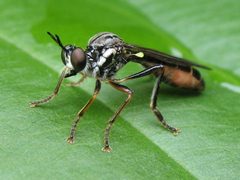
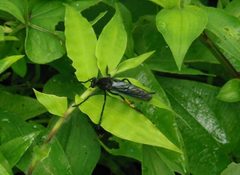
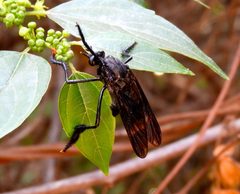
Dasypogoninae can be distinguished from other Asilidae by a mystax (dense facial beard of bristles) confined to the oral margin and composed chiefly of stout bristles. The subfamily includes notably large-bodied with streamlined bodies often nearly devoid of setae. Specific within the subfamily possess additional diagnostic characters: Microstylum species exhibit large, shimmering and exceptionally large body size relative to other robber flies.
Images
Habitat
Members of Dasypogoninae occupy open, dry including short grass prairies, scrublands, and limestone glades. The Microstylum is associated with Great Plains grassland and prairie remnants. Habitat specificity varies among genera; some demonstrate strong fidelity to particular grassland types while others occur across broader arid and semi-arid zones.
Distribution
The occurs primarily in the Nearctic and Neotropical regions. In North America, distribution centers on the southcentral and southwestern United States, extending from Texas and Oklahoma westward through Arizona, Colorado, and New Mexico. Some , such as Microstylum morosum, have shown recent range extensions northeastward into Arkansas and Missouri. The subfamily extends southward through Mexico and Central America into South America.
Behavior
in the Microstylum are extremely wary, rarely allowing close approach. They exhibit long, loping escape when disturbed. As with all robber flies, members are predatory and capture prey in flight.
Ecological Role
Dasypogoninae function as apex aerial in their . Large such as Microstylum morosum prey upon other flying insects including bees and likely other robust prey items. Their presence in high-quality prairie remnants indicates intact function and habitat quality.
Human Relevance
Dasypogoninae serve as indicators of grassland integrity. The discovery of Microstylum morosum in Missouri represented a significant range extension and highlighted the conservation value of remnant limestone glades. Some members of the , particularly large species, attract interest from entomologists and naturalists due to their impressive size and predatory habits.
Similar Taxa
- AsilinaeAnother of large robber flies; distinguished from Dasypogoninae by mystax structure and distribution of facial setae
- LeptogastrinaeSlender robber flies historically grouped with Dasypogoninae; separated based on morphological and phylogenetic differences
- LaphriinaeIncludes mimics such as Laphria; distinguished by dense body setae and different mystax configuration
More Details
Taxonomic history
The was revised by Back (1909) in a foundational monograph on New World robber flies. The Microstylum derives its name from the small stylus of the apex, a character noted by Macquart in his 1838 original description—despite the notably large body size of in this genus.
Conservation significance
of Dasypogoninae in the eastern United States are restricted to high-quality grassland remnants and represent disjunct distributions at the northeastern edge of their ranges. Fire suppression and woody encroachment threaten these populations.