
Leptogastrinae
Schiner, 1862
Genus Guides
6- Apachekolos
- Beameromyia
- Leptogaster(Slender Robberflies)
- Leptopteromyia
- Psilonyx
- Tipulogaster
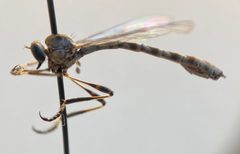
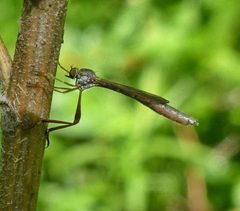
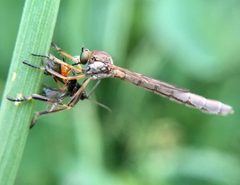
Leptogastrinae is a of robber flies (Asilidae) comprising more than 450 described . Members are distinguished from other asilids by their slender, elongate bodies and cryptic in vegetation. Unlike the robust, -mimicking species common in other subfamilies, Leptogastrinae are nearly invisible as they navigate through tall grasses. They share the predatory habits characteristic of the Asilidae.
Pronunciation
How to pronounce Leptogastrinae: /ˌlɛptoʊˈɡæstrɪniː/
These audio files are automatically generated. While they are not always 100% accurate, they are a good starting point.
Identification
Distinguished from other Asilidae by slender, elongate body form. The gracile build contrasts sharply with robust, -mimicking in subfamilies like Laphriinae. When navigating through tall grasses, members are described as nearly invisible due to their slender profile. For definitive identification, examination of wing venation and other structural characters is required; the subfamily is not reliably distinguished by color pattern alone.
Images
Appearance
Slender, elongate body form distinct from the robust build typical of many other Asilidae. Body shape adapted for moving through dense vegetation. Specific morphological characters of the include features associated with this gracile habitus, though detailed diagnostic characters require examination of wing venation and other structural features.
Habitat
Vegetated environments, particularly areas with tall grasses where their slender form provides camouflage. Occurs in a range of from grasslands to forest edges, consistent with general Asilidae habitat preferences but with specific association to dense, upright vegetation structure.
Distribution
Global distribution corresponding to that of Asilidae. occur in Afrotropical, Neotropical, Oriental, and Nearctic regions. Specific -level records include Colombia (first country record for genus Schildia), Ecuador, Venezuela, Guatemala, Jamaica, Malaysia, and Madagascar.
Behavior
Predatory consistent with Asilidae, including perching to scan for prey and aerial interception of flying insects. The slender body form enables movement through dense grasses with minimal visibility. Specific behavioral details at level are not well documented.
Ecological Role
of other insects, contributing to . As part of the diverse Asilidae fauna, they occupy a predatory in terrestrial . Specific ecosystem functions at level have not been quantified.
Human Relevance
No documented direct interactions with humans. Like other Asilidae, they do not bite people under normal circumstances and do not . Their predatory role may contribute to of other insects, though this has not been specifically evaluated for this .
Similar Taxa
- Other Asilidae subfamilies (e.g., Laphriinae, Asilinae)Leptogastrinae differ in slender, elongate body form versus the robust, often -mimicking build of many other asilids. This difference in habitus is immediately apparent in the field.
- Mydidae (mydas flies)Mydas flies may resemble slender asilids but lack the deep concave area between the at the top of the characteristic of Asilidae.
- Empididae (dance flies)Dance flies are also slender predatory flies but lack the concave vertex and bearded of Asilidae.
More Details
Taxonomic diversity
The contains more than 450 described , making it a significant component of Asilidae diversity. The Schildia, revised in 2009, includes ten recognized species with Afrotropical, Neotropical, and Oriental distributions.
Fossil record
Extinct are known from amber deposits; Schildia martini was described from Dominican amber, indicating long evolutionary history of the lineage.
Sources and further reading
- BugGuide
- Wikipedia
- NCBI Taxonomy
- Catalogue of Life
- Bug Eric: Robber Flies
- First distribution record of Schildia Aldrich, 1923 (Insecta: Diptera: Asilidae: Leptogastrinae) for Colombia
- Taxonomic revision of the genus Schildia Aldrich, 1923 (Diptera: Asilidae: Leptogastrinae) with the description of new extant and extinct species