
Microstylum morosum
Loew, 1872
Giant Prairie Robber Fly
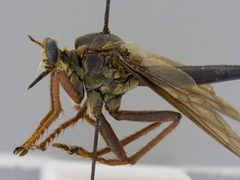
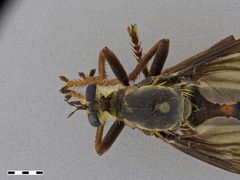
Microstylum morosum is the largest robber fly in North America, with body lengths reaching 35–50 mm. The was long considered to Texas until range extensions were documented into Oklahoma, Kansas, Arkansas, Missouri, and southwestern states. It inhabits prairie and grassland , where are active . The species exhibits distinctive emerald-green and a relatively hairless, streamlined body compared to other large asilids.
Pronunciation
How to pronounce Microstylum morosum: //maɪˈkɹɒstɪləm məˈɹoʊsəm//
These audio files are automatically generated. While they are not always 100% accurate, they are a good starting point.
Identification
Distinguished from the only other U.S. , Microstylum galactodes, by: larger size (35–50 mm vs. smaller); dark wings vs. milky white wing ; black to brown body vs. reddish-brown; thoracic pruinescence restricted to lateral margins vs. evenly distributed whitish bloom across and thoracic dorsum. Distinguished from other large North American robber flies (Promachus, Proctacanthus) by nearly hairless, streamlined body and emerald-green . The enormous size alone eliminates most other .
Images
Habitat
Short-grass prairies, mixed-grass prairies, scrublands, and limestone glades. In Oklahoma and Missouri, found on flat-topped mesas and rocky glades with scattered eastern redcedar (Juniperus virginiana). Associated with high-quality prairie remnants. In Arkansas, documented at Terre Noire Natural Area, a blackland prairie remnant.
Distribution
South-central and south-western United States: Texas (historically considered ), Oklahoma, Kansas, Arkansas, New Mexico, Arizona, Colorado, and Missouri. Easternmost records in southwestern Missouri (White River Hills) and northwestern Arkansas represent significant range extensions. Occurs throughout Oklahoma in at least 13 counties.
Seasonality
active during warmer months; specific not well documented. Observations in Oklahoma and Missouri occurred in summer (June–July).
Diet
Active aerial . Preys on other insects including small carpenter bees (Ceratina spp.) and likely other flying insects of appropriate size. Specific prey spectrum incompletely documented.
Life Cycle
Complete (holometabolous). Larval stage presumably subterranean or in soil, as typical for Asilidae, but specific details unreported. and larval feeding habits undocumented in published sources.
Behavior
Perches on ground, rocks, or vegetation to ambush prey. Exhibits : males fly to highest points in landscape (mesas, hilltops, scattered trees) to defend perches and seek mates. described as loping and wavering, less zippy than smaller robber flies. Generally wary and difficult to approach, though individuals occasionally allow close approach. Mating pairs observed perching in trees. Females presumably oviposit in soil, though this behavior not directly observed for this .
Ecological Role
Apex aerial in prairie . densities appear robust in suitable patches. Serves as indicator of high-quality prairie remnants due to specific habitat requirements.
Human Relevance
Subject of interest to entomologists and nature photographers due to exceptional size and striking appearance. New state records continue to be documented, contributing to understanding of Great Plains insect . No documented economic importance or pest status.
Similar Taxa
- Microstylum galactodesOnly other U.S. ; distinguished by smaller size, milky white wings, reddish-brown body, and evenly distributed whitish pruinescence on and vs. dark wings and lateral thoracic pruinescence in M. morosum.
- Promachus hineiAnother 'giant robber fly' but hairier body, different coloration, and smaller maximum size; lacks emerald-green and streamlined, nearly hairless appearance.
- Proctacanthus fulviventrisLarge southeastern U.S. robber fly with bright yellow beard, black , red tibiae, and reddish abdominal ; distinctly different color pattern and hairier appearance.
More Details
Taxonomic etymology
name 'Microstylum' derives from Greek 'micro' (small) + 'stylus' (stylus/needle), referring to the small terminal stylus of the —a feature noted by Macquart in his 1838 original description, despite the enormous body size of in this genus.
Conservation significance
Missouri and Arkansas occur in high-quality prairie remnants that have experienced dramatic reduction since Euro-American settlement due to fire suppression, overgrazing, and woody encroachment. distribution appears restricted to these remnant , emphasizing conservation importance of limestone glades and blackland prairies.
Global context
While M. morosum is North America's largest robber fly, the M. magnum from Madagascar holds the world record at 60 mm body length and 84 mm wingspan.
Sources and further reading
- BugGuide
- Wikipedia
- GBIF taxonomy match
- iNaturalist taxon
- Catalogue of Life
- The marvelously monstrous Microstylum morosum | Beetles In The Bush
- Asilidae | Beetles In The Bush | Page 2
- North America’s largest robber fly | Beetles In The Bush
- Observations of the Behavior of the Giant Prairie Robberfly, Microstylum morosum Loew (Diptera: Asilidae) at Terre Noire Natural Area, Clark County, Arkansas