
Promachus hinei
Bromley, 1931
Maroon-legged Lion Fly
Promachus hinei is a large robber fly in the Asilidae, commonly known as the Maroon-legged Lion Fly. It is one of three 'tiger-striped' Promachus species in the eastern United States, distinguished by yellow and black abdominal striping. The species is the most common Promachus in Missouri and is known for its bold predatory , capturing a wide range of flying insects including bees and even hummingbirds.
Pronunciation
How to pronounce Promachus hinei: /ˈproʊmæˌkʌs ˈhaɪnaɪ/
These audio files are automatically generated. While they are not always 100% accurate, they are a good starting point.
Identification
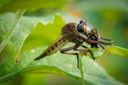
Distinguished from the more southeastern P. rufipes by its reddish versus black . Separated from the more northern P. vertebratus by larger dark areas dorsally on abdominal segments and distinctly contrasting two-toned legs (reddish femora against darker leg segments). The tiger-striped abdominal pattern is shared with these two , requiring leg and abdominal segment examination for definitive identification.
Images
Appearance
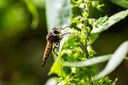
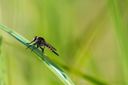
Large, robust robber fly with yellow and black tiger-striped abdominal patterning. Legs are distinctly two-toned with reddish (maroon) contrasting with darker tibiae and . Dark markings on abdominal segments are larger than those of similar . The 'beard' or mystax on the is prominent and white to grayish in color. are large and occupy most of the .
Habitat
Open, sunny including glades, prairies, and other grassland-edge environments. Frequently observed in Ozark glades and similar rocky, open areas with sparse vegetation.
Distribution
Eastern United States, most common in Missouri. Range extends from the central United States eastward, with the being more southeastern than P. vertebratus and more northern/western than P. rufipes.
Diet
of flying insects. Documented prey includes small carpenter bees ( Ceratina, Apidae). Has been observed capturing hummingbirds.
Behavior
Conspicuous and fearless that actively hunts flying insects. Perches in open areas to ambush prey. Known to attack prey regardless of size, including targets larger than itself. Bold enough to pursue hummingbirds.
Ecological Role
Apex aerial in open insect . Controls of bees and other flying insects through direct .
Human Relevance
Subject of macrophotography due to impressive size and striking appearance. Provides of potential pest insects, though also predates beneficial such as bees.
Similar Taxa
- Promachus rufipesOverlaps in eastern U.S. range but has black versus reddish femora in P. hinei; more southeastern in distribution
- Promachus vertebratusOverlaps in eastern U.S. range but has smaller dark abdominal markings and less distinctly two-toned legs; more northern in distribution
Misconceptions
Despite the 'giant robber fly,' P. hinei is not the largest robber fly in its ; larger occur in the same glade environments.
More Details
Photography Notes
The ' large and prominent mystax make it a popular subject for macrophotography. Effective lighting requires multidirectional flash to avoid harsh shadows while maintaining detail in the eye structure.