
Proctacanthus fulviventris
Macquart, 1850
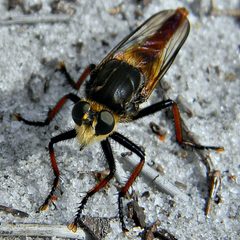
Proctacanthus fulviventris is a large robber fly in the nominate Asilinae, reaching 25–30 mm in length. The is a Florida near- with its distribution extending minimally into southern Georgia. It is distinguished by a bright yellow mystax (beard), black with red tibiae, and reddish abdominal . Females have been observed ovipositing in loose sandy soils.
Pronunciation
How to pronounce Proctacanthus fulviventris: /prɔkˈtakænθəs fʌlˈvɪvɛntrɪs/
These audio files are automatically generated. While they are not always 100% accurate, they are a good starting point.
Identification
The combination of large size (25–30 mm), bright yellow beard, black with red tibiae, and reddish abdominal distinguishes this from other eastern North American Proctacanthus. Dark coloration with light brown wings separates it from P. milbertii, which has more extensive yellow markings and occurs across much of the U.S. rather than being Florida-near . The specific epithet fulviventris (yellow-bellied) and generic name Proctacanthus (spiny-butt) both reference diagnostic features.
Images
Appearance
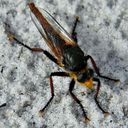
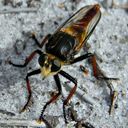
Large robust robber fly, 25–30 mm in length. Bright yellow mystax (dense beard of bristles on ). Black contrasting with red tibiae. Reddish abdominal . Dark overall coloration with light brown wings.
Habitat
Sand pine scrub with white-sand substrates. Found along sandy 2-tracks and open sandy areas within pine scrub. Requires loose sandy soil for oviposition.
Distribution
Florida near-, extending minimally into southern Georgia. Documented from Levy County and Dixie County in north Florida.
Life Cycle
Females oviposit by inserting deeply into loose sand. After withdrawal, female sweeps abdomen tip back and forth over the hole, presumably to cover and hide the . Larval stages unknown but presumed to feed on soil insects, roots, and decaying organic matter based on congeneric patterns in Proctacanthus.
Behavior
Perches on substrates in open sandy areas. Oviposition observed in loose sand with subsequent covering . Rapid when disturbed.
Ecological Role
Predatory robber fly, likely contributing to regulation of insect in sand pine scrub . Specific prey unknown but presumed to include various flying insects typical of Asilidae.
Similar Taxa
- Proctacanthus milbertiiLarger geographic range across much of the U.S., late season , loves butterflies (though grasshoppers comprise 94% of prey), more extensive yellow markings rather than dark coloration with yellow beard only
- Promachus speciesSimilar large size and robust build in Asilinae, but distinguished by tiger-striped abdominal patterning in P. hinei, P. rufipes, and P. vertebratus versus reddish abdominal in P. fulviventris
More Details
Etymology
The translates to yellow-bellied spiny-butt, referencing the yellow mystax and presumably spiny abdominal features
Taxonomic authority
described by Macquart in 1850