
Proctacanthus milbertii
Macquart, 1838
Milbert's proctacanthus, Common Marauder
Proctacanthus milbertii is a large robber fly (Asilidae) found across much of the United States. It is a late-season and a formidable aerial . Research in western Nebraska found that grasshoppers constitute 94% of its prey, with prey selection driven by availability rather than size. The species has a prominent beard and lays in soil crevices.


Pronunciation
How to pronounce Proctacanthus milbertii: /prɒkˈtækænθəs mɪlˈbɛrtiːaɪ/
These audio files are automatically generated. While they are not always 100% accurate, they are a good starting point.
Identification
Large robber fly with a prominent beard. Distinguished from similar Promachus by lacking the yellow and black tiger striping on the seen in P. hinei, P. rufipes, and P. vertebratus. Specific diagnostic features for separating P. milbertii from other Proctacanthus species are not documented in the available sources.
Images
Habitat
Open with sandy or loose soil suitable for oviposition. Occurs in grassland and prairie environments where prey is abundant.
Distribution
Occurs across much of the United States. Documented from western Nebraska and ranges widely throughout the country.
Seasonality
Late season , active in late summer and early fall.
Diet
are aerial . A study in western Nebraska found grasshoppers (Orthoptera) made up 94% of prey captured. Nearly all remaining prey captures were other P. milbertii individuals. Prey selection was determined by availability rather than size, with even the largest species captured as readily as smaller ones.
Life Cycle
Females lay in crevices in soil. Larvae feed on soil insects, roots, and decaying plant matter. Development occurs within the soil.
Behavior
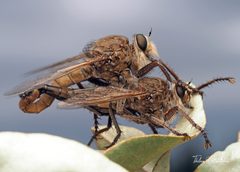
Perches in open areas to ambush flying prey. Exhibits ferocious predatory , capable of capturing large grasshoppers and even other individuals of its own . Mating postures can resemble prey handling positions.
Ecological Role
Significant of grasshoppers in prairie , potentially contributing to . Larval stage contributes to soil as a predator and .
Similar Taxa
- Promachus hineiSimilar large size and predatory habit, but distinguished by yellow and black tiger striping on and reddish
- Promachus rufipesSimilar large size and predatory habit, but distinguished by yellow and black tiger striping, black with orangish tibiae, and southeastern U.S. distribution
- Promachus vertebratusSimilar large size and predatory habit, but distinguished by more muted abdominal striping, two-toned legs with smaller dark areas dorsally on abdominal segments, and northern distribution
More Details
Etymology
The name Proctacanthus translates to 'spiny butt' in reference to the spiny ; the epithet milbertii honors the naturalist Milbert
Research note
Joern & Rudd (1982) conducted the primary dietary study of this in western Nebraska, providing quantitative prey data