
Euodynerus foraminatus
(de Saussure, 1853)
Potter wasp, Mason wasp
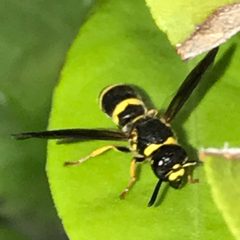
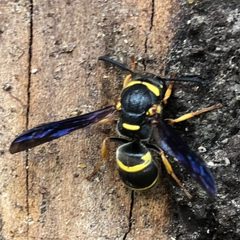
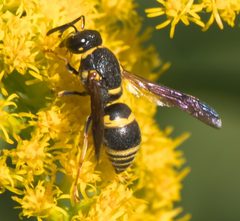
Euodynerus foraminatus is a solitary mason wasp in the Vespidae, Eumeninae. Females construct multi-celled nests in pre-existing cavities such as holes in wood or abandoned burrows, provisioning each with paralyzed caterpillars as food for their larvae. The is notable for having single-locus complementary sex determination, which typically produces sterile males, yet field studies have documented surprisingly high rates of sibling mating in natural . It is widespread across North America and readily uses artificial nest structures such as bee blocks.
Pronunciation
How to pronounce Euodynerus foraminatus: /juːoʊˈdaɪnərəs ˌfɔrəˈmɪnətəs/
These audio files are automatically generated. While they are not always 100% accurate, they are a good starting point.
Identification
The can be recognized as a member of Euodynerus by its robust, somewhat blocky body form typical of the . Specific diagnostic features distinguishing E. foraminatus from similar species such as E. hidalgo or E. annulatus are not documented in available sources. Nests are identifiable by mud partitions between and a final mud plug sealing the entrance.
Images
Habitat
Utilizes pre-existing cavities in wooden structures, including holes in dead wood, abandoned solitary burrows, and artificial bee blocks. Has been observed nesting in both outdoor and indoor wooden structures, including building walls and shelving systems.
Distribution
Transcontinental in North America: recorded across the United States from coast to coast, all Canadian provinces, and south into Mexico.
Seasonality
active during warmer months; larvae complete development and emerge as adults approximately one year after nesting, with typically occurring in June.
Diet
feed on nectar from flowers. Larvae are fed paralyzed caterpillars, specifically larvae of in the Oecophoridae, Tortricidae, Gelechiidae, Pyralidae, and Crambidae ( Pyraustinae).
Host Associations
- Lepidoptera - Females paralyze caterpillars to provision nest for larval offspring
Life Cycle
Females construct linear series of within pre-existing cavities, each cell stocked with multiple paralyzed caterpillars. An is laid on the first or last caterpillar in each cell, followed by construction of a mud partition. Multiple may be produced per year in some regions. The egg and larval stages complete in approximately 7-9 days; pupal development takes about 14 days for males and 19 days for females. emerge from pupae after approximately one year, leaving an exit hole in the mud plug.
Behavior
Solitary nesting ; females hunt caterpillars, paralyze them with venom, and transport them back to nest cavities. Visits flowers for nectar. Will occupy artificial nest structures such as blocks with holes of appropriate diameter. Nest entrances are sealed with mud plugs upon completion.
Ecological Role
agent of caterpillar pests, particularly those that conceal themselves in rolled or tied leaves that other avoid. Contributes to pollination through nectar-foraging activity.
Human Relevance
Beneficial for garden pest control through on caterpillars of pest . Readily attracted to artificial blocks, providing opportunities for observation and in residential settings. Does not defend nests aggressively and poses minimal stinging risk to humans.
Similar Taxa
- Euodynerus hidalgoBoth are widespread transcontinental mason wasps with similar body form; E. hidalgo has a strong carina on the front edge of the pronotum and thin, slightly upturned hind margins on the second and third abdominal tergites
- Euodynerus annulatusSimilar size and distribution; E. annulatus excavates burrows in soil rather than using pre-existing cavities and constructs distinctive curved mud chimneys above ground
More Details
Genetic system
Possesses single-locus complementary sex determination (sl-CSD), a genetic sex determination system where heterozygosity at a single sex locus produces females and hemizygosity produces males. This system normally selects against inbreeding because it increases production of sterile or inviable males, yet genetic studies have found 55-77% sibling mating in natural populations with lower-than-expected frequencies of diploid males.
Nesting in artificial structures
Documented to nest in indoor wooden furniture and shelving systems when access is available, completing entire within buildings.
Sources and further reading
- BugGuide
- Wikipedia
- GBIF taxonomy match
- iNaturalist taxon
- NCBI Taxonomy
- Catalogue of Life
- Bug Eric: The Mason Wasp Euodynerus foraminatus Endorses Bee Blocks
- Bug Eric: Wasp Wednesday: Euodynerus annulatus
- Bug Eric: Wasp Wednesday: Euodynerus hidalgo
- Inbreeding in a natural population of Euodynerus foraminatus (Hymenoptera: Vespidae), a solitary wasp with single‐locus complementary sex determination