
Ripiphoridae
Laporte, 1840
wedge-shaped beetles
Subfamily Guides
4- Pelecotominae
- Pirhidius
- Ptilophorus
- Ripiphorinae(wedge-shaped beetles)
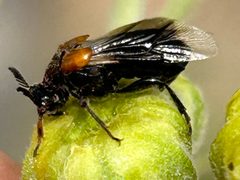
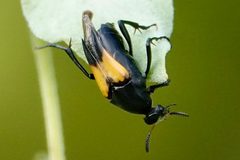
Ripiphoridae is a of approximately 450 described of beetles commonly known as wedge-shaped beetles. The family is notable for hypermetamorphic development, a trait shared only with Meloidae among beetles. associations vary by : Ripiphorinae attack bees and , Ripidiinae parasitize , and Pelecotominae attack wood-boring larvae. The family exhibits extreme morphological modifications including abbreviated , sexually dimorphic ( or pectinate in males), and in some groups, wingless females.

Pronunciation
How to pronounce Ripiphoridae: /rɪˈpɪfɔˌraɪdiː/
These audio files are automatically generated. While they are not always 100% accurate, they are a good starting point.
Identification
distinguished by abbreviated that often leave much of the exposed; hind wings unfolded and exposed at rest, giving -like or -like appearance rather than typical form. sexually dimorphic: males typically with (fan-like) or pectinate (comb-like) antennae, females with less elaborate pectinate or serrate forms. Body wedge-shaped, tapering posteriorly. Some with full-length elytra covering abdomen (e.g., Toposcopus). Ripidiinae females often wingless and , with reduced mouthparts and no elytra.
Images
Habitat
varies by and association. Ripiphorinae associated with flowers where females oviposit into buds of mass-flowering plants including Dipsacaceae (Cephalaria, Scabiosa), Asteraceae (Carduus, Cirsium), and Apiaceae (Eryngium, Daucus). Ripidiinae found in habitats supporting . Pelecotominae associated with dead wood and trees bearing wood-boring larvae; occur on dead trees or dead portions of living trees. Some inhabit sown wildflower plots at agricultural field edges adjacent to saline steppe.
Distribution
distribution with approximately 450 described . Documented from all major biogeographic regions. Notable records include: southern Europe, North Africa, Asia (extending to Kazakhstan, Uzbekistan), North America (southwestern U.S. extending to Oklahoma, Texas, Arizona, New Mexico), Central America, and Macaronesian volcanic islands (Cape Verde archipelago representing first insular record for Ripiphorus). Fossil species known from Cretaceous amber deposits in France, Germany, Myanmar, and Middle Jurassic of China, indicating ancient lineage.
Seasonality
activity generally coincides with availability and flowering periods of oviposition sites. Ripiphorus subdipterus adults active July-August in Hungary. attacking bees appear when host colonies are active. Wood-boring (Pelecotominae) likely active when host larvae are present in dead wood. Specific seasonality poorly documented for most species due to secretive habits and brief adult lifespan of few days.
Host Associations
- Hymenoptera - Ripiphorinae; laid on flowers, first instar larvae (triungulins) attach to visiting bees/ and are carried to nests where they parasitize
- Blattodea - Ripidiinae; larvae attack nymphs, feeding internally then externally
- Coleoptera - Pelecotominae; larvae attack wood-boring larvae, using narcotizing substance to pierce
Life Cycle
Hypermetamorphic development with highly modified larval instars. First instar larvae ( or triungulins) are mobile, active, and specialized for location and entry. In : triungulins hold erect on apex, attach to via , carried to host nest, enter host larva, become until host pupates, then consume host and pupate. In parasites: larvae hatch from laid on substrate, actively seek cockroach nymphs, feed internally then emerge to pupate nearby. In wood-borer parasites: larvae hatch in wood, actively search for hosts (surviving up to 10 days without food), pierce host with narcotizing secretion, feed first as endoparasitoid then as ectoparasitoid, finally bore gallery and pupate at gallery apex. typically short-lived, non-feeding or with reduced feeding.
Behavior
Females of -parasitizing exhibit specialized oviposition , inserting into buds of still-closed flowers. Some species (e.g., Toposcopus wrightii) hold outstretched during oviposition on dead branches, function unknown. Males of some species wait near colonies to mate with newly emerged females. Triungulin larvae exhibit phoretic behavior, actively positioning to contact host insects. Some Ripidiinae females are , wingless, and attract mates via .
Ecological Role
Human Relevance
Similar Taxa
- MeloidaeShares hypermetamorphic development; distinguished by different (typically more elongate, soft-bodied, with complete ), different associations (primarily and provisions), and first instar larvae (triungulins) with different body plan
- StrepsipteraSimilar lifestyle with extreme and mobile first instar larvae; distinguished by entirely different body plan (twisted-wing parasites, males with reduced and large fan-like hind wings, females typically internal and )
- RhipiceridaeFormerly included in Ripiphoridae; now separate , distinguished by different larval and associations
More Details
Morphological diversity
exhibits exceptional morphological diversity correlated with associations. Ripidiinae shows most extreme : males winged with normal appearance, females wingless, , with reduced mouthparts and no . Pelecotominae females possess elongated, needle-like ovipositor for inserting into wood. Antennal structure highly variable, with , pectinate, serrate, and forms across .
Fossil record
Oldest confirmed Ripiphoridae from Middle Jurassic of China (Archaeoripiphorus nuwa, ~165 million years ago), indicating ancient origin of lifestyle. Cretaceous amber fossils from Myanmar, France, Germany preserve larval and stages, demonstrating long evolutionary history of hypermetamorphic development. Fossil larvae show specialized morphological adaptations (prosternal spines, reduced stemmata) indicating early diversification of parasitoid strategies.
Taxonomic history
name formerly spelled ; spelling corrected to Ripiphoridae following ICZN conventions. Historical confusion with related families (Rhipiceridae, formerly included) resolved through larval and molecular studies. classification (Ripiphorinae, Ripidiinae, Pelecotominae, Ptilophorinae) reflects major shifts in evolutionary history.
Sources and further reading
- BugGuide
- Wikipedia
- GBIF taxonomy match
- iNaturalist taxon
- NCBI Taxonomy
- Catalogue of Life
- Ripiphoridae | Beetles In The Bush
- Bug Eric: February 2011
- My Publications | Beetles In The Bush
- Highly specialized Cretaceous beetle parasitoids (Ripiphoridae) identified with optimized visualization of microstructures
- Wedge-Shaped Beetles (suggested common name) Ripiphorus spp. (Insecta: Coleoptera: Ripiphoridae)
- Two parasitoid beetle species new to the fauna of Hungary (Coleoptera: Meloidae, Ripiphoridae)
- The first fossil wedge-shaped beetle (Coleoptera, Ripiphoridae) from the middle Jurassic of China
- Taxonomy and distribution of Palaearctic and Oriental species of the genus Macrosiagon. Part III (Coleoptera, Ripiphoridae)
- Ripiphorus caboverdianus sp. nov.—the first ripiphorid record from the Macaronesian volcanic islands (Coleaoptera: Ripiphoridae: Ripiphorinae)
- Taxonomy and distribution of the genus Pterydrias Reitter and confirmation of its synonymy with Eorhipidius Iablokoff-Khnzorian (Coleoptera: Ripiphoridae: Ripidiinae)
- The earliest parasitoid beetle (Tenebrionoidea: Ripiphoridae) and an overview of Coleoptera from the Lower Cretaceous Crato formation
- Distribution of Ptilophorus dufourii (Latreille, 1818) in France, with remarks on the behaviour of adults (Coleoptera, Ripiphoridae)
- Figure 1 from: Batelka J, Weingardt M, Bock BL, Beutel RG (2024) Relationships of Cretaceous Ripiphoridae (Coleoptera) based on larval morphology, with evidence for the same reproduction timing and chosen microhabitat for oviposition. Contributions to Entomology 74(2): 113-130. https://doi.org/10.3897/contrib.entomol.74.e125308
- Pelecotoidessinicus, a new species of ripiphorid beetle from east China (Ripiphoridae, Ptilophorinae).