
Prionyx thomae
(Fabricius, 1775)
Prionyx thomae is a solitary, thread-waisted wasp in the Sphecidae. It is one of seven Prionyx in the United States, ranging from the southeastern and western U.S. south to Argentina. The species is a of grasshoppers, paralyzing them with venom to provision underground nests for its larvae. It lacks a common English name, reflecting its limited economic importance.
Pronunciation
How to pronounce Prionyx thomae: /ˈpriː.ə.nɪks ˈθoʊ.miː/
These audio files are automatically generated. While they are not always 100% accurate, they are a good starting point.
Identification
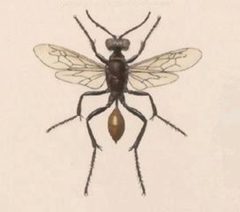
Prionyx thomae closely resembles P. parkeri and P. canadensis, but can be distinguished from P. parkeri by the latter's two pairs of long palps (part of the mouthparts). It can be separated from P. canadensis by geographic range and associations. Like other Prionyx , it has a globose , stout spiny legs, and a thread-waisted petiole. The species is black and red with silvery highlights, unlike the entirely black P. atratus and P. subatratus.
Images
Habitat
Open areas with sandy or damp, rocky soil suitable for burrowing. Observed in shortgrass prairie, degraded prairie with social trails, and arroyo environments. In Brazil, found at multiple locations in Rio de Janeiro State.
Distribution
Ranges from the southeastern and western United States south to Argentina. In the U.S., occurs in Arizona (Madera Canyon), and has been recorded from South Dakota northward. GBIF records indicate presence in North America, Middle America, the Caribbean, and South America.
Diet
of grasshoppers ( Acrididae). Documented prey includes Conozoa carinata, Amphitornus, Aulocara, Orphulella pelidna, Arphia xanthoptera, Dissosteira carolina, Encoptolopus subgracilis, and Paraidemona. In Brazil, observed preying on Orphulella punctata, Rhammatocerus pseudocyanipes, Abracris flavolineata, and Ronderosia bergi.
Life Cycle
Solitary nesting . The female excavates a burrow after securing prey. The burrow may be curved, linear, or L-shaped, terminating in a single chamber that receives one paralyzed . An is laid on the prey, and the entrance is sealed before the female departs to repeat the process. Larval development has been described from Brazilian .
Behavior
Females transport paralyzed grasshoppers to nest burrows, carrying prey that may exceed their own body size. They secure prey before digging, leaving the victim at a distance from the excavation site—possibly to minimize exposure to . During nesting, females exhibit alert, nervous , snapping at approaching ants. Males have been observed exhibiting territorial behavior in Brazil. When disturbed during burrow excavation, females may abandon the site and prey. Nest closure involves packing loose soil into the tunnel and obliterating surface evidence.
Ecological Role
of grasshoppers (Acrididae), potentially contributing to . Serves as for kleptoparasitic satellite flies ( Sarcophagidae, Miltogramminae), which lay or larvae on the 's prey, starving the wasp larvae.
Human Relevance
Of no direct economic importance. Occasionally encountered by entomologists and naturalists in field settings. May be incidentally observed in gardens and open spaces with suitable nesting substrate.
Similar Taxa
- Prionyx parkeriSimilar black and red coloration with silvery highlights; distinguished by two pairs of long palps on mouthparts
- Prionyx canadensisSimilar appearance; distinguished by geographic range and associations; not confirmed in southeast Arizona where P. thomae occurs
- Prionyx atratusEntirely black coloration (no red), stockier build with shorter not extending beyond wingtips at rest; females have silvery or gold
- Sphex lucaeSimilar thread-waisted appearance and color pattern (female black with red ); distinguished by more oval abdomen, lack of silvery facial patches, and prey rather than grasshoppers
Sources and further reading
- BugGuide
- GBIF taxonomy match
- iNaturalist taxon
- NCBI Taxonomy
- Catalogue of Life
- Bug Eric: Wasp Wednesday: Prionyx thomae
- Bug Eric: Caught on Video: Prionyx atratus
- Bug Eric: Wasp Wednesday: Sphex lucae
- Bug Eric: White Prairie Clover: An Awesome Blossom
- Bug Eric: Ammophila in Action
- saproxylic beetles | Blog
- Reproductive behaviour and larval development of Prionyx thomae (Fabricius) from Brazil (Hymenoptera: Sphecidae).