
Sphex lucae
de Saussure, 1867
katydid hunter
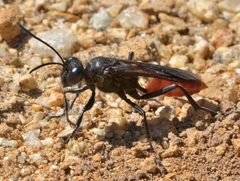
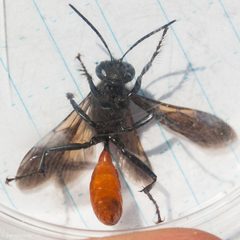
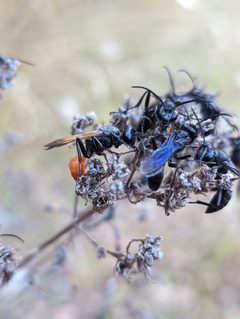
Sphex lucae is a solitary thread-waisted wasp in the Sphecidae, native to western North America. This exhibits pronounced : females have a black body with red and yellowish to violaceous wings, while males are entirely black with violaceous wings. Females are hunters that excavate subterranean burrows and provision them with paralyzed katydids as food for their larvae. Males form communal sleeping clusters in sheltered locations. The species is the sole North American representative of the subgenus Fernaldina, named for entomologist Henry Torsey Fernald.
Pronunciation
How to pronounce Sphex lucae: /spɛks luːˈkae/
These audio files are automatically generated. While they are not always 100% accurate, they are a good starting point.
Identification
Distinguished from similar Sphex and related by combination of: female's red (vs. entirely black in Sphex pensylvanicus, golden-orange in Sphex ichneumoneus); more oval female abdomen compared to cylindrical abdomen of Prionyx species; absence of silvery facial and thoracic patches present in Prionyx; violaceous wing coloration. Males entirely black with violaceous wings, separable from other black Sphex males by geographic range and association with red females.
Images
Appearance
Medium to large solitary with slender build and distinct . Females: black and , red , wings yellowish to violaceous with variable coloration. Males: entirely black body with violaceous wings, more slender than females. Both sexes lack silvery patches on and thorax present in related such as Prionyx. Female abdomen more oval in shape compared to the more cylindrical abdomen of Prionyx .
Habitat
Open including grasslands, meadows, and edges of woodlands. Commonly found in areas with flowering plants for nectar foraging. Nesting occurs in sandy or loose soils suitable for burrow excavation. Males form sleeping clusters in sheltered situations such as beneath rock overhangs.
Distribution
Western North America from southern British Columbia through California, eastward to Arizona, Colorado, Oklahoma, and Mexico. Disjunct reported in southeastern United States (Georgia, Florida) though recent records are lacking. Most abundant and well-documented in southwestern United States, particularly Arizona.
Seasonality
active primarily in spring and summer months. In Arizona, observed from at least May through summer. Activity coincides with flowering of nectar sources and availability of prey.
Diet
feed on nectar from diverse flowering plants including White Sweetclover (Melilotus alba) and various "acacia" (sensu lato). Larvae are , feeding on paralyzed katydids provisioned by the female parent.
Host Associations
- Insara elegans - preyElegant Bush Katydid, documented prey item
- Melilotus alba - foodWhite Sweetclover, nectar source
Life Cycle
Solitary with subterranean nesting. Female excavates single-celled burrow in soil, then hunts and paralyzes katydids with sting. Prey sometimes amputated. Paralyzed dragged to nest entrance, inspected, then stored in with single laid upon it. Nest entrance sealed after provisioning. Larva develops on preserved prey, pupates in cell. Multiple per year possible in favorable climates.
Behavior
Females exhibit stereotyped nesting : prey deposited at nest entrance, burrow inspected, prey retrieved and dragged headfirst into burrow. Males form communal sleeping ("bachelor parties") in sheltered microhabitats, giving false impression of sociality. Both sexes forage for nectar at flowers, showing little aggression toward humans during feeding.
Ecological Role
of katydids, potentially regulating orthopteran . through nectar foraging. Subterranean nesting may contribute to soil aeration.
Human Relevance
Generally avoids human contact; not aggressive. Sting used for prey capture and defense, with venom capable of paralyzing large orthopterans. Communal male sleeping clusters may startle observers unfamiliar with the . Valued by entomologists for study of instinctive behavior patterns.
Similar Taxa
- Sphex ichneumoneusSimilar size and ; distinguished by female's golden-orange and more widespread transcontinental distribution
- Sphex pensylvanicusGreat black wasp, similar size and black coloration; female lacks red abdominal segments, entirely black
- Prionyx spp. hunters with superficially similar appearance; distinguished by cylindrical , silvery facial and thoracic patches, and different prey type
- Isodontia elegansGrass-carrier wasp with similar prey and thread-waisted form; uses grass blades to line nest rather than subterranean burrows
Misconceptions
Communal sleeping of males have been misinterpreted as evidence of social or colony formation; the is strictly solitary. Historical reports of southeastern U.S. distribution remain unconfirmed by recent observations.
More Details
Taxonomic history
Originally described by de Saussure in 1867. Proposed for transfer to Fernaldina by Bohart and Menke, though this classification is not universally adopted. Subgenus Fernaldina named in honor of Henry Torsey Fernald, pioneer entomologist who provided early descriptions of the .
Behavioral research significance
Prior to 1965, primary research focus was on communal roosting , one of the earliest documented cases of such in solitary .