
Isodontia elegans
(F. Smith, 1856)
Elegant Grass-carrying Wasp
Isodontia elegans is a solitary, nest-provisioning thread-waisted wasp in the Sphecidae. Commonly known as the elegant grass-carrying wasp, it hunts orthopteran prey including tree crickets and katydids, which it paralyzes and stores in nest for its developing larvae. The is notable for using pre-existing cavities—particularly window tracks and wind chime tubes in suburban settings—lining them with finely chewed grass fibers that serve as both partitions between cells and defensive barriers against .
Pronunciation
How to pronounce Isodontia elegans: /ˌaɪsəˈdɒntiə ˈɛləɡænz/
These audio files are automatically generated. While they are not always 100% accurate, they are a good starting point.
Identification
Distinguished from similar Isodontia by consistent morphological differences and geographic distribution—elegans is more southern and western compared to I. apicalis which occurs chiefly in central, eastern and northern states. Distinguished from other sphecid by its habit of carrying grass to nests and by wings splayed at rest rather than folded flat over . Similar in general form to Sphex lucae and Prionyx species, but lacks silvery patches on and seen in Prionyx.
Images
Appearance
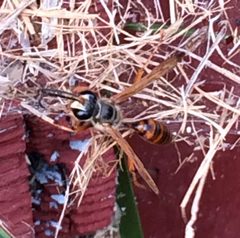
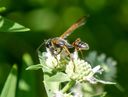
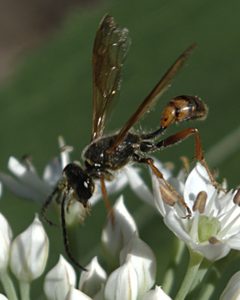
Generally black-colored body with rusty-red to yellowish and translucent wings with some tinting. Wings are typically splayed at rest, distinguishing it from other sphecid that fold wings flat over the abdomen. present: females are larger and more robust than males. Males lack stingers entirely.
Habitat
Uses pre-existing cavities in dead wood or artificial structures for nesting. In suburban settings, frequently occupies window tracks, wind chime tubes, and other narrow cavities. Nests provisioned with finely chewed fibers of dead weeds and grass. forage on wildflowers including sweetclover, sumac, and grape, and visit colonies for honeydew.
Distribution
Originally considered western and southern North America, but has been found in increasing numbers in the northeastern corner of the continent. Confirmed in Oregon, Washington state, Arizona, and expanding eastward. GBIF records indicate presence in Middle America and North America.
Seasonality
active during summer months. Larvae pupate and emerge as adults the following summer in northern climates. Multiple per year possible in warmer regions.
Diet
feed on nectar from flowers including sweetclover, sumac, and grape; also consume honeydew from colonies. Larvae are fed paralyzed orthopteran prey, primarily tree crickets (Oecanthus spp.) and small katydids including Insara elegans (Elegant Bush Katydid).
Life Cycle
Females construct nests in pre-existing cavities, creating a series of along the tunnel length. Each cell is provisioned with multiple paralyzed orthopteran prey items, then sealed with a partition of dry grass. An is laid on the prey. Larva hatches and consumes the fresh prey, then pupates within the cell. emerges the following summer in northern climates. One in the (not I. elegans specifically noted) forms communal chambers resembling bird nests.
Behavior
Solitary nesting; each female constructs and provisions her own nest. Females hunt actively, paralyzing prey with sting and transporting it back to the nest. Males form sleeping clusters in sheltered situations. Non-aggressive toward humans; stings occur only if female is physically grabbed. Males cannot sting. Notable for using window tracks and other artificial cavities in suburban environments, possibly because these sites are roomier than natural cavities and may have reduced pressure.
Ecological Role
of orthopteran insects, potentially providing of crickets and katydids. Serves as for parasitic flies (Sarcophagidae, including satellite flies) and parasitic . May compete with or share nest holes with blue orchard mason bees (Osmia lignaria).
Human Relevance
Occasionally considered a nuisance when nesting in window tracks, but is not a pest and provides natural pest control. Can be attracted to boxes or bee blocks as alternative nesting sites. Fascinating subject for observation due to visible grass-carrying .
Similar Taxa
- Isodontia apicalisSimilar and , but I. elegans has more southern and western distribution and shows consistent morphological differences; historically considered potentially but now treated as distinct
- Isodontia mexicanaAnother common eastern grass-carrying wasp with similar nesting ; distinguished by geographic range and subtle morphological differences
- Sphex lucaeSimilar black and red coloration and thread-waisted form, but Sphex lucae has more oval in females and lacks the grass-carrying nesting ; folds wings flat at rest rather than splaying them
- Prionyx speciesSimilar general appearance as hunters, but have silvery patches on and not present in Isodontia
Misconceptions
Often mistaken for social or aggressive stinging insects due to wasp-like appearance. The grass-filled cavities in window tracks are sometimes attributed to birds or other causes. Larvae found in nests are sometimes mistaken for pests rather than beneficial offspring.
More Details
Suburban Adaptation
The has shown remarkable adaptability to human-altered environments, readily adopting window tracks, wind chimes, and other artificial cavities for nesting. This may represent an ecological release from that have not yet adapted to these novel nesting sites.
Parasite Pressure
Subject to by satellite flies (Sarcophagidae) and various parasitic . The shift to artificial nesting sites may reduce loads, potentially explaining the success of suburban .
Sources and further reading
- BugGuide
- Wikipedia
- GBIF taxonomy match
- iNaturalist taxon
- NCBI Taxonomy
- Catalogue of Life
- Bring on the Tourists! | Bug Squad
- Bug Eric: Wasp Wednesday: More on Isodontia
- Bug Eric: Wasp Wednesday: Sphex lucae
- Bug Eric: June 2012
- Archive — Bug of the Week
- Bug Eric: Wasp Wednesday: Steniolia elegans
- Nesting Biology and Offspring Development of the Cavity-Nesting Solitary Wasp Isodontia elegans (F. Smith) from Trap-Nests in Oregon
- NOTES ON THE NORTH AMERICAN SPECIES OF ISODONTIA, PATTON, WITH DESCRIPTIONS OF A NEW SPECIES AND VARIETY