
Isodontia mexicana
(de Saussure, 1867)
Mexican Grass-carrying Wasp, Grass-carrying Wasp
Isodontia mexicana is a solitary sphecid native to North America that has become a successful in Europe since the 1960s. Females construct nests in pre-existing cavities such as hollow stems, abandoned tunnels, or even window tracks, lining them with grass fragments. They provision nests with paralyzed orthopteran prey—primarily small katydids (Tettigoniidae) and tree crickets (Gryllidae, particularly Oecanthinae)—to feed their larvae. The is notable for its splayed wing posture at rest and has been observed visiting diverse flowering plants for nectar.
Pronunciation
How to pronounce Isodontia mexicana: /ˌaɪsoʊˈdɒntiə mɛkˈsɪkənə/
These audio files are automatically generated. While they are not always 100% accurate, they are a good starting point.
Identification
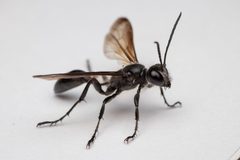
Distinguished from native European Isodontia by smaller size (females 16–18 mm, males 15–17 mm), uniform black coloration with bronze reflections, and strongly infuscated wings. The splayed wing posture at rest contrasts with other sphecid that fold wings flat. Window track nests filled with dry grass, dead orthopterans, and pale larvae are diagnostic of this species in suburban settings. Similar black sphecid wasps such as Sphex species lack the hairy and grass-carrying .
Images
Appearance
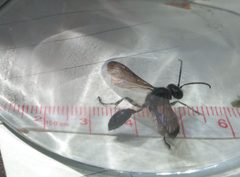
measure 15–20 mm in length. The body is uniformly black with subtle bronze-blue reflections. The (mesosoma) is conspicuously hairy with whitish setae. Wings are strongly infuscated, appearing smoky-brown. Females are larger than males and possess a stinger; males lack a stinger entirely. A key visual trait is the elongated metasomal petiole (the ' waist') connecting the thorax and . At rest, wings are characteristically splayed outward rather than folded flat over the abdomen.
Habitat
Occupies diverse environments from natural to anthropogenic. Nests exclusively in pre-existing cavities: hollow plant stems, branches, abandoned borings, and increasingly in artificial structures including window tracks, wind chimes, and bamboo tubes. In suburban settings, shows preference for 'roomier' cavities that may reduce pressure. Agricultural areas with artificial shelters are also utilized. Not —does not excavate its own burrows.
Distribution
Native to North America: central and eastern United States extending to northern Mexico. Introduced to Europe beginning in France in the 1960s, likely around World War II era, subsequently spreading throughout the continent. Established in France, Switzerland, Hungary, Italy, Spain, Austria, Germany, Czech Republic, Slovakia, Croatia, Slovenia, Serbia, Netherlands, Belgium, Britain, Ukraine, and Russia (Crimea). Easternmost European record: Crimea (2012). Southernmost: Sicily. Also introduced to Pacific Islands (Hawaii, Midway Atoll, Howland Island) and Iran. In North America, common throughout the eastern U.S.
Seasonality
activity spans early summer through September in temperate regions. Females emerge later in the season than males. In northern climates, larvae overwinter in nests and adults emerge the following summer. Multiple per year possible in warmer climates.
Diet
feed on nectar from diverse flowering plants including sweetclover, sumac, grape, and honeydew. Larvae are , consuming paralyzed orthopteran prey provisioned by the female parent.
Host Associations
- Gryllidae (Oecanthinae) - preyTree crickets, primarily small individuals
- Tettigoniidae - preyKatydids, small selected
- Melittobia acasta - Eulophid that destroys cocoons
- Melittobia chalybii - of related sphecid nests, likely attacks this
- Sarcophagidae (satellite flies) - Amobia and related infiltrate nests
- Chrysis spp. - Cuckoo wasps known to parasitize sphecid nests in shared
Life Cycle
Females construct linear series of within pre-existing cavities, each cell partitioned with dry grass. Each cell is provisioned with multiple paralyzed orthopteran prey items, then an is deposited. Larvae hatch and consume fresh prey, progressing through instars. occurs within the nest cell, with emerging the following season in temperate regions. Nest architecture includes a terminal plug of grass that resembles a tiny broom handle-first in the cavity entrance.
Behavior
Non-aggressive toward humans; stings only if physically grabbed. Males lack stingers entirely. Foraging visit flowers and colonies for . Females hunt specifically for small orthopterans, paralyzing them with venom and transporting them to nests. Shows behavioral flexibility in nest site selection, readily adopting novel anthropogenic cavities. Communal does not occur—each female maintains solitary nests, though multiple females may use adjacent cavities.
Ecological Role
controlling of small orthopterans. Potential due to hairy body and frequent flower visitation. As an in Europe, may compete with native cavity-nesting Hymenoptera and exert pressure on native orthopteran populations. Serves as for and flies, contributing to complexity.
Human Relevance
Generally beneficial and not considered a pest. Occasionally nests in window tracks, causing minor nuisance; simple cleaning discourages reoccupation. Potential value as agent for crop-damaging orthopterans. Artificial nest shelters ( blocks, bamboo bundles) can attract females away from structures. Subject of citizen science documentation for plant- interaction studies.
Similar Taxa
- Isodontia elegansNative western North American ; overlaps in some regions. Distinguished by subtle morphological differences in petiole structure and genitalia; requires expert examination.
- Isodontia auripesAnother North American grass-carrying with similar nesting . Differences in petiole and geographic distribution aid separation.
- Sphex pensylvanicusGreat black wasp, similar size and black coloration but (digs soil burrows), has smooth , folds wings flat at rest, and provisions nests with katydids in underground rather than pre-existing cavities.
- Sphex ichneumoneusGreat golden digger wasp, distinguished by orange legs and petiole, nesting habit, and wing-folding posture.
- Monobia quadridensFour-toothed mason wasp, shares cavity-nesting habit but uses mud partitions rather than grass, provisions with caterpillars not orthopterans, and has distinct pale markings.
Misconceptions
Larvae in window tracks are sometimes mistaken for 'worms' or maggots by homeowners, causing unnecessary alarm. The are not aggressive and do not defend nests actively, contrary to social wasp . The 'grass-carrying wasp' applies to multiple Isodontia , not exclusively I. mexicana.
More Details
Invasion Biology
The represents a textbook case of accidental introduction and establishment without apparent shift. Spread throughout Europe likely facilitated by lack of specialized and , though parasitoids (Melittobia spp.) have subsequently attacked nests. Jump- events, such as the 2012 Crimea record, suggest human-mediated transport.
Nest Site Plasticity
Suburban show remarkable flexibility, adopting window tracks, wind chimes, and other novel cavities. This behavioral plasticity may explain invasion success and suggests that natural cavity limitation in urban environments drives exploitation of artificial alternatives.
Sexual Size Dimorphism
Females are larger and emerge later than males, a pattern documented in detailed studies of sex allocation and nesting .
Sources and further reading
- BugGuide
- Wikipedia
- GBIF taxonomy match
- iNaturalist taxon
- NCBI Taxonomy
- Catalogue of Life
- RJ Millena: from Entomology-Focused Kindergartener to Scoring Cover of Journal With Her Research | Bug Squad
- Bug Eric: Wasp Wednesday: More on Isodontia
- Bug Eric: The Wasp Wall
- Bug Eric: February 2011
- Bug Eric: Grape is Blooming
- Why Larvae of One Wasp Species Often Eat Their Siblings
- Isodontia mexicana, a new invasive wasp species in the Republic of Moldova fauna
- Biology of Isodontia (Murrayella) mexicana in Trap-Nests in Wisconsin (Hymenoptera: Sphecidae)
- FURTHER SPREADOF THE ALIEN INVASIVE SPHECID WASP ISODONTIA MEXICANA(SAUSSURE, 1867) (HYMENOPTERA SPHECIDAE) INITALY
- Nesting behaviour of adventiveIsodontia mexicana(Saussure) in Piedmont (Italy North-West) (Hymenoptera Sphecidae)
- Prey and nesting preferences of the alien wasp Isodontia mexicana (Hymenoptera, Sphecidae) in southern Germany
- Isodontia Mexicana (Hymenoptera, Sphecidae), a New Invasive Wasp Species in the Fauna of Ukraine Reared from Trap-Nests in the Crimea
- Extracting secondary data from citizen science images reveals host flower preferences of the Mexican grass‐carrying wasp Isodontia mexicana in its native and introduced ranges