
Isodontia
Patton, 1880
Grass-carrying Wasps, Grass-carrier Wasps
Species Guides
6- Isodontia apicalis(grass-carrier wasp)
- Isodontia auripes(Brown-legged Grass-carrier Wasp)
- Isodontia elegans(Elegant Grass-carrying Wasp)
- Isodontia exornata(grass-carrier wasp)
- Isodontia mexicana(Mexican Grass-carrying Wasp)
- Isodontia philadelphica(Grass-carrying Wasp)
Isodontia is a of solitary in the Sphecidae, commonly known as grass-carrying wasps. Females construct nests in pre-existing cavities such as hollow stems, window tracks, or abandoned tunnels, lining them with dry grass or hay. They provision nests with paralyzed Orthoptera (tree crickets and katydids) as food for their larvae. Several are in Europe, with Isodontia mexicana being the most widespread non-native species.
Pronunciation
How to pronounce Isodontia: /ˌaɪsoˈdɒntiə/
These audio files are automatically generated. While they are not always 100% accurate, they are a good starting point.
Identification
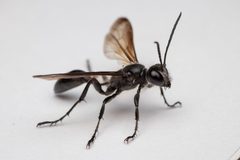
Distinguished from other sphecid by the habit of splaying wings at rest while foraging, exposing the narrow waist. Nests are diagnostic: pre-existing cavities filled with dry grass, with partitions between and entrance plugs made of packed grass fragments. Can be confused with Prionyx or Sphex , but these typically fold wings flat over the when at rest.
Images
Appearance
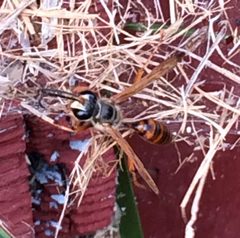
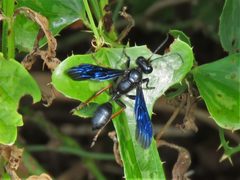
Medium-sized solitary with slender bodies. typically have the wings splayed at rest, exposing the narrow petiole (wasp waist) connecting the and . Coloration varies by ; Isodontia mexicana has a relatively hairy mesosome. may occur in some species.
Habitat
Pre-existing natural cavities in dead wood, hollow plant stems, window tracks, wind chimes, and abandoned tunnels. In suburban settings, frequently uses artificial cavities such as window tracks and bamboo tubes. Native range includes North America; in Europe occupy similar cavity-rich .
Distribution
Native to North America (USA, Mexico, Central America). in Europe (first recorded France 1960s, now widespread including Italy, Germany, Ukraine, Moldova, Crimea), Pacific Islands (Hawaii, Midway Atoll, Howland Island), and Iran. At least six occur in North America; Isodontia mexicana is the most widespread in Europe. Isodontia nigella, native to Eastern Palaearctic and Australia, has also been recorded in Crimea as invasive.
Seasonality
emerge from cocoons in early summer. One per year in northern climates; two generations per year reported for Isodontia nigella in Crimea. Active foraging period extends through summer months.
Diet
feed on nectar and honeydew from colonies. Larvae are fed paralyzed Orthoptera, specifically tree crickets (Gryllidae: Oecanthinae) and small katydids (Tettigoniidae).
Life Cycle
Females construct nests in pre-existing cavities, creating 2-11 (typically 5-8) separated by grass partitions. Each cell is provisioned with 2-6 paralyzed orthopteran prey items. is laid on prey; larva consumes provisioned food, then pupates. Some form communal chambers rather than individual cells. may overwinter. One per year in most North American ; two generations in some regions.
Behavior
Non-: does not excavate burrows, instead using pre-existing cavities. Females hunt paralyzed prey, transport it to the nest, and seal with grass partitions. Nest entrance plugged with dry grass upon completion. Males lack stingers entirely; females sting only if physically grabbed. Not aggressive toward humans or pets. frequently visit flowers including sweetclover, sumac, and grape, and feed on honeydew at colonies.
Ecological Role
of Orthoptera, potentially contributing to of crop pests. through frequent flower visitation. Cavity-nesting creates nesting opportunities for other after abandonment. may compete with native cavity-nesting insects and impact local orthopteran populations.
Human Relevance
Occasionally considered a nuisance when nesting in window tracks, but not structurally damaging and not aggressive. Potential value as agent for orthopteran crop pests. Subject of citizen science observation and research on plant- interactions.
Similar Taxa
- SphexSimilar size and coloration; distinguished by habit of folding wings flat over at rest, versus splayed wings in Isodontia
- PrionyxSuperficially similar appearance; distinguished by wing posture and lack of silvery facial patches found in some Prionyx
- Sceliphron (mud daubers)Both are sphecid that provision nests with paralyzed prey; Sceliphron builds free-standing mud nests rather than using pre-existing cavities with grass
More Details
Invasive Species Status
Isodontia mexicana is a notable in Europe, first recorded in France in the early 1960s and now established across much of the continent. It represents one of the most successful sphecid invasions, with recent records extending to Sicily (southernmost Europe), Ukraine, and Moldova. Isodontia nigella has also been recorded as in Crimea, representing the second invasive Isodontia in Europe.
Sibling Cannibalism
Isodontia harmandi, native to Japan and Korea, exhibits routine larval in communal . Stronger larvae consume siblings both for nutrition and to reduce competition for prey provisions, with cannibalism increasing when prey availability declines. This represents an unusual case of brood reduction in a solitary with gregarious larval development.
Nesting Plasticity
Suburban have adopted window tracks and wind chimes as nesting sites, possibly because these artificial cavities are roomier than natural cavities and may experience lower rates. This behavioral flexibility has likely facilitated range expansion in both native and introduced ranges.
Sources and further reading
- BugGuide
- Wikipedia
- GBIF taxonomy match
- iNaturalist taxon
- NCBI Taxonomy
- Catalogue of Life
- Bug Eric: Wasp Wednesday: More on Isodontia
- Why Larvae of One Wasp Species Often Eat Their Siblings
- Bug Eric: February 2011
- Bug Eric: The Wasp Wall
- Bug Eric: Wasp Wednesday: Sphex lucae
- Bug Eric: Grape is Blooming
- Isodontia mexicana, a new invasive wasp species in the Republic of Moldova fauna
- Biology of Isodontia (Murrayella) mexicana in Trap-Nests in Wisconsin (Hymenoptera: Sphecidae)
- FURTHER SPREADOF THE ALIEN INVASIVE SPHECID WASP ISODONTIA MEXICANA(SAUSSURE, 1867) (HYMENOPTERA SPHECIDAE) INITALY
- Nesting behaviour of adventiveIsodontia mexicana(Saussure) in Piedmont (Italy North-West) (Hymenoptera Sphecidae)
- Prey and nesting preferences of the alien wasp Isodontia mexicana (Hymenoptera, Sphecidae) in southern Germany
- NOTES ON THE NORTH AMERICAN SPECIES OF ISODONTIA, PATTON, WITH DESCRIPTIONS OF A NEW SPECIES AND VARIETY
- Isodontia Mexicana (Hymenoptera, Sphecidae), a New Invasive Wasp Species in the Fauna of Ukraine Reared from Trap-Nests in the Crimea
- Nesting Biology and Offspring Development of the Cavity-Nesting Solitary Wasp Isodontia elegans (F. Smith) from Trap-Nests in Oregon
- Extracting secondary data from citizen science images reveals host flower preferences of the Mexican grass‐carrying wasp Isodontia mexicana in its native and introduced ranges
- The first record of the Far Eastern grass-carrying wasp Isodontia nigella (F. Smith, 1856) (Hymenoptera: Sphecidae: Sphecinae) from the Crimea
- Brood reduction caused by sibling cannibalism in Isodontia harmandi (Hymenoptera: Sphecidae), a solitary wasp species building communal brood cells.