
Isodontia auripes
(Fernald, 1906)
Brown-legged Grass-carrier Wasp, brown-legged grass-carrier
Isodontia auripes, the brown-legged grass-carrier , is a solitary thread-waisted wasp in the Sphecidae. The is known for its distinctive nesting : females construct nests in pre-existing cavities such as window tracks, wind chimes, or abandoned tunnels, filling them with dry grass and provisioning them with paralyzed tree crickets (Oecanthus spp.) as food for their larvae. The wasp is non-aggressive toward humans and has been observed using nests made by Xylocopa virginica or mining bees. Larvae feed for approximately three days before pupating for two days.

Pronunciation
How to pronounce Isodontia auripes: /ˌaɪsəˈdɒntiə ˈɔːrɪˌpɛs/
These audio files are automatically generated. While they are not always 100% accurate, they are a good starting point.
Identification
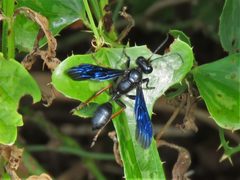
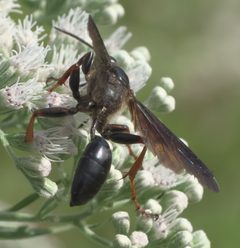
Isodontia auripes can be distinguished from other Isodontia by its brown legs, referenced in both its scientific and . The species has a thread-waisted body typical of Sphecidae. have wings splayed at rest, unlike other sphecid that fold wings flat over the . Similar species include Isodontia mexicana, which is very common in the eastern U.S. and shares the grass-carrying nesting ; I. auripes is distinguished by leg coloration and geographic range.
Images
Habitat
Found in suburban and urban environments where pre-existing cavities are available for nesting, including window tracks, wind chimes, hollow plant stems, and abandoned tunnels of carpenter bees (Xylocopa virginica) or mining bees. The has adapted to human-altered environments, using artificial structures as nest sites.
Distribution
East coast of the United States. Records indicate presence in eastern North America, with distribution extending into Canada (Ontario).
Diet
feed on nectar from flowers including sweetclover, sumac, and grape, and consume honeydew from colonies. Larvae are fed paralyzed tree crickets (Oecanthus spp.), which are common prey items throughout the ' range.
Host Associations
- Oecanthus - preyTree crickets, paralyzed and provisioned in nests as larval food
- Xylocopa virginica - nest siteOpportunistically uses abandoned nests
- mining bees - nest siteOpportunistically uses abandoned nests
Life Cycle
Females construct nests in pre-existing cavities, provisioning each with paralyzed tree crickets before laying a single and partitioning cells with dry grass. The nest entrance is plugged with grass upon completion. Larvae hatch and consume the paralyzed prey, feeding for three days before entering a two-day pupal stage. emerge the following summer in northern climates.
Behavior
Solitary nesting; each female constructs and provisions her own nest. Non-aggressive toward humans and pets; stinging only occurs if a female is physically grabbed. Males lack stingers entirely. Females hunt tree crickets, paralyzing them with venom and transporting them to the nest. rest with wings splayed, unlike related sphecid .
Ecological Role
of tree crickets (Oecanthus spp.), contributing to of these orthopterans. The serves as for including satellite flies (Sarcophagidae) and potentially other parasitic and flies.
Human Relevance
Often noticed by homeowners when nests are constructed in window tracks or wind chimes, causing concern due to presence of "worms" (larvae) and accumulated grass. The is beneficial and non-threatening; is recommended. Can be encouraged to nest away from homes by providing boxes or bundles of bamboo as alternative cavity sites.
Similar Taxa
- Isodontia mexicanaVery common eastern U.S. with similar grass-carrying nesting and appearance; distinguished by geographic overlap and subtle morphological differences including leg coloration
- Isodontia elegansWestern that also uses grass in nesting; distinguished by distribution
- Isodontia harmandiAsian with similar communal ; distinguished by geography