
Sphex ichneumoneus
(Linnaeus, 1758)
Great Golden Digger Wasp, Great Golden Sand Digger
Sphex ichneumoneus is a large, conspicuous solitary distributed across the Western Hemisphere from Canada to South America. Females excavate vertical burrows in sandy soils, provisioning individual with paralyzed katydids and related Orthoptera as food for their larvae. The exhibits a distinctive fixed action pattern during prey retrieval, repeatedly inspecting the burrow entrance before dragging prey inside by the —a famously cited in discussions of genetic determinism. forage for nectar at flowers and are frequently observed on blooms of rabbitbrush, prairie clover, and grape.
Pronunciation
How to pronounce Sphex ichneumoneus: /ˈsfɛks ɪkˈnjuːməˌniːəs/
These audio files are automatically generated. While they are not always 100% accurate, they are a good starting point.
Identification
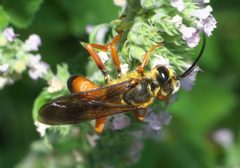
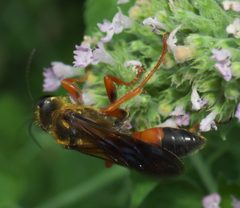
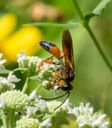
Distinguished by dense golden covering the and , contrasting with reddish-orange legs and partially reddish-orange abdominal segments. Body length 15–27 mm. The color pattern separates it from the all-black Sphex pensylvanicus and the sexually dimorphic Sphex lucae, where females are black with red and males entirely black.
Images
Habitat
Open sandy or sandy-loam areas with sparse vegetation, including sand pits, river banks, dunes, and sagebrush valleys. Nests are constructed in well-drained, warm soils of moderate compactness; females avoid overly soft soils that collapse or excessively hard-packed substrates.
Distribution
Transcontinental in North America; ranges from Canada through the United States to Peru and Brazil. Documented in western North America from Oregon and the Sierra Nevada region to Massachusetts, with observations in Colorado, Missouri, Wisconsin, and southcentral Montana.
Seasonality
Active during warm, sunny conditions; observed from summer through early autumn. In western North America, active in August and September. Nesting activity ceases during cloudy weather or when temperatures drop.
Diet
feed on nectar from flowers including Ericameria nauseosa (rubber rabbitbrush), Chrysothamnus viscidiflorus (yellow rabbitbrush), Dalea candida (white prairie clover), wild grape, and Melilotus alba. Females provision nests exclusively with paralyzed Orthoptera: katydids in Neoconocephalus, Orchelimum, Conocephalus, Scudderia, Amblycorypha, Neduba, and Atlanticus, plus tree crickets (Oecanthus) and leafroller crickets (Gryllacrididae).
Host Associations
- Paraxenos westwoodi - Strepsipteran ; 25% of males and 7% of females stylopized in Montana study, 6.8% of females in Poland. Only female are parasitized; stylopized females show reduced ovarian development.
Life Cycle
Females excavate vertical or near-vertical burrows with 2–7 lateral chambers arranged at right angles to the main shaft. Each chamber receives multiple paralyzed prey items and a single . Larvae develop on the provisioned food, with larger katydids requiring fewer individuals per . Nest entrance is sealed after provisioning. Multiple females may nest in proximity, creating loose without social cooperation.
Behavior
Exhibits a pronounced fixed action pattern during prey retrieval: the pauses at the burrow entrance, enters to inspect the chamber, then reemerges to drag the paralyzed prey inside by its . If prey is experimentally moved away from the entrance, the wasp repeats the inspection sequence persistently. Females gather soil in their forelegs and deposit it away from the nest entrance, rather than kicking it backward like sand wasps. Males perch on elevated vegetation to watch for females.
Ecological Role
of katydids and crickets, potentially influencing local Orthoptera . Nesting activity contributes to soil aeration and turnover in sandy . serve as during nectar foraging. to strepsipteran .
Human Relevance
Sting is defensive and painful when provoked; one documented case involved a that entered a home and stung when stepped upon. Generally placid during nectar foraging and approachable for observation. Subject of behavioral research on fixed action patterns and genetic determinism, with the term "sphexish" coined to describe its stereotyped .
Similar Taxa
- Sphex pensylvanicusSimilar large size and nesting , but entirely black with blue wing reflections rather than golden and reddish-orange coloration.
- Sphex lucaeWestern North American with superficially similar female coloration (black with red ), but lacks golden thoracic and shows pronounced (males entirely black).
- Prionyx speciesSimilar thread-waisted build and -hunting , but have more cylindrical and silvery facial patches absent in S. ichneumoneus.
Sources and further reading
- BugGuide
- Wikipedia
- GBIF taxonomy match
- iNaturalist taxon
- NCBI Taxonomy
- Catalogue of Life
- Bug Eric: Wasp Wednesday: Great Golden Digger
- A rare opportunity to do fall insect collecting in western North America | Beetles In The Bush
- Bug Eric: White Prairie Clover: An Awesome Blossom
- Bug Eric: Grape is Blooming
- Bug Eric: Wasp Wednesday: Sphex lucae
- Pseudomethoca simillima – a model for Enoclerus ichneumoneus? | Beetles In The Bush
- Nest‐site selection in the great golden digger wasp, Sphex ichneumoneus L. (Sphecidae)
- Prevalence of Stylopization ofSphex ichneumoneus(L.) (Hymenoptera: Sphecidae) byParaxenos westwoodi(Templeton) (Strepsiptera: Xenidae)