
Prionyx canadensis
(Provancher, 1887)
Prionyx canadensis is a solitary, thread-waisted wasp in the Sphecidae. Females are distinguished from similar P. parkeri and P. thomae by the absence of silvery hairs on the . Like other members of the , this species is a that hunts grasshoppers and provisions underground burrows with paralyzed prey for their larvae.
Pronunciation
How to pronounce Prionyx canadensis: /ˈpɹaɪoʊˌnɪks ˌkænəˈdɛnsɪs/
These audio files are automatically generated. While they are not always 100% accurate, they are a good starting point.
Identification
Distinguished from P. parkeri and P. thomae by the lack of silvery hairs on the female's . P. parkeri additionally has two pairs of long palps (mouthparts) not present in P. canadensis. The similar P. thomae has silvery thoracic hairs. All three share black and red coloration with silvery facial highlights and globose .
Images
Appearance
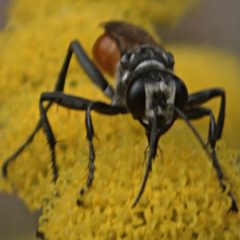
Thread-waisted wasp with globose, nearly spherical . Black and red coloration with silvery highlights on the . Females lack the silvery hairs on the that characterize P. parkeri and P. thomae. Legs are stout and spiny. Abdomen does not extend beyond wingtips when at rest.
Habitat
Open, sandy areas suitable for burrowing, including shortgrass prairie, degraded prairie, and arroyos with sandy soil. Associated with where prey is abundant.
Distribution
North America and Middle America. Records include Massachusetts (South Deerfield), with range likely extending across much of the United States and adjacent southern Canada based on distribution.
Seasonality
active during summer months. Specific period not documented, but likely June through August based on observations of and prey availability.
Diet
feed on nectar. Females provision nests with paralyzed grasshoppers ( Acrididae) as food for larvae.
Host Associations
- Acrididae - preyGrasshoppers paralyzed and stored in burrows as larval food
Life Cycle
Solitary nesting. Female excavates burrow in sandy soil after securing prey. Burrow may be curved, linear, or L-shaped, ending in a single chamber that receives one victim. is laid on the prey, the entrance is sealed, and the female departs to repeat the process. Larva feeds on the paralyzed grasshopper, eventually killing it.
Behavior
Females hunt grasshoppers, paralyzing them with venom. Prey is carried to a distant location while the burrow is excavated, then retrieved and hauled -first into the nest at remarkable speed. Females exhibit alert, nervous when disturbed, snapping at approaching ants. They groom themselves and reposition prey before and during nesting activities. Males may be observed nectaring at flowers.
Ecological Role
of grasshoppers, potentially contributing to of acridid . Serves as for kleptoparasitic satellite flies (Miltogramminae, Sarcophagidae), which lay larvae on the 's prey, starving the wasp larvae.
Human Relevance
No documented economic importance. May be encountered in sandy areas, vacant lots, and prairie . Not aggressive toward humans; stings used to paralyze prey rather than for defense.
Similar Taxa
- Prionyx parkeriVery similar appearance, but distinguished by two pairs of long palps (mouthparts) and silvery thoracic hairs in females
- Prionyx thomaeNearly identical coloration, but females have silvery hairs on absent in P. canadensis
- Prionyx atratusEntirely black coloration (no red), females with silvery or gold ; stockier build with shorter
- Sphex lucaeSimilar thread-waisted appearance and color pattern (black with red in females), but has more oval abdomen and lacks sil facial patches
More Details
Nesting vulnerability
During burrow excavation and prey provisioning, females and their prey are vulnerable to satellite flies (Miltogramminae), which orbit the and deposit larvae on the . This kleptoparasitism often results in starvation of the wasp larva.
Nomenclature
described by Provancher in 1887. No widely used exists, consistent with most insects lacking economic importance.
Sources and further reading
- BugGuide
- Wikipedia
- GBIF taxonomy match
- iNaturalist taxon
- NCBI Taxonomy
- Catalogue of Life
- Bug Eric: Wasp Wednesday: Prionyx thomae
- Bug Eric: Caught on Video: Prionyx atratus
- Bug Eric: Wasp Wednesday: Sphex lucae
- Bug Eric: Spider Sunday: Red Velvet Jumper
- Bug Eric: True Bug Tuesday: Mirid plant bug
- Bug Eric: White Prairie Clover: An Awesome Blossom