
Prionyx atratus
(Lepeletier de Saint Fargeau, 1845)
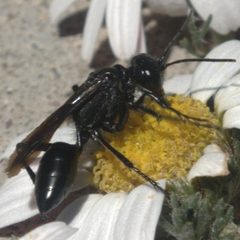
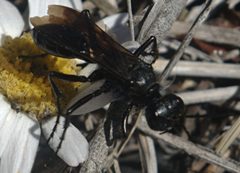
Prionyx atratus is a solitary, thread-waisted wasp in the Sphecidae. It is one of two entirely black in the Prionyx found in North America. Females construct underground burrows in sandy soil to provision with paralyzed grasshoppers as food for their offspring. The species is distributed across virtually the entire United States and into southwest Canada.
Pronunciation
How to pronounce Prionyx atratus: /ˈpriː.oʊ.nɪks əˈtrɑː.təs/
These audio files are automatically generated. While they are not always 100% accurate, they are a good starting point.
Identification
The entirely black coloration, stocky build with nearly spherical , and conspicuously spiny legs distinguish this from most other thread-waisted wasps. The abdomen does not extend beyond the wingtips at rest, unlike more elongate sphecids. Prionyx subatratus is similarly all-black but can be separated by subtle morphological differences; other Prionyx species are black and red with silvery highlights. The combination of black coloration, spiny legs, and compact globose abdomen is diagnostic within the .
Images
Appearance
A stocky, thread-waisted wasp with a nearly spherical that does not extend beyond the wingtips when at rest. Entirely black in coloration. Females have silvery or gold due to appressed, reflective . Legs are relatively short and conspicuously spiny, more so than in other sphecid . Females average 15 mm in body length, males 12 mm. The compact, robust build makes individuals appear substantially larger than their actual measurements.
Habitat
Open areas with sandy, well-drained soil suitable for burrow excavation. Found in degraded shortgrass prairie, sandy arroyos, vacant lots, and other open with exposed ground. Nests are constructed in social trails, bare patches, and other areas of loose, workable substrate.
Distribution
Occurs across virtually the entire United States and adjacent southern Canada, including British Columbia and Saskatchewan near the border. GBIF records indicate presence in Middle America and North America.
Seasonality
are active during summer months. Nesting has been observed in mid-July in Colorado. Activity period likely extends from late spring through summer, with precise timing varying by latitude and local conditions.
Life Cycle
Solitary nesting with one per year. Females dig burrows after securing prey, leaving paralyzed grasshoppers at a distance while excavating. Each burrow contains a single provisioned with one paralyzed , on which an is laid. The burrow is then sealed with packed soil and surface evidence obliterated. Larvae develop as , consuming the living but immobilized prey. occurs in the sealed cell.
Behavior
Females hunt grasshoppers ( Acrididae), paralyzing them with venom and transporting them to nest burrows. Prey is carried headfirst, held in the legs and , with the running rapidly over terrain while bearing loads disproportionate to body size. When disturbed during nesting, females may abandon burrows and prey. Prey is left at a distance from the burrow during excavation, likely reducing kleptoparasitism risk. Nest closure involves packing soil into the tunnel for at least one centimeter, then disguising surface evidence. Males have been observed visiting flowers for nectar.
Ecological Role
of grasshoppers, potentially contributing to of acridid . Serves as for kleptoparasitic satellite flies (Miltogramminae, Sarcophagidae), which larviposit on paralyzed prey. As a nectar visitor, may contribute to pollination of flowering plants.
Human Relevance
Not aggressive toward humans; stings occur only if handled. May be encountered in gardens, parks, and vacant lots with sandy soils. Nesting can be observed by patient observers in appropriate . No economic importance as pest or beneficial documented.
Similar Taxa
- Prionyx subatratusAlso entirely black; distinguished by subtle morphological features not visible in field
- Prionyx thomaeBlack and red with silvery highlights, not uniformly black; hunts similar prey
- Prionyx parkeriBlack and red with silvery highlights; distinguished by two pairs of long palps
- Ammophila spp.Thread-waisted sphecids with more elongate, cylindrical ; provision nests with caterpillars rather than grasshoppers
More Details
Nesting Behavior
Females dig burrows using front legs to pull soil out, contrasting with sand wasps (Bembix) that kick soil backward. Burrows may be curved, linear, or L-shaped. Nest excavation occurs after prey capture, not before.
Prey Transport
The speed and strength of prey transport is remarkable; females can run while carrying grasshoppers comparable to a human carrying a large piece of furniture. This makes photography and observation challenging.
Sources and further reading
- BugGuide
- Wikipedia
- GBIF taxonomy match
- iNaturalist taxon
- Catalogue of Life
- Bug Eric: Caught on Video: Prionyx atratus
- Bug Eric: White Prairie Clover: An Awesome Blossom
- Bug Eric: Ammophila in Action
- Bug Eric: January 2014
- Bug Eric: Wasp Wednesday: Prionyx thomae
- T.G.I.Flyday—Black horse fly (Tabanus atratus) | Beetles In The Bush