
Sarcophaginae
Typical Flesh Flies
Genus Guides
11- Arachnidomyia
- Blaesoxipha(Grasshopper Flesh Flies)
- Boettcheria
- Fletcherimyia
- Helicobia(flesh flies)
- Johnstoniini
- Oxysarcodexia
- Ravinia
- Sarcophaga(Common Flesh Flies)
Sarcophaginae is a diverse of flesh flies comprising at least 60 and over 1,800 worldwide, with the highest diversity in the Neotropical region. These calyptrate flies are characterized by their association with decomposing organic matter, including carrion, , and decaying material. Many species exhibit , thriving in human-modified environments. Their encompass necrophagy, , and scavenging, with some species documented in association with eusocial nests. Species identification relies heavily on male genitalia due to uniform external chaetotaxy.

Pronunciation
How to pronounce Sarcophaginae: /ˌsɑːrkəˈfædʒɪniː/
These audio files are automatically generated. While they are not always 100% accurate, they are a good starting point.
Identification
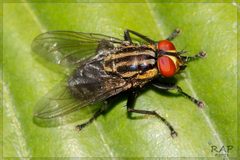
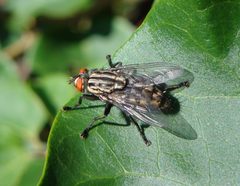
Distinguished from other Sarcophagidae by the presence of a developed subscutellum (weak or absent in Miltogramminae), aristate with or smooth , and characteristic thoracic chaetotaxy including two strong and two small notopleural setae. The ptilinal fissure and lunule are present on the . Gray coloration with three longitudinal black stripes on the is common. Male terminalia provide the only reliable characters for -level identification.
Images
Habitat
Forest, rural, and urban ; strongly associated with anthropic and environments. Forest habitats show highest . Frequently found at sap flows, decomposing organic matter, and carrion.
Distribution
Widely distributed globally with highest diversity in the Neotropical region. Documented from southern Brazil, Colombian Guajira biogeographic province, Buenos Aires Province (Argentina), Croatia, and Oklahoma (USA).
Diet
Scavenger habits confirmed; attracted to fermented fruit, decomposing fish, human , carrion, and sap flows. Necrophagous and feeding strategies predominant.
Life Cycle
Larvae develop in decomposing organic substrates including carrion and . emerge from using an inflatable that expands through the ptilinal fissure to break open the pupal case.
Behavior
Strong association with human environments and activity. observed at sap flows and carrion sources. Interactions with eusocial nests are best characterized as sarcosaprophagous rather than parasitoidal.
Ecological Role
Decomposers and nutrient recyclers in terrestrial . Potential sanitary concern due to carriage of pathogenic bacteria including Escherichia coli, Shigella spp., and Staphylococcus aureus on external body surfaces.
Human Relevance
Sanitary and public health significance due to habits and mechanical transmission of pathogenic bacteria. Some serve as forensic indicators for estimating postmortem intervals.
Similar Taxa
- MiltogramminaeLacks well-developed subscutellum; typically has smooth and smaller body size; many are kleptoparasites of solitary rather than scavengers
- MuscidaeLacks the row of setae on the meron present in Sarcophaginae; has only two notopleural setae versus two strong plus two small setae in Sarcophaginae
- CalliphoridaeHas only two notopleural setae versus the characteristic four in Sarcophaginae; typically shows metallic coloration absent in most Sarcophaginae
Sources and further reading
- BugGuide
- iNaturalist taxon
- NCBI Taxonomy
- Catalogue of Life
- Sarcophagidae | Beetles In The Bush
- Brazil Bugs #2 | Beetles In The Bush
- Super Crop Challenge #4 | Beetles In The Bush
- Synanthropy of Sarcophaginae (Diptera: Sarcophagidae) From Southern Brazil and Its Sanitary Implications
- New records and distributional data of Sarcophaginae (Diptera: Sarcophagidae) from Colombia
- Supplementary material 1 from: Valverde Castro C, Buenaventura E, Sánchez-Rodríguez JD, Wolff M (2017) Flesh flies (Diptera: Sarcophagidae: Sarcophaginae) from the Colombian Guajira biogeographic province, an approach to their ecology and distribution. Zoologia 34: 1-11. https://doi.org/10.3897/zoologia.34.e12277
- Figure 1 from: Krčmar S (2023) Diversity of flesh flies (Sarcophagidae, Sarcophaginae) of pond habitats in rural areas in the Croatian part of Baranja. ZooKeys 1159: 17-36. https://doi.org/10.3897/zookeys.1159.100878
- Flesh flies (Diptera: Sarcophagidae: Sarcophaginae) from the Colombian Guajira biogeographic province, an approach to their ecology and distribution
- Diversity of flesh flies (Sarcophagidae, Sarcophaginae) of pond habitats in rural areas in the Croatian part of Baranja
- Figure 2 from: Valverde Castro C, Buenaventura E, Sánchez-Rodríguez JD, Wolff M (2017) Flesh flies (Diptera: Sarcophagidae: Sarcophaginae) from the Colombian Guajira biogeographic province, an approach to their ecology and distribution. Zoologia 34: 1-11. https://doi.org/10.3897/zoologia.34.e12277
- Review of the Sarcophaginae (Diptera: Sarcophagidae) of Buenos Aires Province (Argentina), with a key and description of a new species
- First record of the Ravinia almeidai (Lopes, 1946) (Diptera: Sarcophagidae: Sarcophaginae) to the state of Bahia, Brazil
- Figures 3-4 from: Valverde Castro C, Buenaventura E, Sánchez-Rodríguez JD, Wolff M (2017) Flesh flies (Diptera: Sarcophagidae: Sarcophaginae) from the Colombian Guajira biogeographic province, an approach to their ecology and distribution. Zoologia 34: 1-11. https://doi.org/10.3897/zoologia.34.e12277
- Parasitoids, predators, or scavengers? On the nature of flesh fly (Diptera: Sarcophagidae: Sarcophaginae) interactions with eusocial wasps (Hymenoptera: Vespidae) in light of new findings in Brazil