
Bembecinus
A. Costa, 1859
sand wasp, sand wasps
Species Guides
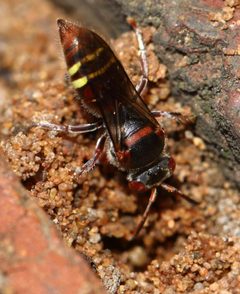
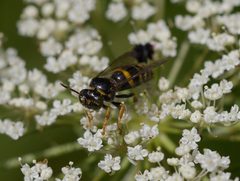
4Bembecinus is a of sand wasps in the Crabronidae, with approximately 200 described worldwide. These small to medium-sized are known for their distinctive —strongly convergent at the bottom of the and strongly divergent at the top of the —and for practicing of their larvae. Females construct burrows in sandy substrates and hunt leafhoppers to feed their offspring, while males exhibit complex alternative mating tactics including digging for pre-emergent females and patrolling for mates.
Pronunciation
How to pronounce Bembecinus: /bɛmˈbɛsɪnəs/
These audio files are automatically generated. While they are not always 100% accurate, they are a good starting point.
Identification
Key diagnostic features include that are strongly convergent ventrally and strongly divergent dorsally; the second submarginal of the forewing is or nearly so. Males of some possess short tarsal rakes of spines on the front feet, which can cause them to be mistaken for females. Body size ranges from approximately 8–10 mm in smaller species to larger dimensions in others.
Images
Habitat
Sandy substrates suitable for burrow excavation; includes coastal dunes, riverbanks, and other loose-soil environments. Some occupy urban , including rooftop gardens with artificial green spaces.
Distribution
distribution across all continents except Antarctica. North America north of Mexico at least 10 . European species include B. tridens, B. peregrinus, and others. Asian distribution includes India, Pakistan, Nepal, Sri Lanka, and Saudi Arabia.
Diet
have been observed nectaring on Ziziphus mauritiana; females hunt leafhoppers (Cicadellidae and related ) as prey for larval provisioning.
Life Cycle
Females construct burrows with terminal , lay a single per cell, and practice —bringing prey to the larva on an as-needed basis rather than . Documented prey deliveries range from 71 to 757 items per nest. The burrow is sealed permanently when the larva reaches the pre-pupal stage; females then initiate new nests. Multiple may use the same nesting , with offspring emerging in large numbers the following year.
Behavior
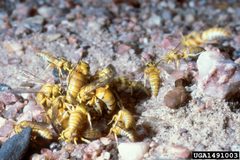
Highly gregarious nesting, with multiple females often establishing burrows in small areas. Males display alternative mating tactics: large males dig for pre-emergent females and physically compete for mates, while small males patrol outside areas to intercept departing females. Both sexes form sleeping clusters on vegetation near nesting areas; cluster composition varies seasonally. Females actively defend nests, including physically ejecting intruders such as ants. Some remain active during extremely hot conditions.
Ecological Role
of leafhoppers; may contribute to of these herbivores. Serves as for nest including velvet ants (Mutillidae) and cuckoo wasps (Chrysididae). Provides pollination services through nectar feeding.
Human Relevance
Presence in urban green spaces, including rooftop gardens, indicates potential value for urban biodiversity conservation. No documented negative impacts; generally not aggressive toward humans.
Similar Taxa
- BembixBoth are sand wasps in tribe Bembicini, but Bembix has different wing venation and structure; Bembecinus has second submarginal and strongly convergent/divergent eyes.
- BicyrtesSimilar size and general appearance, but Bicyrtes lacks the distinctive convergence pattern and has different wing structure.
- MicrobembexShares subtribe Bembecina with Bembecinus, but Microbembex has different nesting and lacks the characteristic .
Sources and further reading
- BugGuide
- Wikipedia
- GBIF taxonomy match
- iNaturalist taxon
- NCBI Taxonomy
- Catalogue of Life
- Bembicid Holdings | Entomology Research Museum
- Bug Eric: Wasp Wednesday: Bembecinus
- Phenotypic correlates of mating success in the sand wasp Bembecinus quinquespinosus (Hymenoptera: Sphecidae)
- A Note on the Rediscovery of the Sand Wasp <i>Bembecinus proximus</i> (Handlirsch) from an Urban Habitat