
Liris partitus
Krombein & Shanks Gingras, 1984
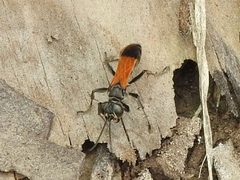
Liris partitus is a of square-headed wasp in the Crabronidae, tribe Larrini. It is known from Central America and North America. As a member of the Liris, it is likely a solitary that hunts crickets as prey, though specific biological details for this species remain poorly documented. The species was described in 1984 as part of a revision of North American Liris.
Pronunciation
How to pronounce Liris partitus: //ˈlaɪ.rɪs pɑːrˈtiː.təs//
These audio files are automatically generated. While they are not always 100% accurate, they are a good starting point.
Identification
Liris partitus can be distinguished from other Liris by reference to male genitalia, female structure, and the size and shape of sensory areas on antennal segments. These characters require microscopic examination, making field identification to species level impractical. The Liris can be separated from similar genera Tachytes and Tachysphex by longer held parallel and straight out from the , larger body size than Tachysphex, and less frenetic movement than Tachytes.
Images
Distribution
Central America and North America. Records indicate presence in Middle America and North America.
Similar Taxa
- Liris argentatusMost abundant North American Liris ; distinguished from L. partitus by male genitalia, female , and antennal sensory area characters requiring microscopic examination
- Liris beataOne of only two Liris consistently found north of the extreme southern U.S.; distinguished from L. partitus by obscure morphological characters requiring reference to the 1984 revision
- TachytesSimilar tribe Larrini member; stockier build, frequently bright green , and extremely rapid movement distinguish it from Liris
- TachysphexSimilar tribe Larrini member; usually smaller, often with red and pointed , and shorter than Liris
- Lyroda subitaSimilar -hunting in Crabronidae; distinguished by large on last tarsal segment (petite feet in Liris) and single mid-ocellus (Liris has reduced lateral ocelli appearing as longitudinal scars)