
Camnula pellucida
(Scudder, 1862)
Clear-winged Grasshopper, Clearwinged Grasshopper, Warrior Grasshopper
Camnula pellucida, the clear-winged , is a medium-sized band-winged grasshopper native to North America. It is a significant agricultural pest, particularly destructive to small grains and rangeland grasses. The exhibits dramatic fluctuations, remaining scarce for years before irrupting to densities exceeding 20 per square yard across thousands of square miles. Adults possess distinctive transparent hindwings and mottled forewings. The species is notable for its migratory , with nymphs marching in cohesive bands and adults forming flying swarms.

Pronunciation
How to pronounce Camnula pellucida: /ˈkam.nʊ.lə pəˈluː.sɪ.də/
These audio files are automatically generated. While they are not always 100% accurate, they are a good starting point.
Identification
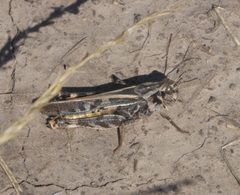
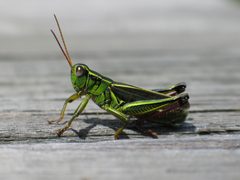
Distinguished from similar band-winged grasshoppers by transparent hindwings and mottled forewings with converging light stripes. Nymphs identified by triangular lateral foveolae, dark transverse bar on , and pronotum with entire carina in early instars becoming notched once in older instars. Hind tibia fuscous in first to third instar, becoming fuscous or tan in fourth and fifth instars. Differs from Melanoplus by wing structure and from other Oedipodinae by combination of transparent hindwings and specific forewing pattern.
Images
Appearance
are medium-sized with yellow to brown coloration. Males average 201 mg live weight (55 mg dry), females 605 mg live weight (105 mg dry). Forewings are mottled with light stripes along the angles that converge near the middle when wings are closed. Hindwings are transparent, giving the its . First instar nymphs are strikingly colored cream, tan, and black. Nymphs have triangular lateral foveolae on the , a dark bar crossing transversely under antennal sockets, and a pronotum with low but uniformly elevated carina.
Habitat
Inhabits northern mixedgrass prairie, bunchgrass prairie, and mountain meadows. Found at elevations from lowland grasslands to 10,800 feet in Colorado (just below timberline). Thrives in areas where cereal crops adjoin short grass oviposition sites. Native grasslands alone do not support large except at margins adjacent to cereal crops.
Distribution
Widely distributed across North America, excluding some southeastern states. Documented in British Columbia, California, Colorado, Massachusetts, Nebraska, and throughout the western United States and Canadian prairies. Resident established from arctic tundra to subalpine meadows.
Seasonality
Early-hatching . begin embryonic growth in summer of deposition, enter at 50% development (Stage 19), requiring 400 of heat. Diapause broken by winter chilling (minimum 70 days at 41°F). Hatching begins when soil temperature reaches 80°F and air temperature 65°F, typically in late spring. Nymphal development completes in 26 days under favorable conditions, extending to 40+ days in poor conditions. appear from July through August depending on elevation and seasonal temperatures.
Diet
Primarily feeds on grasses. Prefers succulent plants including western wheatgrass, reed canarygrass, barley, and wheat. Consumes fescues (Idaho fescue, red fescue), bluegrasses (Sandberg bluegrass, Kentucky bluegrass), wheatgrasses (western wheatgrass, crested wheatgrass), bromes (downy brome, smooth brome, soft brome), and slender hairgrass. Most favorable single- diets include red fescue, bluegrasses, wheat, and crested wheatgrass. Consumes small amounts of forbs such as fireweed and legumes in natural . Nymphs and feed on green forage, with adults consuming approximately 38.7 mg dry forage per day under laboratory conditions.
Host Associations
- Triticum aestivum - food plant role in nutritional ; wheat supports better survival, larger size, and 20x greater than native prairie grasses
- Festuca rubra - food plantmost favorable single- diet
- Poa pratensis - food plantpreferred bluegrass
- Agropyron smithii - food plantwestern wheatgrass, preferred
- Bromus tectorum - food plantdowny brome, consumed
- Epilobium angustifolium - food plantfireweed, minor forb component of diet
Life Cycle
One annually. deposited in short, stout pods (5/8 inch long, 3/16 inch diameter, slightly curved) containing 10-38 eggs (average 28). Eggs are light brown, 4.7 mm long. Embryonic development begins in summer, reaches 50% (Stage 19) before . Diapause broken by winter chilling; post-diapause development at 30°C leads to hatching in ~10 days. Late-season eggs show little embryonic development and poor winter survival. Nymphs pass through five instars. live approximately 60 days; females produce average 8 pods (176 eggs) over reproductive lifespan. Rate of oviposition reaches maximum of approximately one pod every four days during mid-summer, declining as temperatures drop.
Behavior
activity pattern. Aggregates on bare soil, earth clods, and dried cattle for basking in morning. Seeks shelter in protected places at night. Nymphs exhibit marching in cohesive bands when densities are high, moving toward cooler, more humid areas; marches occur during day at temperatures above 20°C, rarely exceeding 300 yards. form flying swarms for , taking off into gentle wind on hot, sunny afternoons, traveling 100-500 yards per at low or high altitudes. Females fly between feeding grounds and beds for oviposition, aggregating on egg beds during heat of day. Males remain on egg beds, attending females and eventually dying there. Flushed flight silent, short (2-8 feet), at heights of 4-6 inches. Exhibits phototactic and thermokinetic reactions leading to and .
Ecological Role
Herbivore consuming significant quantities of grass ; densities of 20 per square yard can consume entire available forage yield. Serves as prey for sandhill cranes and skunks. Subject to of fungal Entomophaga grylli I, which can cause population crashes. Acts as competitor with other grass-feeding grasshoppers in mixed .
Human Relevance
Severe pest of small grains, particularly destructive to spring wheat early in season. on rangeland may devastate 2,000+ square miles of grass forage. Cage plot tests show each nymph per square yard reduces Kentucky bluegrass yield by 5.1 pounds dry weight per acre. Swarms invade vegetable crops, preferentially feeding on onions, lettuce, cabbage, and peas. Subject to chemical suppression using malathion, carbaryl, and other ; applications show 0% mortality in field trials, indicating poor bait acceptance. using has been investigated. Cooperative control programs funded by ranchers, state, and federal governments when densities exceed 8-9 per square yard.
Similar Taxa
- Melanoplus sanguinipesSimilar size and pest status; distinguished by fully developed wings in C. pellucida with transparent hindwings versus different wing structure, and by C. pellucida's earlier hatching and distinct nymphal marching
- Melanoplus bruneriCo-occurs in mountain meadows; distinguished by C. pellucida's transparent hindwings, smaller size, and grass- diet versus M. bruneri's forb preference
- Bruneria brunneaCo-occurs in western mountain meadows; distinguished by C. pellucida's transparent hindwings and band-winged versus B. brunnea's slant-faced and different wing pattern
More Details
Egg water uptake physiology
take in no water for several weeks post-oviposition while embryonic growth progresses; water uptake occurs slowly as anatrepsis completes. In natural , eggs absorb most moisture shortly after snow melt, but embryonic development remains arrested due to low temperatures until spring warming.
Temperature tolerances
most successfully terminated by chilling at 5°C for 70 days. Exposure to -12, -18, and -23°C for 30 days reduces viability by ~10%, 20%, and 50% respectively; -29°C kills all eggs in 3.5-5 hours. can endure very high mid-summer temperatures and below-freezing late autumn temperatures.
Population dynamics
remain virtually unseen for 5-10 years, then increase gradually over 3-4 years, peak for 2-3 years, then crash due to fungal , drought, or temperature extremes. require combination of favorable weather, nutritious plants, and reduced natural enemy pressure.
Sources and further reading
- BugGuide
- GBIF taxonomy match
- iNaturalist taxon
- NCBI Taxonomy
- Catalogue of Life
- Clearwinged Grasshopper
- Grasshoppers of Colorado
- Bruner Slantfaced Grasshopper
- Grasshoppers of Colorado
- Grasshoppers of Colorado
- Bruner Spurthroated Grasshopper
- REPRODUCTIVE BEHAVIOUR OF THE CLEAR-WINGED GRASSHOPPER, CAMNULA PELLUCIDA (ORTHOPTERA: ACRIDIDAE)
- SOME OBSERVATIONS ON THE BIOLOGY AND BEHAVIOUR OFCAMNULA PELLUCIDA(ORTHOPTERA: ACRIDIDAE)
- WATER UPTAKE IN EGGS OF CAMNULA PELLUCIDA (ORTHOPTERA: ACRIDIDAE) AND ITS RELATIONSHIP TO EMBRYOGENESIS
- Development, Survival and Reproduction of Camnula pellucida (Scudder) (Orthoptera: Acrididae) in Relation to Climatic Conditions
- Outbreaks of Camnula pellucida (Scudder), (Orthoptera: Acrididae), in Relation to Native Grasslands and Cereal Crops in Saskatchewan
- Wheat Crops and Native Prairie in Relation to the Nutritional Ecology of Camnula pellucida (Scudder) (Orthoptera: Acrididae) in Saskatchewan
- Humidity Reactions ofMelanoplus bivittatus(Say) andCamnula pellucida(Scudd.) (Orthoptera, Acrididae): Reactions of Normal Grasshoppers
- THE NUTRITIONAL REQUIREMENTS OF GRASSHOPPERS: II. EFFECTS OF PLANT PHOSPHOLIPIDS AND EXTRACTS OF BRAN ON GROWTH, DEVELOPMENT, AND SURVIVAL OF THE GRASSHOPPERS MELANOPLUS BIVITTATUS (SAY) AND CAMNULA PELLUCIDA (SCUDDER)
- SEASONAL PATTERNS OF CADAVER PERSISTENCE AND SPORULATION BY THE FUNGAL PATHOGEN ENTOMOPHAGA GRYLLI (FRESENIUS) BATKO (ENTOMOPHTHORALES: ENTOMOPHTHORACEAE) INFECTING CAMNULA PELLUCIDA (SCUDDER) (ORTHOPTERA: ACRIDIDAE)