
Cordillacris crenulata
(Bruner, 1889)
Crenulated Grasshopper, Crenulatewinged Grasshopper
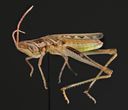
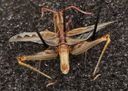
Cordillacris crenulata is a small, slender slant-faced grasshopper native to western North American grasslands. It is distinguished by the diagnostic crenulate (scalloped) brown stripe on each tegmen. The is a feeder on blue grama grass and reaches greatest abundance in shortgrass and desert prairies. Though occasionally present in , its small size and typically low densities limit its economic impact.
Pronunciation
How to pronounce Cordillacris crenulata: /kɔrdɪˈlækrɪs ˌkrɛnʊˈlɑːtə/
These audio files are automatically generated. While they are not always 100% accurate, they are a good starting point.
Identification
Distinguished from similar by the wide, brown, crenulate (scalloped) stripe on each tegmen. Differs from Cordillacris occipitalis by greater contrast in hind coloration (brown dorsally, cream ventrally). Nymphs identifiable by strongly slanted , postocular brown stripe, and distinctive cream-colored wedge on upper edge of lateral pronotal lobe.
Images
Habitat
Shortgrass and desert prairies; heavily grazed upland sites of mixedgrass prairie; bunchgrass prairie and shrub-grass associations westward to Nevada and California. Prefers short stands of grass with blue grama and interspersed bare ground. Does not inhabit tallgrass prairie or dense stands of mid grasses.
Distribution
Western North America: Arizona, Colorado, Nebraska, New Mexico, Wyoming; extends west to Nevada and California in bunchgrass prairie and shrub-grass associations.
Seasonality
Hatching occurs mid-May in desert prairie of Arizona, first half of June in mixedgrass prairie of eastern Wyoming and shortgrass prairie of northcentral Colorado. appear in July in northern mixedgrass and shortgrass prairies.
Diet
grass feeder preferring blue grama (Bouteloua gracilis); in shortgrass prairie of eastern Colorado, blue grama comprised over 99% of crop contents for instars I-IV and over 96% for . Also observed feeding on threadleaf sedge (Carex filifolia) in Montana, needleandthread grass (Hesperostipa comata) in Wyoming, and various grasses including hairy grama, buffalograss, and burrograss in southwest Texas desert prairie.
Host Associations
- Bouteloua gracilis - primary Preferred food plant; over 96% of crop contents in Colorado shortgrass prairie
- Carex filifolia - secondary Observed feeding heavily in Montana
- Hesperostipa comata - secondary Single observation in Wyoming mixedgrass prairie
Life Cycle
laid in summer, develop to embryonic stage 18 by fall, enter , and overwinter in shallow soil (top 0.5 inch). Hatching resumes with spring warming. Nymphal period averages 36 days (range 30-43 days), requiring four instars (rarely five in some females). appear in July and remain in natal . Females produce 2-3 eggs at a time without forming a protective pod; eggs pale yellow, 5-5.5 mm long.
Behavior
Foraging involves agitated crawling with waving and hindlegs shaking until suitable blue grama leaf found; feeds -down, backing toward leaf tip, consuming most leaf width while leaving narrow standing portion for grip. Evasive straight and silent, 2-8 feet distance, peak height ~6 inches, landing facing away from intruder. Daily activity includes basking 1-2 hours after sunrise (perpendicular or diagonal orientation to sun), then pottering, feeding, mating, and ovipositing until temperatures become excessive. Rests in blue grama crowns or on ground litter at night and during hot periods.
Ecological Role
Primary consumer in grassland ; subdominant member of acridid typically comprising 12-18 . Contributes to nutrient cycling through herbivory on blue grama and other grasses. Serves as prey for grassland including birds, spiders, and other arthropods.
Human Relevance
Minor economic pest of rangeland. Attacks blue grama, a preferred livestock forage grass. Comprises 1-4% of some in northern mixedgrass prairie; occasionally reaches densities of 8 per square yard as . Recorded causing considerable damage to threadleaf sedge in Montana and destroying young grasses on newly seeded rangeland in Arizona. Usually not serious due to small size and generally low densities.
Similar Taxa
- Cordillacris occipitalisSimilar size and ; distinguished by spotted rather than crenulate wing pattern and less contrasting hind coloration
- Chorthippus curtipennisPrevious in listing; differs in wing pattern and preferences
More Details
Oviposition behavior
Females oviposit into old crowns of blue grama grass, bracing forelegs and midlegs on adjacent plants while holding hindlegs off ground. One observed oviposition at 45° angle took 26 minutes at soil surface temperatures of 105-112°F; attending male present but did not assist.
Local movement
Average daily displacement of in desert prairie is 16 feet, with maximum recorded displacement of 210 feet. Movement achieved by both (short bouts to 6 feet continuous) and brief evasive .
Population dynamics
Densities usually low (0.05-1 young per square yard), persisting in fluctuating low numbers year-to-year where present. Environmental factors allowing increases in also allow increases in this ; mechanism for occasional dominance unknown.