
Cordillacris occipitalis
(Thomas, 1873)
spotted wing grasshopper, spot-winged grasshopper
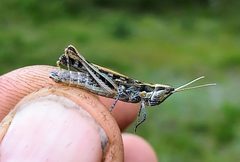
Cordillacris occipitalis is a medium-sized, slant-faced grasshopper native to western North America. It inhabits grasslands including mixedgrass, shortgrass, desert, and bunchgrass prairies. The is an early-hatching , with nymphs emerging five to seven days before the bigheaded grasshopper. It can reach densities in sandy loam soils of the mixedgrass prairie, where it may become the .


Pronunciation
How to pronounce Cordillacris occipitalis: //kɔrˌdɪləˈkrɪs ɒkˌsɪpɪˈtælɪs//
These audio files are automatically generated. While they are not always 100% accurate, they are a good starting point.
Identification
are tan and gray, slim, and medium-sized. are tan or pale and slightly . A conspicuous brown stripe runs from behind the middle of the onto the lateral lobe of the pronotum. The pronotum has a low but distinct carina cut once behind the middle, with low lateral carinae highlighted in ivory. Wings are long, extending to the end of the or slightly beyond; tegmina are spotted brown with an ivory streak above the base of the hindleg. Hind tibiae are pale orange. Nymphs have a strongly slanted , ensiform antennae brown with light tan edges, a conspicuous brown stripe running from behind the compound eye along the side of the and body, and a wide tan stripe with brown spots on the dorsum.
Images
Habitat
Grasslands including mixedgrass, shortgrass, desert, and bunchgrass prairies. Reaches greatest abundance in sandy loam soils of the mixedgrass prairie. Does not inhabit tallgrass prairie or dense stands of mid grasses.
Distribution
Western North America. Recorded in California, Colorado, Nebraska, Nevada, and New Mexico.
Seasonality
Early-hatching . Nymphs emerge five to seven days before bigheaded grasshopper nymphs. Hatching period lasts four weeks. appear in July in northern mixedgrass and shortgrass prairies.
Diet
Feeds on green leaves of grasses. Diet includes at least 15 grass and four sedge species, including blue grama, needleandthread, western wheatgrass, sand dropseed, downy brome, threadleaf sedge, and needleleaf sedge. Rarely consumes forbs or ground litter.
Life Cycle
are laid in the ground at shallow depth (top one-half inch of soil) and develop to embryonic stage 19 by fall, entering . Development resumes in spring. Nymphal period estimated at 22.5 days by calculation, though 36-41 days is considered more realistic. appear in July. Females oviposit in bare ground or at base of grass clumps, forming vertical pods containing two to three eggs.
Behavior
Spends night resting on vegetation or ground. Basks sides perpendicular to sun rays for one to two hours after sunrise, beginning normal activities when air temperature reaches 70°F. Feeds by climbing plants and chewing leaves in a -down position, holding the leaf with front . Evasive are straight, silent, low (2-4 inches), and short (2-4 feet), usually with the wind. When temperatures exceed 90°F air and 120°F soil, climb small shrubs to rest in shade.
Ecological Role
Primary consumer in grassland . Can reach densities of 40 per square yard in conditions, though more commonly 1-5 per square yard. Contributes to grassland herbivory pressure, particularly in sandy loam soils where it may dominate .
Human Relevance
Pest of rangeland grasses, particularly in mixedgrass prairie with sandy loam soils. At densities, causes economic damage to forage. Individual impact estimated at half that of the bigheaded grasshopper due to smaller size.
Similar Taxa
- Cordillacris crenulataSimilar size and preference, but C. crenulata has crenulate or scalloped brown stripes on tegmina rather than spotted pattern, and hatches three to four weeks later.
- Aulocara elliotti (bigheaded grasshopper)Similar feeding habits and , but larger (twice the weight), with different color pattern and shape.