
Aulocara elliotti
(Thomas, 1870)
Big-headed Grasshopper, Bigheaded Grasshopper, Elliott Grasshopper
Aulocara elliotti, commonly known as the big-headed , is a medium-sized slant-faced grasshopper native to western North America. It is a significant economic pest of rangeland grasses, often reaching densities of 20-40 individuals per square yard. The is notable for its relatively large , early spring , and destructive feeding that includes both consumption and cutting of grass leaves. It completes one annually and is frequently the in grasshopper across desert, mixedgrass, shortgrass, and bunchgrass prairies.
Pronunciation
How to pronounce Aulocara elliotti: /ˌaʊloʊˈkɛərə ɛˈliːoʊtaɪ/
These audio files are automatically generated. While they are not always 100% accurate, they are a good starting point.
Identification
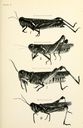
distinguished from similar Aulocara femoratum (whitecrossed ) by: eighth abdominal sternum of female without deep clefts (A. femoratum has two deep clefts); forewings usually extend slightly beyond (A. femoratum wings typically do not reach abdomen end); generally darker, less contrasting coloration. Nymphs distinguished from A. femoratum by drab gray coloration with less contrasting markings versus lighter tan/cream background of A. femoratum. From other slant-faced grasshoppers: combination of large , X-pattern on pronotum, blue hind tibia with black knee, and two black bars on hind .
Images
Appearance
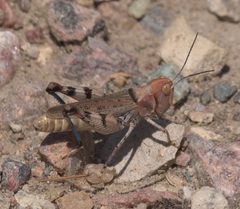
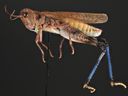
Medium-sized with a disproportionately large and slightly slanted . typically colored gray with fuscous markings. Spotted forewings extend slightly beyond . Pronotum disk marked by distinctive light lines forming an X-pattern, though several pattern variants exist in . Hind with two black bars on upper medial area continuing onto upper marginal area and inner medial area; knee black. Hind tibia medium blue. Females larger than males: live weight 285-663 mg (average 476 mg) versus 131-230 mg (average 189 mg) for males.
Habitat
Inhabits diverse grassland types across western North America including desert prairie, mixedgrass prairie, shortgrass prairie, and bunchgrass prairie. Most abundant in areas with mid grasses (western wheatgrass, needle-and-thread) and short grasses (blue grama). In mixedgrass prairie, prefers sites with abundant western wheatgrass and needle-and-thread. In desert grasslands of Arizona, associated with sparse vegetation on gravelly soils. laid in bare ground patches 1-6 square inches surrounded by short grass .
Distribution
Western North America from southern Canada (Alberta, Saskatchewan) through the Great Plains to central Mexico. Documented in U.S. states: Colorado, Montana, Nebraska, Oklahoma, Wyoming, Arizona, New Mexico, Texas, South Dakota, North Dakota, Idaho. Distribution includes 60% more area than A. femoratum. Center of distribution in Southwest's shortgrass and desert prairies; abundant throughout mixedgrass prairie of Montana and Wyoming.
Seasonality
Early-hatching . begin embryonic development summer of deposition, reach 50% development before winter . Hatching occurs mid-spring (mid-May to early June in northern mixedgrass prairie; earlier in Southwest). Nymphal development 36-42 days. present from late June through August, occasionally into September. One annually.
Diet
Obligate grass feeder. Consumes green leaves of grasses and sedges, including blue grama, western wheatgrass, needle-and-thread, thread-leaf sedge, needleleaf sedge. Also feeds on crested wheatgrass (introduced forage). Known to feed on 22 grass and 2 sedge species. Crop contents average 2.2 plant species per individual. Also consumes ground litter: cut grass leaves (green or dry), seeds, bran, dead grasshoppers. Feeding includes climbing grass blades, turning -down, chewing leaf at various distances from tip, frequently cutting leaf which drops to ground.
Host Associations
- blue grama - primary food plantBouteloua gracilis, heavily grazed when available
- western wheatgrass - primary food plantPascopyrum smithii, preferred nutritious
- needle-and-thread - primary food plantHesperostipa comata
- thread-leaf sedge - food plantCarex filifolia
- needleleaf sedge - food plantCarex duriuscula
- crested wheatgrass - preferred introduced Agropyron cristatum, nutritious forage plant
Life Cycle
Hemimetabolous development with , nymph, and stages. Eggs laid in curved pods 1/2-5/8 inch long, 3/16 inch diameter, with nippled cap, containing 7-9 pale yellow eggs 5.2-5.5 mm long. Eggs deposited at shallow depth (average 3/8 inch) in bare ground. Embryonic development begins summer of deposition, reaches 50% before winter . Diapause broken by 80 days at 37-41°F. Hatching triggered by soil temperatures ≥50°F and 450 heat accumulation. Nymphs emerge over 3-4 week period. Males develop through 4 instars, females through 5 instars. Adults mature in 6-8 days, mate, begin oviposition at 12-20 days. Average adult longevity 20 days in nature; 72 days in protected field cages. : 15 eggs/female in nature, 76-161 eggs/female in cages depending on food quality.
Behavior
Ground-dwelling, . resting on bare ground without vegetation cover. Morning basking : sits perpendicular to sun rays, lowers flexed hindleg to expose , hugs ground surface for ~1 hour beginning 1-2 hours after sunrise. Activity threshold approximately 70°F air temperature and 95°F soil surface temperature. Activities include pottering (intermittent wandering with frequent direction changes), feeding, mating, oviposition. Thermoregulatory behaviors include stilting (raising body on legs) at high temperatures, moving to shade of shrubs when soil exceeds 120°F. Mating involves visual courtship: male approaches quickly, tips hind , waves silently; copulation lasts 40-70 minutes. Female oviposits in bare ground, sweeps soil over hole with hind for ~1 minute post-deposition.
Ecological Role
Primary consumer and significant herbivore in grassland . Reduces grass forage through direct consumption and leaf cutting; cut material becomes litter or food for ground-feeding insects. At densities (20-40 per square yard), can lay land bare causing wind and water erosion. Serves as prey for birds, rodents, and insect . subject to by birds, rodents, beetles, and bee flies (54% mortality fall to spring). and nymphs preyed upon by predators. Contributes to nutrient cycling through consumption and production of and cadavers.
Human Relevance
Major economic pest of western North American rangelands. Destructive at densities as low as one individual per square yard; field cage tests demonstrate reduction of 20 pounds dry forage per acre at this . reduce livestock grazing value and cause soil erosion. Subject to chemical control programs; carbaryl and bran baits used for management. Integrated with using . Preserved specimens found on Glacier, Montana, evidence of historical mass . Studied as model organism for grasshopper , thermal , and rangeland pest management.
Similar Taxa
- Aulocara femoratumCongeneric whitecrossed with overlapping distribution. Distinguished by female eighth sternum with two deep clefts (absent in A. elliotti), wings typically not reaching end, and lighter coloration with more contrasting markings.
- Amphitornus coloradusCo-occurring early-hatching slant-faced grasshopper. Distinguished by striped rather than spotted forewings, different pronotal pattern, and smaller relative to body.
- Ageneotettix deorumCo-occurring early-hatching of similar size. Distinguished by different color pattern, less prominent , and preference for sandier .
More Details
Population Dynamics
irrupt frequently in mixedgrass and desert prairies, often increasing gradually for 3-4 years then increasing 3-4 fold in one year to precipitate . Outbreaks may persist 5+ years before declining due to (e.g., Nosema), , or unknown factors. Hypotheses for outbreak causation include increased physiological vigor, changes in vegetation nutritive composition, and environmental release (favorable weather, reduced enemies).
Thermal Biology
and longevity influenced by plant growth temperatures and rearing temperatures. require 450 (base 50°F) to complete development after . Laboratory studies show eggs held at 37-41°F break diapause in 80 days.
Migration Evidence
Mass documented by discovery of large numbers of preserved on ice of Glacier, Crazy Mountains, Montana. Presumed to have originated from mixedgrass prairie northeast of mountains. Migrants in Arizona recorded traveling 1-7 miles.