
Aulocara femoratum
Scudder, 1899
Whitecrossed Grasshopper, White Cross Grasshopper, White-crossed Grasshopper
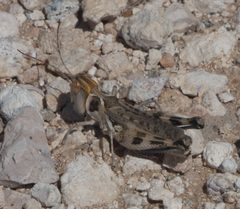
Aulocara femoratum, commonly known as the whitecrossed , is a medium-sized slant-faced grasshopper inhabiting western North American grasslands. It is a grass feeder that occasionally reaches pest status in mixedgrass prairie , though it is typically subdominant to its Aulocara elliotti. The exhibits in both size and feeding , with males being smaller and more mobile while females are larger and more sedentary. It completes one annually, as .
Pronunciation
How to pronounce Aulocara femoratum: //ˌɔːləˈkɑːrə fəˌmɔːˈreɪtəm//
These audio files are automatically generated. While they are not always 100% accurate, they are a good starting point.
Identification
Distinguished from the congeneric bigheaded (Aulocara elliotti) by: (1) the margin of the eighth abdominal sternum in females has two deep clefts (absent in A. elliotti); (2) slightly smaller body size; (3) nymphs are lighter colored with greater contrast between background tan/cream and fuscous markings versus the drab gray of A. elliotti nymphs. The X-figure on the pronotum is present in both . The whitecrossed grasshopper has three dark bands on the hind versus two in A. elliotti.
Images
Habitat
Primarily inhabits mixedgrass prairie where western wheatgrass and needle-and-thread are abundant alongside the short grass blue grama. Also occurs in bunchgrass prairie, shortgrass prairie, and desert prairies. Within mixedgrass prairie, prefers more luxuriant vegetation types with greater abundance of mid grasses. Occupies sites with small bare areas (1–6 square inches) interspersed among grassy vegetation for resting and oviposition.
Distribution
Western North America from southern Canada to central Mexico. Recorded from Colorado, Kansas, Nebraska, Oklahoma, Wyoming, Montana, Arizona, New Mexico, and Texas. Distribution covers approximately 60 percent of that of Aulocara elliotti. More prevalent in Montana than in Wyoming based on survey data.
Seasonality
Intermediate-hatching . begin hatching in the first week of June in the mixedgrass prairie of Montana and Wyoming, approximately 10–14 days after Aulocara elliotti. Nymphs emerge over a two-week period. appear during the first and second weeks of July. Males fledge before females. Mating begins approximately three weeks after female fledging. One annually with in the egg stage.
Diet
General grass feeder exploiting grasses and sedges. In mixedgrass prairie of eastern Wyoming, greatest utilization of western wheatgrass and needleleaf sedge. In desert prairie of southwest Texas, main plants are buffalograss and blue grama. Also consumes burrograss, fall witchgrass, sideoats grama, hairy grama, and Sporobolus . Males ingest more short grasses and sedge; females ingest more mid grasses due to behavioral differences—males walk extensively on the ground while females are more sedentary and climb mid grasses to feed. Has been observed feeding on dry fallen grass and dry cow . Accepts bran .
Host Associations
- Pascopyrum smithii - primary western wheatgrass; major component of diet in mixedgrass prairie
- Hesperostipa comata - primary needle-and-thread; major component of diet
- Bouteloua gracilis - primary blue grama; short grass in preferred
- Carex duriuscula - primary needleleaf sedge; heavily utilized
- Bouteloua dactyloides - primary buffalograss; main in desert prairie
- Scleropogon brevifolius - secondary burrograss
- Digitaria cognata - secondary fall witchgrass
- Bouteloua curtipendula - secondary sideoats grama
- Bouteloua hirsuta - secondary hairy grama
Life Cycle
stage overwinters. Eggs laid in pods 9/16 to 10/16 inch long and 1/4 inch in diameter, inserted vertically 1/8 inch below ground surface to 3/4 inch depth. Pods have unusually strong, thick walls and lack a nipple on the cap (distinguishing them from A. elliotti pods). Egg mass contains 9–11 pale yellow eggs, 4.7–5.2 mm long. Nymphs emerge in mid-spring; males develop through four instars in minimum 30 days, females through five instars in minimum 42 days. appear in early July, mate three weeks after female fledging, and oviposit in summer. One annually.
Behavior
insect spending most of day and all night on the ground. Rests on bare areas of 1–10 square inches interspersed among vegetation, not under . Basks in morning by turning side perpendicular to sun rays and lowering associated hindleg to expose . Morning activity period lasts about two hours. When temperatures rise, employs thermoregulatory : stilting (raising body on legs), crawling onto short vegetation to rest diagonally facing sun, climbing mid grass stems 2–7 inches, or seeking shade. Males walk extensively on ground to find and court females; females more sedentary. Courtship involves hindleg movements resembling stridulation. Flushed covers 2–6 feet at 4–10 inch heights, silent and straight, landing facing away from intruder.
Ecological Role
Primary consumer in grassland . Functions as a herbivore on grasses and sedges. Occasionally becomes locally in , reaching densities up to 13 per square yard, though usually subdominant to Aulocara elliotti or other . Serves as prey for various vertebrate and . Less injurious to vegetation than A. elliotti due to smaller size, lower densities, and thriftier feeding habits with little leaf clipping.
Human Relevance
Occasional pest of rangeland forage grasses. Reaches densities high enough to cause economic damage in certain mixedgrass prairie , though usually subdominant in where A. elliotti is . Less damaging than A. elliotti due to smaller size, lower densities, less frequent occurrence, and minimal leaf clipping. Subject to control efforts when part of damaging assemblages. Consumes bran , making it susceptible to bait-based control methods.
Similar Taxa
- Aulocara elliottiCongeneric with similar X-marked pronotum and general appearance. Distinguished by larger size, two dark bands on hind versus three, absence of deep clefts on female eighth abdominal sternum, earlier hatching, and drab gray nymph coloration versus light tan with high contrast.
- Boopedon nubilumOccurs in similar western grassland and may be found in same . Distinguished by striking (black males, pale brown females), larger size, and different pronotal markings.
More Details
Sexual differences in diet
A study in mixedgrass prairie revealed that male and female whitecrossed grasshoppers have remarkably different diets due to behavioral differences. Males, which walk extensively on the ground seeking females, ingest much larger amounts of short grasses and sedge. Females, being more sedentary and climbing mid grasses to feed, ingest more mid grasses such as western wheatgrass.
Thermoregulatory posture
During basking, the whitecrossed lowers the hindleg on the sun-facing side to expose more of the to solar radiation—a specific posture not observed in all grasshopper .
Egg pod structure
The pod lacks the nipple present on the cap of A. elliotti pods, and has unusually strong, thick walls that may provide protection in its deeper soil placement.