
Boopedon nubilum
(Say, 1825)
ebony grasshopper, black-males grasshopper, plains boopie
Boopedon nubilum is a large slant-faced grasshopper inhabiting western North American grasslands. Males are strikingly black with functional wings, while females are large, pale brown, and typically flightless. The is a specialized grass feeder with documented food preferences that vary geographically. At high densities, it becomes a significant pest of rangeland forage, particularly in the southern mixedgrass and desert prairies of Arizona, New Mexico, and western Texas.

Pronunciation
How to pronounce Boopedon nubilum: /ˈbuːpɛˌdɒn ˈnjuːbɪləm/
These audio files are automatically generated. While they are not always 100% accurate, they are a good starting point.
Identification
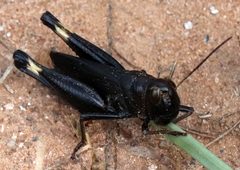
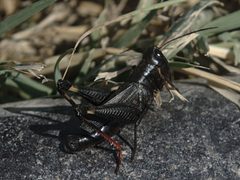
Males are unmistakable: entirely black coloration combined with functional wings and pale blue hind wing disk is diagnostic. Females distinguished from other large grassland by short nonfunctional wings, pale brown coloration with black markings on lateral lobe and hind knee crescents, and large body size. Nymphs identifiable by inverted black triangular marking on pronotal lateral lobe, black stripe on hind , and ringed hind tibia pattern. Distinguished from Boopedon flaviventris by coloration and distribution; from Aulocara species by larger size and structure; from Bruneria brunnea by male coloration and wing characteristics.
Images
Appearance
Males are entirely black with long, functional wings; hind wing disk is pale blue with black area. Hind tibia varies from entirely black to multi-colored combinations of black, red, and cream. Females are large, pale brown grasshoppers with short, nonfunctional wings; a small percentage possess long wings. Female lateral lobe and hind knee crescents are black. Nymphs have a large with moderately slanted tan , black sides with triangular black spot above each base. Pronotum lacks lateral carinae; lateral lobe bears inverted black triangular marking. Hind has nearly solid black stripe on medial area; tibia displays three pale yellow rings alternating with three black rings, sometimes tinged red. Dorsum has wide tan band; venter is pale yellow. Live weight averages 580 mg for young males and 1,452 mg for young females.
Habitat
Inhabits mixedgrass, shortgrass, sand, and desert prairies of western North America. Prefers luxuriant stands within these grassland types. Occupies bunchgrass prairie in northern range and desert prairie in southern range. In Arizona, has been recorded from cultivated areas of corn, sorghum, and wheat. Takes nightly shelter in grass and low shrubs.
Distribution
Western North America from Montana south through the Great Plains to Mexico. Documented in Arizona, Colorado, Nebraska, New Mexico, Oklahoma, Texas, and Wyoming. Core range includes southern mixedgrass and desert prairies of Arizona, New Mexico, and western Kansas, Oklahoma, and Texas.
Seasonality
Late-hatching . hatch late May to first half of June in eastern Colorado and western Kansas, approximately two to three weeks after Melanoplus sanguinipes. At 5,200 feet elevation in Larimer County, Colorado, hatching began June 22. In San Rafael Valley, Arizona (elevation 5,000 feet), hatching delayed until July 22-28, triggered by rainfall soaking eggs. Nymphal development requires 27-40 days depending on location and conditions. emerge mid-July to mid-August in Colorado; delayed in Arizona due to late hatch but rapid nymphal development produces adults by mid-August.
Diet
Specialized grass feeder. Crop analysis from southwestern Texas desert prairie: 57% blue grama, 17% buffalograss, 9% common fallwitchgrass, 8% bristlegrass, 6% common burrograss, 3% hairy grama. From Nebraska North Platte Agricultural Experiment Station: 72% western wheatgrass, 7% needle-and-thread, 5% blue grama, 4% sand dropseed, 4% prairie sandreed, 3% threadleaf sedge, 1% witchgrass. Demonstrates geographic variation in preferred forage: heavily consumes western wheatgrass in Nebraska but refuses it in Wyoming food preference tests. Two-choice tests show preference for blue grama, needle-and-thread, downy brome, and young wheat; refusal of western wheatgrass, crested wheatgrass, Kentucky bluegrass, foxtail barley, and cultivated barley. Feeds by climbing grass leaves, biting through, holding cut section with front , and consuming entirely without clipping and wasting.
Life Cycle
overwinter in large pods (1 7/8 to 2 inches long, 3/16 to 1/4 inch diameter) deposited in bare soil between grass clumps and sod during summer and autumn. Eggs dark brown, 6.5-7.7 mm long, covered by female secretions. Five nymphal instars. Ovarian development observed 21 days after . One caged female produced first pod of 44 eggs at 40 days of age, totaling three pods and 134 eggs over 62-day adult lifespan. Females in San Rafael Valley produced multiple pods containing 38-62 eggs each.
Behavior
activity pattern with basking beginning shortly after sunrise, continuing up to two hours. Basking posture: turns side perpendicular to sun, does not lower hindleg to expose . Late nymphal females engage in stirring, preening , vibrating hindlegs, and intermittent short walks (2-12 inches) after basking. When soil temperatures reach 90°F and air 80°F (~9 a.m.), seeks shade by facing directly into or away from sun, or crawling into grass clumps or shrub . Feeding observed only in evening (5:30-6:30 p.m.) in limited observations. Enters shelter shortly before sunset. Males capable of swift, strong, straight, silent flushed at approximately 12 inches height for 6-9 feet. Whole disperse or migrate by when food depleted; observed rapid across low hills in Arizona during drought years.
Ecological Role
Primary consumer in grassland . At high densities, contributes significantly to grass forage removal—documented consumption of 600 lb dry weight per acre in Arizona. Normally subdominant numerically in assemblages, but large size may exceed total of smaller, more numerous . Serves as for parasitic dipteran Neorhynchocephalus sackenii, which can significantly depress by preventing development and killing females.
Human Relevance
Economic pest of rangeland forage at high densities. Injurious typically involve mixed- with B. nubilum as one of several abundant species. Major irruptions documented in southern mixedgrass and desert prairies, persisting multiple consecutive years. Notable : 1955 western Oklahoma (four including B. nubilum); 1973-1979 western Oklahoma (1.5 million acres); 1956 San Rafael Valley, Arizona (46 young per square yard mixed assemblage). application can drastically reduce . Subject to management in rangeland control programs.
Similar Taxa
- Boopedon flaviventrisSympatric in Arizona; distinguished by coloration and relative abundance in mixed
- Aulocara elliottiCo-occurs in ; smaller size, different structure, and coloration distinguish it
- Aulocara femoratumSmaller, different wing and color pattern, though can be locally abundant with B. nubilum
- Bruneria brunneaSlant-faced grasshopper in same ; males lack striking black coloration and blue hind wing disk of B. nubilum
- Melanoplus speciesOften co- in ; distinguished by spur-throated , different wing structure, and nymphal characteristics