
Boopedon
Thomas, 1870
boopies, ebony grasshopper (B. nubilum), yellow-belly boopie (B. flaviventris), prairie boopie (B. gracile), short-winged boopie (B. auriventris)
Species Guides
4- Boopedon auriventris(short-winged boopie)
- Boopedon flaviventris(yellow-belly boopie)
- Boopedon gracile(Prairie Boopie)
- Boopedon nubilum(ebony grasshopper)
Boopedon is a of grasshoppers in the Acrididae, commonly known as boopies. The genus contains at least eight described distributed across western North American grasslands. Species in this genus are notable for pronounced , with males typically winged and darkly colored while females are often larger, flightless, and paler. Several species, particularly B. nubilum (the ebony ), are significant rangeland pests capable of reaching densities.
Pronunciation
How to pronounce Boopedon: //buːˈpɛ.dɒn//
These audio files are automatically generated. While they are not always 100% accurate, they are a good starting point.
Identification
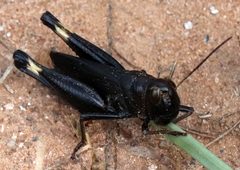
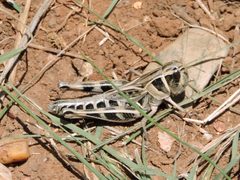
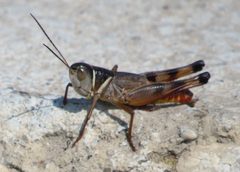
Males are strikingly black with functional wings; hind wing disk pale blue with black area. Females are large, pale brown to dark brown or black, with short nonfunctional wings (rare individuals with long wings). Hind tibia coloration variable: entirely black, or black and red, or cream-black-red. Nymphs identifiable by large with moderately slanted , tan face with black sides, triangular black spot above base, pronotum without lateral carinae but with light line indicating position, lateral lobe with inverted black triangular marking covering upper two-thirds or less, hind with nearly solid black stripe on medial area, tibia with three pale yellow and three black rings sometimes tinged red, wide tan dorsal band, pale yellow venter.
Images
Habitat
Western North American grasslands including mixedgrass prairie, shortgrass prairie, sand prairie, and desert prairie. Occupies more luxuriant stands within these . Also recorded from cultivated areas of corn, sorghum, and wheat in Arizona.
Distribution
Western North America from Montana to Mexico. Documented in Arizona, Arkansas, Colorado, Kansas, New Mexico, Oklahoma, Texas, Wyoming.
Seasonality
Late-hatching . hatch late May to first half of June in eastern Colorado and western Kansas, approximately two to three weeks after Melanoplus sanguinipes. At 5,200 feet elevation in Larimer County, Colorado, hatching began 22 June. In southern Arizona at 5,000 feet, hatching delayed until July following substantial rainfall. emerge mid-July to late July in northern range, August in southern Arizona.
Diet
Strictly grass-feeding. Documented consumption includes blue grama, buffalograss, common fallwitchgrass, bristlegrass, common burrograss, hairy grama, western wheatgrass, needleandthread, sand dropseed, prairie sandreed, threadleaf sedge, witchgrass, downy brome, young wheat. Shows feeding preferences in choice tests, refusing western wheatgrass, crested wheatgrass, Kentucky bluegrass, foxtail barley, and young cultivated barley.
Life Cycle
overwinter and hatch the following summer. Nymphal development through five instars; minimum 40 days in eastern Colorado, as rapid as 27 days in Arizona. Females produce multiple egg pods containing 38–62 eggs each; one captive female produced three pods totaling 134 eggs over 62-day lifespan. Pods deposited in bare soil between grass clumps and sod during summer and autumn. Large pods 1 7/8 to 2 inches long, 3/16 to 1/4 inch diameter; dark brown eggs 6.5–7.7 mm long.
Behavior
activity pattern: shelters in grass and low shrubs at night, emerges shortly after sunrise to bask perpendicular to sun without lowering hindleg, basking continues up to two hours followed by stirring, preening, leg vibrating, and intermittent . Takes evasive action when soil temperature reaches 90°F and air 80°F, either facing directly into or away from sun or seeking shade in vegetation. Feeding observed in evening 5:30–6:30 p.m. Males capable of strong, swift, straight silent at approximately 12 inches height for 6–9 feet. Females usually flightless; disperse by walking, with documented across low hills to new forage sources when denuded.
Ecological Role
Herbivore in grassland . At high densities, contributes to that significantly reduce grass forage . Normally subdominant numerically in assemblages but may exceed smaller in total biomass due to large size. Serves as for parasitic dipteran Neorhynchocephalus sackenii, which can significantly depress .
Human Relevance
Economic pest of rangeland forage. Injurious usually involve where B. nubilum is one of several abundant . Documented in 1955 western Oklahoma (four including B. nubilum), 1956 and 1965–1966 San Rafael Valley Arizona, and 1973–1979 western Oklahoma on 1.5 million acres. Capable of consuming cultivated corn, sorghum, and wheat. Subject to rangeland management programs including application.
Similar Taxa
- Bruneria brunneaSame (Gomphocerinae), distinguished by different coloration and wing structure
- Aulocara femoratumCo-occurs in same and ; Aulocara are smaller with different pronotal structure
- Melanoplus speciesCo-occur in but belong to different (Melanoplinae), typically with different body shape and hind wing coloration