
Boopedon flaviventris
Bruner, 1907
yellow-belly boopie
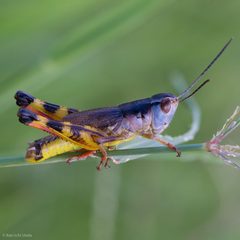
Boopedon flaviventris, commonly known as the yellow-belly boopie, is a slant-faced grasshopper in the Acrididae. The occurs in Central America and North America, with confirmed records from Arizona and southwestern Mexico. It belongs to the Boopedon, which includes other grassland-dwelling species associated with western North American prairies. The refers to the yellow coloration characteristic of this species.
Pronunciation
How to pronounce Boopedon flaviventris: //buːˈpiːdɒn flæˌvɪˈvɛntrɪs//
These audio files are automatically generated. While they are not always 100% accurate, they are a good starting point.
Identification
The specific epithet flaviventris (yellow belly) indicates a diagnostic yellow surface that distinguishes this from . In the Boopedon, B. flaviventris can be separated from the similar B. nubilum (ebony ) by coloration: B. nubilum males are strikingly black with pale blue hind wing disks, while B. flaviventris has yellow abdominal coloration. B. nubilum females are pale brown to dark brown or black with short nonfunctional wings. The yellow belly of B. flaviventris provides a clear visual distinction from the darker B. nubilum.
Images
Habitat
Specific information for B. flaviventris is not documented in available sources. Related in the Boopedon inhabit grasslands including mixedgrass, shortgrass, sand, and desert prairies, often occupying more luxuriant stands within these habitats.
Distribution
Confirmed distribution includes Arizona in the United States and southwestern Mexico. The is recorded from Central America and North America broadly, with GBIF distribution records specifying Arizona and Mexico Southwest.
Behavior
A 1956 study in San Rafael Valley, Arizona recorded B. flaviventris as part of a with an estimated of 13.4 young per square yard. This observation indicates the can reach high local densities and participates in irruptive similar to other Boopedon species.
Similar Taxa
- Boopedon nubilumB. nubilum (ebony ) is the most similar and overlaps in range. B. flaviventris is distinguished by its yellow belly versus the black or pale brown coloration of B. nubilum males and females respectively. B. nubilum males have functional wings with pale blue hind wing disks, while B. flaviventris has yellow coloration.
More Details
Taxonomic note
Authority cited as Bruner, 1907 in Catalogue of Life and GBIF, though NCBI lists Bruner, 1904. The is classified in tribe Amblytropidiini within Gomphocerinae.
Population ecology observation
During a 1956 irruption in San Rafael Valley, Arizona, B. flaviventris was more abundant than B. nubilum in the sampled (13.4 vs. 4.2 young per square yard), suggesting it can be numerically in certain conditions.