
Aulocara
Scudder, 1876
slant-faced grasshoppers
Species Guides
2- Aulocara elliotti(Big-headed Grasshopper)
- Aulocara femoratum(Whitecrossed Grasshopper)
Aulocara is a of slant-faced grasshoppers in the Acrididae, comprising at least three described distributed across western North America. The genus includes economically significant rangeland pests, notably Aulocara elliotti (big-headed ), which can reach densities and cause substantial damage to grass forage. Species in this genus inhabit diverse grassland from southern Canada to central Mexico.
Pronunciation
How to pronounce Aulocara: /ˌaʊloʊˈkɑrə/
These audio files are automatically generated. While they are not always 100% accurate, they are a good starting point.
Identification
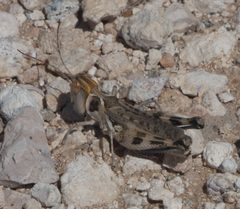
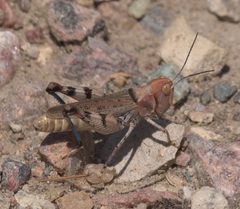
Members of Aulocara possess the characteristic slant-faced of Gomphocerinae, with angled backward from the vertical plane. Aulocara elliotti is distinguished by a relatively large , gray coloration with fuscous markings, and forewings with spotted patterns extending slightly beyond the . The pronotal disk typically displays light lines forming an X-pattern. Hind bear two black bars on the upper medial area, continuing onto the upper marginal area and inner medial area, with black knees. The hind tibia is medium blue. Aulocara femoratum (white-crossed grasshopper) differs in having two deep clefts on the margin of the eighth abdominal sternum in females, versus the smooth margin in A. elliotti.
Images
Habitat
in this inhabit a variety of grassland types including desert grassland, mixed-grass prairie, shortgrass prairie, and bunchgrass prairie. They require open terrain with bare ground for basking, oviposition, and ground-foraging activities. Vegetation consists primarily of native grasses and sedges.
Distribution
Western North America, ranging from southern Canada through the western United States to central Mexico. Documented in Colorado, Kansas, Montana, Nebraska, Wyoming, Arizona, and Mexico Northeast.
Seasonality
Early-hatching with beginning embryonic development in summer of deposition and reaching 50% development before winter . Nymphs emerge in mid-spring when soil temperatures rise above 50°F, completing development in 36-42 days. present from late spring through summer, with one annually.
Diet
Graminivorous. Aulocara elliotti feeds primarily on green leaves of grasses and sedges, including blue grama, western wheatgrass, needle-and-thread, thread-leaf sedge, and needleleaf sedge. Crested wheatgrass is a preferred introduced . Also consumes ground litter including cut grass leaves, seeds, bran, and even dead grasshoppers. Documented to feed on at least 22 grass and 2 sedge species.
Host Associations
- blue grama - food plantBouteloua gracilis, heavily grazed when available
- western wheatgrass - food plantPascopyrum smithii, preferred
- needle-and-thread - food plantHesperostipa comata
- thread-leaf sedge - food plantCarex filifolia
- needleleaf sedge - food plantCarex eleocharis
- crested wheatgrass - food plantAgropyron cristatum, introduced forage, preferred and nutritious
Life Cycle
laid in early summer at shallow depth (average 3/8 inch), enclosed in tough pods containing 7-9 eggs. Embryos develop to 50% completion before entering winter . Diapause broken after exposure to 37-41°F for approximately 80 days. Hatching triggered by soil temperatures rising to 50°F and accumulation of 450 (base 50°F). Nymphal development requires 36-42 days; males typically have 4 instars, females 5 instars. live 20-72 days depending on conditions; females become receptive to mating at 6-8 days old and deposit first egg pods at 12-20 days old. Average 15-116 eggs per female under field conditions, up to 161 eggs in optimal laboratory conditions.
Behavior
Ground-dwelling insects with activity strongly influenced by temperature and light. Daily routine includes basking perpendicular to sun rays one to two hours after sunrise, becoming active around 70°F air temperature and 95°F soil surface temperature. Engage in pottering (intermittent wandering with frequent direction changes), feeding, mating, and oviposition during active periods. When temperatures exceed 90°F air and 120°F soil, individuals stilt (raise bodies on legs) or move to shade. Resume activity as temperatures decline in afternoon, with evening basking two to three hours before sunset. Night spent resting uncovered on ground. capable of evasive 2-7 feet at 4-12 inches height; evidence of longer movements up to 1-7 miles. Courtship involves visual cues with males approaching females and displaying by tipping hind and waving . Copulation lasts 40-70 minutes. Females sweep soil over oviposition holes using hind as brushes.
Ecological Role
Significant primary consumer in grassland . High- can substantially reduce grass , altering vegetation structure and potentially exposing soil to erosion. Serves as prey for diverse including birds, rodents, beetles, and bee flies. experience 54% mortality between fall and spring. Subject to natural including Nosema that can decimate populations.
Human Relevance
Major economic pest of rangeland grasses in western North America. Aulocara elliotti often dominates , reaching densities of 20 per square yard in mixed-grass prairie and 40 per square yard in desert grassland. Individual consumption estimated at equivalent to 20 pounds dry forage per acre per per year. Damage occurs through direct consumption and leaf-cutting that drops forage to ground. Outbreaks can persist 5+ years, reducing livestock grazing value and promoting erosion. Subject to chemical control programs and using .
Similar Taxa
- Amphitornus coloradusAlso a slant-faced grasshopper in Gomphocerinae with similar preferences; distinguished by different color patterns and pronotal markings
- MelanoplusSpur-throated grasshoppers in different (Melanoplinae); distinguished by vertical , presence of spur on , and different hind leg coloration
- AeropedellusSlant-faced grasshopper in same ; Aulocara distinguished by larger size in A. elliotti and distinctive pronotal X-pattern
More Details
Population Dynamics
exhibit irruptive dynamics, gradually doubling annually for 3-4 years before increasing 3-4 fold in a single year. Outbreak hypotheses include increased physiological vigor, vegetation nutritional changes, and environmental release (favorable weather, reduced enemies). Mass evidenced by specimens preserved on Glacier in Montana's Crazy Mountains, presumably from mixed-grass prairie northeast of mountains.
Research History
Extensively studied A. elliotti was first described by Thomas in 1870. Research by Anderson and Hastings (1966) established laboratory rearing methods. studies by Hastings and Pepper (1964) documented fluctuations. Embryonic development studied by Van Horn (1966). Thermal requirements for development investigated by Kemp and Sanchez (1987).