
Aeropedellus
Hebard, 1935
slant-faced grasshoppers
Species Guides
2- Aeropedellus arcticus(Arctic Grasshopper)
- Aeropedellus clavatus(Club-horned Grasshopper)
Aeropedellus is a of slant-faced grasshoppers in the Acrididae, established by Hebard in 1935. The genus contains more than 20 described distributed across northern North America and parts of Eurasia, including Russia. Species occupy diverse ranging from lowland grasslands to alpine tundra. The best-studied species, Aeropedellus clavatus (the clubhorned ), is a significant pest of rangeland grasses in western North America.
Pronunciation
How to pronounce Aeropedellus: //ˌɛəroʊpɛˈdɛləs//
These audio files are automatically generated. While they are not always 100% accurate, they are a good starting point.
Identification
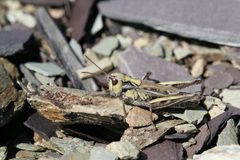
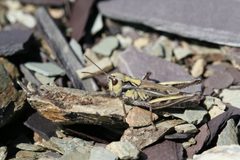
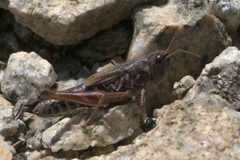
Members of this are characterized by the slant-faced typical of Gomphocerinae. Aeropedellus clavatus is distinguished by with six enlarged, dark terminal segments. have a dark streak running from beneath the to the base, with a cream or light tan vertical band to this streak. The pronotum has low but distinct and lateral carinae cut once by a behind the middle; lateral carinae converge near the middle of the prozona. Nymphs have strongly slanted and oblong, distinct lateral foveolae.
Images
Habitat
occupy grasslands, prairies, and mountain meadows. Aeropedellus clavatus inhabits mixedgrass and bunchgrass prairies, mountain meadows and parks, and alpine tundra. In Colorado, occur above timberline at 13,600 feet in rocky, grass-sedge . In the Canadian prairie provinces, it occurs on dry, somewhat sandy areas south of the forest.
Distribution
The occurs in northern North America and Eurasia. Aeropedellus clavatus ranges from western Canada and the northern United States southward to Arizona and New Mexico in mountainous areas. Aeropedellus reuteri is known from southern Krasnoyarsk Region, Republic of Khakassia, and Irkutsk Region in Russia. GBIF records indicate additional occurrences in the Caucasus, Altay, Alaska, Austria, and Buryatiya.
Seasonality
Aeropedellus clavatus is a very early-hatching ; nymphs emerge approximately ten days before bigheaded grasshopper nymphs, or about the first week of May in eastern Wyoming. The hatching period lasts three to four weeks. In alpine above timberline in Colorado, hatching begins mid to late June depending on altitude and seasonal temperatures.
Life Cycle
Aeropedellus clavatus has four nymphal instars. Nymphal development is completed in approximately 30 days on plains and 42 days in alpine . The has one annually in plains habitats; alpine may require two or possibly three winters for development. Females oviposit among grass or sedge roots. Egg pods are 10–13 mm long and 3.5–4.0 mm in diameter, oriented vertically, containing five to eight eggs arranged in two rows inclined about 30 degrees from vertical.
Behavior
Males of Aeropedellus clavatus stridulate loudly by vibrating the hind against a raised on the tegmen. Females do not fly; their wings are short and do not reach the middle of the . Males have either short or long wings, with long-winged males flying extensively in plains . When escaping , females hop away while males hop and then prance—taking small, repeated hops without appreciable progression.
Human Relevance
Aeropedellus clavatus is a significant agricultural pest. may reach 20 per square yard on Canadian rangeland, causing severe damage to forage grasses. The has attacked seedling cereals; a 1936 in Saskatchewan destroyed 300 acres of wheat. It is frequently abundant in infesting rangeland in Montana and North Dakota.
Similar Taxa
- AgeneotettixBoth are Gomphocerinae grasshoppers with slant-faced ; Aeropedellus is distinguished by in A. clavatus and different pronotal carinae structure.
- AmphitornusShares Gomphocerinae and similar grassland ; Aeropedellus differs in antennal structure and markings.
More Details
Taxonomic note
The was established by Morgan Hebard in 1935. -level includes at least 22 described species, though detailed biological information is available for only a few, particularly A. clavatus.
Research gaps
Courtship and have not been studied in Aeropedellus clavatus. Detailed information for most other in the is lacking.
Sources and further reading
- BugGuide
- Wikipedia
- GBIF taxonomy match
- iNaturalist taxon
- NCBI Taxonomy
- Catalogue of Life
- Grasshoppers of Colorado
- Clubhorned Grasshopper
- Grasshoppers of Colorado
- Grasshoppers of Colorado
- Grasshoppers of Colorado
- Species Records and Accounts
- AEROPEDELLUS REUTERI (MIRAM, 1907) (ORTHOPTERA: ACRIDIDAE: GOMPHOCERINI) – A RARE GRASSHOPPER FROM SOUTH SIBERIA
- Life History of Aeropedellus clavatus (Orthoptera: Acrididae) in the Alpine Tundra of Colorado