
Ageneotettix
McNeill, 1897
slant-faced grasshoppers
Species Guides
3- Ageneotettix brevipennis(short-wing big-headed grasshopper)
- Ageneotettix deorum(white-whiskered grasshopper)
- Ageneotettix salutator
Ageneotettix is a of slant-faced grasshoppers in the Acrididae, established by McNeill in 1897. The genus contains at least three described : A. brevipennis, A. deorum, and A. salutator. Species in this genus are characteristic inhabitants of western North American grasslands, where they serve as important components of . Ageneotettix deorum, the white-whiskered grasshopper, is particularly notable for its widespread distribution and frequent dominance in mixedgrass prairie , where it has been recorded contributing over 50% of total grasshopper in some locations.
Pronunciation
How to pronounce Ageneotettix: //æˌdʒɛn.i.oʊˈtɛt.ɪks//
These audio files are automatically generated. While they are not always 100% accurate, they are a good starting point.
Identification
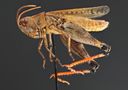
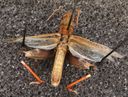
Ageneotettix is distinguished from other slant-faced grasshopper (Gomphocerinae) by structural characters of the pronotum, , and male genitalia. The genus lacks the lateral pronotal carinae present in some related genera. A. brevipennis is immediately recognizable by its short-winged condition. A. deorum can be separated from sympatric slant-faced by its characteristic coloration and pattern, including the pale whisker-like markings on the that give rise to its . Accurate identification to species typically requires examination of males, particularly the structures of the terminalia.
Images
Appearance
Members of Ageneotettix are slant-faced grasshoppers ( Gomphocerinae) with the characteristic oblique facial profile typical of this group. The pronotum lacks lateral carinae, and the are relatively short. within the show variation in wing development: A. brevipennis has abbreviated wings as indicated by its specific epithet. The genus is distinguished from related slant-faced genera by combinations of structural characters including details of the pronotal shape, antennae form, and male genitalia. Nymphs can be recognized by the degree of facial slope, general color pattern, shape of antennae and foveolae, and the extent of curving of the lateral carinae of the pronotum.
Habitat
of Ageneotettix inhabit grassland of western North America. A. deorum is particularly associated with mixedgrass prairie, where it is a characteristic and often . The occurs in northern mixedgrass prairie, shortgrass prairie, and desert grassland . Specific microhabitat preferences vary by species, but members generally occupy the ground layer and lower vegetation strata of open grasslands with relatively sparse cover.
Distribution
The is distributed across western and central North America. Records indicate presence in Arizona, Colorado, Illinois, Indiana, and Michigan. A. deorum has the widest distribution, ranging across the Great Plains and intermountain West. A. brevipennis and A. salutator have more restricted ranges. The genus is absent from the Pacific coastal states and from the southeastern United States.
Seasonality
A. deorum belongs to the early hatching group of grasshoppers, with nymphs emerging in mid-spring. are present from summer through fall, with the timing varying by latitude and elevation. In northern mixedgrass prairie, hatching typically occurs several weeks after the very early hatching . The seasonal cycle is completed in one year, with in the soil.
Diet
A. deorum is a grass-feeding . In mixedgrass prairie, it feeds predominantly on grasses including blue grama and other graminoid . The species has been documented as a pure grass feeder, with crop analyses showing nearly exclusive consumption of grass material. Food preference tests indicate selectivity among available grass species.
Life Cycle
The is , with in the soil and hatching in spring. Nymphs develop through five instars before becoming . The nymphal period typically spans 40-50 days under favorable conditions. Adults reproduce in summer and early fall, with females depositing egg pods in the soil. Egg pods are laid among grass roots or in bare ground, with depth and placement varying by soil conditions.
Behavior
A. deorum is a ground-dwelling () that forages primarily at the base of grasses. Individuals bask in morning sun to elevate body temperature before becoming active. The species is capable of for , though it is not among the strongly migratory grasshopper species. Males produce species-specific acoustic signals by stridulation for mate attraction and recognition. When disturbed, individuals may jump or fly short distances to escape.
Ecological Role
A. deorum is frequently the in of northern mixedgrass prairie, sometimes comprising over 50% of total grasshopper abundance. As a primary consumer, it transfers significant energy from grasses to higher . The serves as prey for birds, small mammals, and insect and . Its influence competitive interactions within grasshopper and contribute to nutrient cycling through herbivory and .
Human Relevance
A. deorum is an important rangeland pest due to its abundance and grass-feeding habits. At high densities, it contributes to forage loss in livestock grazing lands. The species was a major component of damaging in western Oklahoma in 1955 and has been implicated in other historical irruptions. Its economic impact is often in combination with other abundant grass-feeding species such as Aulocara elliotti. Management of A. deorum is a component of programs for western rangelands.
Similar Taxa
- AulocaraBoth are slant-faced grasshoppers in tribe Aulocarini, but Aulocara typically have more pronounced facial markings and different pronotal proportions. A. elliotti is often codominant with A. deorum in mixedgrass prairie.
- AmphitornusAnother slant-faced in Gomphocerinae with overlapping distribution, but distinguished by differences in pronotal structure and color pattern, particularly the striped appearance of A. coloradus.
- PsoloessaSlant-faced of similar size and preference, but with different seasonal timing and structural details of the and pronotum.
More Details
Taxonomic history
The was established by McNeill in 1897. The type is A. deorum (originally described as Orphula deorum by Scudder in 1876). The genus has remained relatively stable taxonomically, with three currently recognized species.
Population ecology
A. deorum exhibits high and can achieve densities exceeding 26 individuals per square yard during . fluctuations are influenced by weather, , and . The tends to maintain status in over multiple years when conditions remain favorable.