
Ageneotettix deorum
(Scudder, 1876)
white-whiskered grasshopper, white whiskers grasshopper, sand grasshopper
Ageneotettix deorum is a medium-sized slant-faced grasshopper widely distributed across North American grasslands. It is frequently the in mixedgrass and bunchgrass prairie , reaching densities of 25 per square yard. The exhibits early-season hatching with nymphal development spanning 40–48 days. Adults are ground-dwelling, herbivores that feed on grasses and ground litter. show sensitivity to weather and , with outbreaks typically building over 3–5 years followed by sudden crashes.
Pronunciation
How to pronounce Ageneotettix deorum: /əˌdʒɛn.i.oʊˈtɛtɪks diˈɔːrəm/
These audio files are automatically generated. While they are not always 100% accurate, they are a good starting point.
Identification
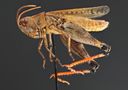
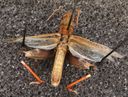
are medium-sized, reddish-brown with fuscous markings. The has a slightly slanted . are with the side light gray or whitish—this character provides the . Wings are long, ranging from just short of to extending beyond the ; tegmina are speckled brown. Hind tibiae are red to orange with the end usually black. The terminal inner spur of the hind tibia is diagnostic: elongated, 1.5 times as long as the other inner spur. Hind have black knees and three fuscous marks on the upper marginal area, with the middle mark triangular. Nymphs show distinctive coloration: black along front and side of head, side of , side of abdomen, and medial area of hind femur; dorsum light tan with few brown spots. Instars 2–5 have a light tan patch below the and on the lateral lobe.
Images
Habitat
Mixedgrass prairie, bunchgrass prairie, and tallgrass prairie. In tallgrass regions, highest densities occur on high ridges with blue grama or in grazed pastures of smooth brome or Kentucky bluegrass. Also inhabits shortgrass prairie, sand prairies, and disturbed areas including roadsides and crop borders. Altitudinal range extends to approximately 5,750 feet; absent above 7,500 feet.
Distribution
Widely distributed in grasslands of North America from southern Canada to northern Mexico, ranging east of the Rocky Mountains to the Atlantic Coast. Documented in Arizona, Colorado, Illinois, Indiana, Michigan, Montana, Nebraska, North Dakota, South Dakota, Wyoming, Kansas, Oklahoma, Texas, Iowa, and New Mexico.
Seasonality
Early-hatching . begin embryonic growth in summer, at 50% development (stage 19 embryo), and resume development in spring. Hatching occurs mid-spring, approximately simultaneous with Aulocara elliotti. Hatching period lasts 4–6 weeks. appear from mid-July in northern locations to earlier dates in southern portions of range. One annually.
Diet
Feeds primarily on grasses and sedges, including blue grama, western wheatgrass, needleandthread, Kentucky bluegrass, threadleaf sedge, and needleleaf sedge. Consumes grasses in proportion to their abundance. Also feeds extensively on ground litter including felled leaves, seeds, livestock , and dead insects. Laboratory tests indicate preference for wheat and Kentucky bluegrass over native grasses. Forbs consumed only in small amounts.
Life Cycle
are deposited in shallow, horizontally-oriented pods just below ground surface, typically in blue grama or buffalograss sod. Pods contain 3–5 eggs (average 4), are 10–12 mm long, tough and curved with a slanted cap. Eggs are 5.0–5.3 mm long, pale yellow to whitish. Embryonic development begins in summer, enters at stage 19, resumes in spring. Nymphs develop through 5 instars (males occasionally 4, females occasionally 6) over 40–48 days. Females take longer than males to complete development. Preoviposition period approximately 14 days. Females deposit successive clutches at approximately 3-day intervals.
Behavior
and ground-dwelling. At night, rests on bare ground or litter under grass . Morning basking occurs 1–2 hours after sunrise on the east side of grass crowns, body perpendicular to sun rays. Basking resumes 2–3 hours before sunset on west side of grass crowns. Normal daytime activities include pottering (intermittent wandering with frequent direction changes), feeding, mating, and oviposition. Activity slows when air temperatures reach 90°F or soil surface temperatures reach 120°F; individuals then seek shade of small shrubs. Evasive is straight, silent, low (3–6 inches), and short (3–6 feet). flights to high altitudes and urban areas documented, but no migrating swarms observed. Courtship involves males approaching moving females and using visual signals (raising and lowering hind and ). Copulation lasts approximately 5 minutes. Ovipositing females attract multiple attending males; after oviposition, female covers hole with litter and soil using hindlegs as brushes. Third and fourth instar nymphs show reduced feeding, increased antipredator , and reduced general activity in presence of lycosid spider ; fifth instars and show no significant behavioral response to spider predators.
Ecological Role
herbivore in mixedgrass prairie , frequently comprising 50% or more of . Contributes to overall forage damage in concert with other grass-feeding grasshoppers. Prey for lycosid spiders, birds, rodents, and insects; subject to size-selective with vulnerability decreasing through nymphal development. preyed upon by birds, rodents, beetles, and bee flies.
Human Relevance
Significant pest of rangeland grasses. Economic damage occurs primarily through contribution to cumulative defoliation by grass-feeding . densities (25+ per square yard) can remove all green vegetation from pastures by early summer. Smaller body size (approximately half the weight of Aulocara elliotti) presumably reduces per-capita damage relative to larger . Subject to rangeland pest management programs including biological and chemical control.
Similar Taxa
- Aulocara elliottiSimilar , distribution, and hatching time; distinguished by larger size (males ~580 mg vs. ~110 mg live weight), different pronotal structure, and lack of whitish .
- Orphulella speciosaOverlaps in tallgrass prairie; distinguished by smaller size, strongly slanted , and different wing proportions.
- Melanoplus angustipennisCo-occurs in sand prairie ; distinguished by spur-throated , diet including forbs, and different coloration.
Sources and further reading
- BugGuide
- Wikipedia
- GBIF taxonomy match
- iNaturalist taxon
- NCBI Taxonomy
- Catalogue of Life
- Grasshoppers of Colorado
- Field Guide
- Ebony Grasshopper
- Whitewhiskered Grasshopper
- Slantfaced Pasture Grasshopper
- Narrowwinged Sand Grasshopper
- Life-history Responses of Ageneotettix deorum (Scudder) (Orthoptera: Acrididae) to Host Plant Availability and Population Density
- Stage-Specific Behavioral Responses of Ageneotettix deorum (Orthoptera: Acrididae) in the Presence of Lycosid Spider Predators
- Importance of dietary nitrogen and carbohydrates to survival, growth, and reproduction in adults of the grasshopper Ageneotettix deorum (Orthoptera: Acrididae)
- Development, growth, and egg production of Ageneotettix deorum (Orthoptera: Acrididae) in response to spider predation risk and elevated resource quality