Orphulella speciosa
(Scudder, 1862)
slant-faced pasture grasshopper, Pasture Locust
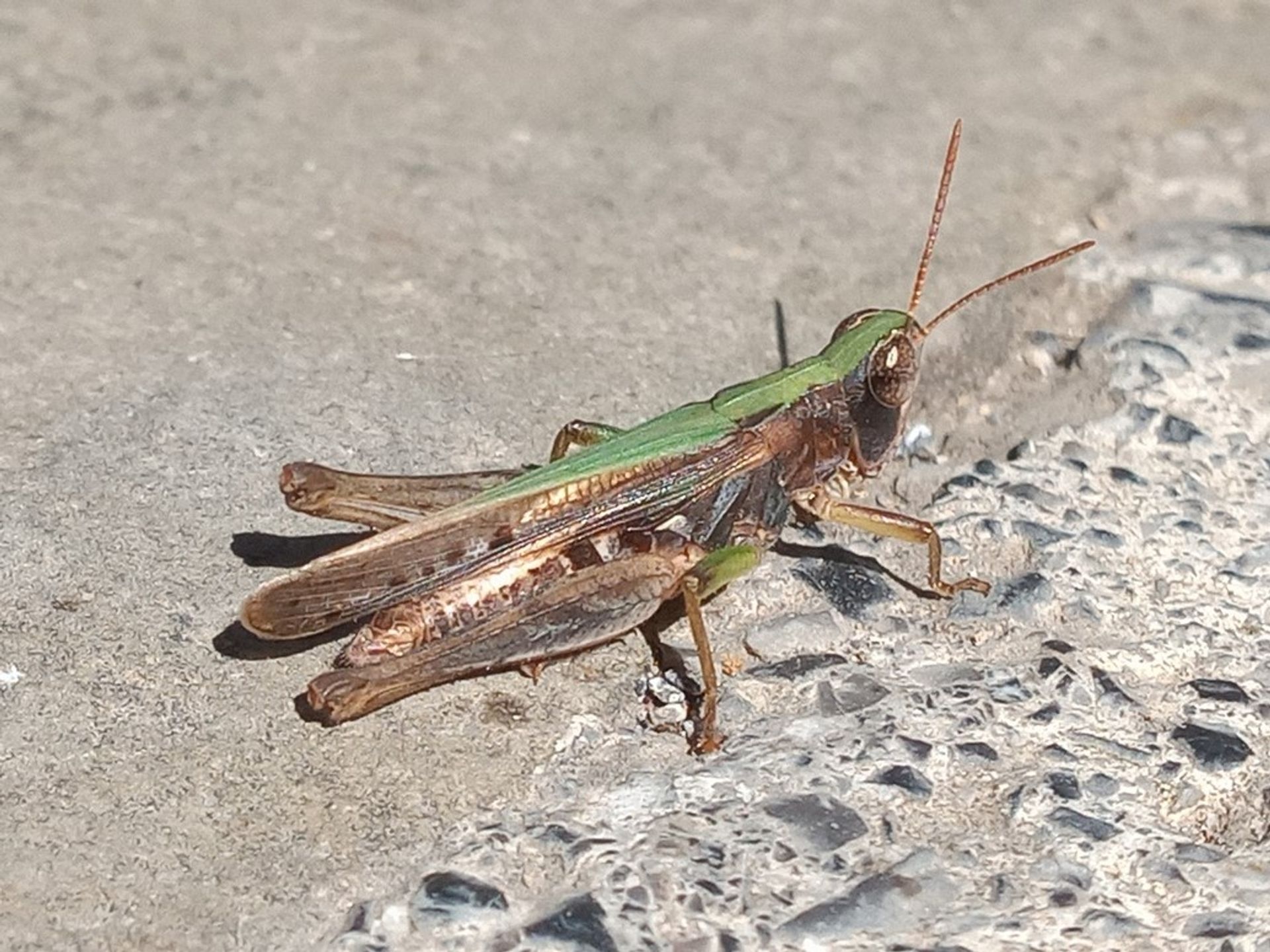
Orphulella speciosa, commonly known as the slant-faced pasture , is a small, long-winged grasshopper in the Acrididae. It is widely distributed across North American grasslands east of the Rocky Mountains, from southern Canada to northern Mexico. The species is particularly abundant in tallgrass and mixed-grass prairies, where it often becomes numerically in short-grass patches. It exhibits considerable color variation, with individuals ranging from green to brown and tan.
Pronunciation
How to pronounce Orphulella speciosa: /ɔrˈfjʊ.lɛl.lə spɛˈki.o.sa/
These audio files are automatically generated. While they are not always 100% accurate, they are a good starting point.
Identification
Distinguished from the similar Orphulella pelidna by structural features of the and pronotum. O. speciosa has a small ridge on the fastigium (the area between the ), with a small semicircular depression of the vertex located closer to the front; the lateral carinae of the pronotum are incised once. O. pelidna is larger, with a larger semicircular depression set farther back on the vertex, and the lateral carinae are incised twice (occasionally three times). The margins of the vertex are less raised than in related , and the foveola (small dent) is not distinct. Pronotal disks are nearly equal in width front and back. The principal on the pronotum cuts the disk slightly past the middle.
Images
Appearance
Small, long-winged with a strongly slanted . Tegmina extend to the end of the hind and curve inward at the apex. Sexually dimorphic: females 16–21.5 mm in body length with 5–6 mm, tegmina 9–16 mm, and hind femora 9.5–12 mm; males 13–14 mm in body length with antennae 4.5–6.5 mm, tegmina 10–13 mm, and hind femora 8.5–10 mm. Males' hind femora vary 1.5–3 mm from the end. Coloration highly variable: combinations of green, brown, and tan, usually spotted and marked with brown and black. Some individuals predominantly green, others entirely tan and brown. Females often light green with dark vertex; occasionally brown with lateral pronotal lines. Males have a pale curved line on the lower end of lateral pronotal lobes. tan with fuscous spots and markings. Behind each , a broad fuscous band, above it a thin black line, and above that a light line often ivory-colored.
Habitat
Inhabits tallgrass and mixed-grass prairies, preferring areas of shorter grass interspersed throughout the prairie plant matrix, including grazed patches. Most abundant in upland areas of short grasses. In shortgrass prairie of Colorado and New Mexico, occupies mesic swales. In eastern states, occurs in relatively dry upland and hilly pastures with sandy loam soil. Generally prefers mesic ; center of distribution appears to be in the tallgrass prairie.
Distribution
Occurs east of the Rocky Mountains to the Atlantic Coast, from southern Canada (northern extent of range) to northern Mexico (southern extent). Documented in Alabama, Arkansas, Colorado, Illinois, and Massachusetts. Widely distributed in North American grasslands.
Seasonality
Late-developing . Hatching begins mid-to-late May in southern range (Flint Hills, Kansas at 1,200 ft elevation), early-to-mid June in northcentral Colorado (5,750 ft), and late June in eastern Montana. Hatching period extends 4–6 weeks. Nymphal development takes 42–48 days. appear early July in Flint Hills, mid-July in Colorado, and early August in eastern Montana. Peak adult abundance: first or second week of August in Flint Hills; July–August in New England; August–October in Texas (southern range), with fewer adults present May–December.
Diet
General grass feeder, exhibiting some preferences among grass . Feeds almost exclusively on grasses, usually in proportion to their availability. Documented food plants include blue grama, sideoats grama, Kentucky bluegrass, little bluestem, big bluestem, buffalograss, hairy grama, prairie junegrass, western wheatgrass, tall dropseed, sand dropseed, Leibig panic, Scribner panic, switchgrass panic, prairie sandreed, reed canarygrass, prairie threeawn, stinkgrass, yellow bristlegrass, Canada bluegrass, arrowfeather threeawn, and poverty oatgrass. Also consumes sedges (Penn sedge, needleleaf sedge, fieldclustered sedge). Unidentified fungi present in 6–8% of crops. Occasional forbs and parts detected. Feeds vertically -up on leaf edges, consuming about 1/8 inch of leaf edge at a time, leaving thin residual edges standing.
Life Cycle
Hemimetabolous () with five nymphal instars. deposited in summer in pods measuring 13/16 inch long, containing 10–13 eggs each. Eggs 3.5–4.1 mm long, pale yellow when laid, becoming brown with age. Eggs overwinter and hatch the following late spring. One annually. Nymphs: Instar I–II with green patterns, terminally expanded (flat and pointed in II), tan hind , green . Instars III–V with antennae, tan/brown/green/gray body coloration, fuscous hind femora. Lateral abdominal band green in I–II, fuscous in III–V.
Behavior
Phytophilous, resting on vegetation (principally grasses) day and night. At night, rests 2–3 inches high on stems and leaves of short grasses. After sunrise (~9 a.m.), climbs up to bask at 45° angle with dorsum and side in sun; basking lasts ~2 hours. Feeds when ground temperature reaches 85°F and air temperature 70°F. Flushed silent, straight or circular, 1–4 feet distance, usually 4–12 inches high (occasionally to 5 feet), chiefly crosswind. Courtship involves male stridulation (faint ticking sound, repeated 3–10 times); males stalk females slowly and pounce without signaling. Males stridulate after coupling to maintain pair bond. Pairs in copulo observed 9 a.m. to 2 p.m. Disperses widely using long wings; attracted to electric lights at night. Swarming observed in New England. disperse when food becomes scarce.
Ecological Role
Primary consumer in grassland . Often numerically in tallgrass prairie , contributing significantly to grass herbivory. During conditions (e.g., 1934–1937 in western Iowa), assemblages with Ageneotettix deorum and other destroyed all green vegetation in bluegrass pastures, reaching 30–100+ per square yard. Contributes to overall forage damage by grass-feeding assemblages. Daily mortality rate approximately 9% for peak , 2% for late nymphal and early adult stages. Serves as prey for and .
Human Relevance
Economic pest in rangeland and pasture systems. Contributes to forage damage during , though individual consumption lower than larger due to small size ( males average 86 mg live weight, females 173 mg). During 1934–1937 outbreak in western Iowa, contributed to complete destruction of green vegetation in bluegrass pastures. Populations fluctuate, increasing during series of dry years. Because it feeds almost exclusively on grasses, contributes to cumulative damage of grass-feeding . Managed as part of rangeland grasshopper control programs.
Similar Taxa
- Orphulella pelidnaOverlapping range and similar appearance, but larger with semicircular vertex depression set farther back and lateral pronotal carinae incised twice (vs. once in O. speciosa)
More Details
Population Dynamics
fluctuate in , increasing during series of dry years along with other grassland . In favorable dry years, can reach densities in shortgrass upland areas of tallgrass prairie. Peak density occurs first or second week of August, followed by rapid decline at ~9% daily mortality rate.
Dispersal Behavior
Long wings allow wide . Documented dispersal to electric lights at night in Lincoln, Nebraska. Swarming observed in New England. Disperses when food becomes scarce, as observed during 1935–1936 Iowa when moved after consuming all green vegetation.