
Metator pardalinus
(Saussure, 1884)
Pard Grasshopper, Blue-legged Grasshopper
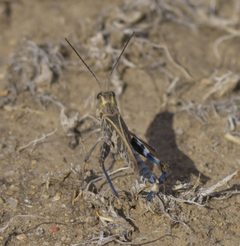
Metator pardalinus, commonly known as the pard or blue-legged grasshopper, is a of band-winged grasshopper in the Acrididae. It belongs to the Oedipodinae and tribe Psinidiini. The species is native to North America, with documented records from regions including Colorado and British Columbia. It is a relatively large grasshopper species that requires five instars to complete nymphal development.
Pronunciation
How to pronounce Metator pardalinus: //ˈmɛtətɔr pɑrˈdælɪnəs//
These audio files are automatically generated. While they are not always 100% accurate, they are a good starting point.
Identification
Distinguished from the similar Hadrotettix trifasciatus (threebanded ) by requiring five instars versus four for development to adulthood, despite H. trifasciatus achieving larger size. M. pardalinus exhibits lower stepwise growth in hind length during nymphal development (growth factor 1.31 vs. 1.43 in H. trifasciatus). First instar nymphs have smaller hind femora (3.6 mm average) compared to H. trifasciatus (4.3 mm).
Images
Appearance
A large band-winged grasshopper. First instar nymphs have hind averaging 3.6 mm in length. possess the characteristic banded wings typical of Oedipodinae. Specific coloration details of adults are not documented in available sources, though the 'blue-legged ' suggests distinctive leg coloration.
Habitat
Specific preferences are not documented in available sources. As a member of Oedipodinae, it likely inhabits open grassland and prairie environments typical of band-winged grasshoppers.
Distribution
Documented from North America, specifically Colorado and British Columbia. The is listed among the grasshoppers of Wyoming and the West, suggesting a western North American distribution.
Life Cycle
Nymphal development requires five instars to reach adulthood. First instar nymphs are relatively large with hind averaging 3.6 mm in length. The nymphal growth factor (increase in hind femur length between instars) averages 1.31, lower than that of comparable .
Similar Taxa
- Hadrotettix trifasciatusBoth are large band-winged grasshoppers in the same region. M. pardalinus requires five instars versus four in H. trifasciatus, and has smaller first instar hind (3.6 mm vs. 4.3 mm) despite H. trifasciatus achieving larger size.
More Details
Comparative Development
Research comparing M. pardalinus and H. trifasciatus revealed that instar number does not directly correlate with body size in these grasshoppers. Despite having more instars (five vs. four), M. pardalinus produces smaller adults than H. trifasciatus due to lower per-instar growth rates and smaller initial nymph size.