
Hadrotettix trifasciatus
(Say, 1825)
three-banded grasshopper, three-banded range grasshopper
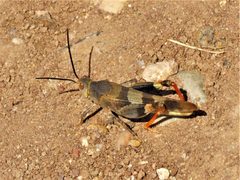
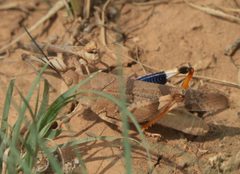
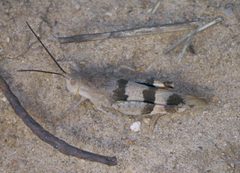
Hadrotettix trifasciatus is a large band-winged grasshopper native to western North American grasslands. It is among the largest rangeland , with females reaching dry weights of approximately 469 mg. The species is notable for its distinctive wing banding pattern and preference for forbs over grasses in its diet. Despite its size, it maintains low densities across most of its range and is not considered economically significant.
Pronunciation
How to pronounce Hadrotettix trifasciatus: /ˌhædrəʊˈtɛtɪks traɪˌfæsiˈeɪtəs/
These audio files are automatically generated. While they are not always 100% accurate, they are a good starting point.
Identification
Distinguished from similar band-winged grasshoppers by the three dark bands on the tegmina, the pale yellow or white hind wing disk with wide dark outer band, and the distinctive color pattern of the hind legs—dark blue inner with orange or red tibia. The low carina on the pronotum and long dark with light annuli provide additional diagnostic characters. Nymphs can be identified by similar hind leg color patterns, though first instar tibiae are often gray and tan rather than orange or red.
Images
Habitat
Occupies shortgrass, desert, and mixedgrass prairies of western North America. Less abundant in tallgrass prairie, where it is restricted to sparse vegetation on gravelly hilltops and slopes. Rare in grass-shrub of intermountain basins. Ground-dwelling, resting horizontally on the ground surface surrounded by grass at night.
Distribution
Widely distributed in grasslands of western North America. Center of distribution in the Southwest's shortgrass and desert prairies. Recorded from Arizona, Colorado, Wyoming, Montana, Nebraska, Texas, and other western states. have been documented at elevations from 6,700 to 10,000 feet in Colorado mountains.
Seasonality
Hatches early in the season, typically late May in mixedgrass prairie of eastern Wyoming and eastern Montana, with first instar nymphs observed as early as May 9 in some years. Earlier hatching occurs in the Southwest, with first instars present in early May. Nymphal development lasts 56–62 days. appear mid-June in shortgrass prairie of southwest Texas and desert prairie of Arizona, and mid-July in mixedgrass prairie of Montana and Wyoming. Oviposition begins approximately one month after adult .
Diet
, feeding chiefly on forbs (75% of crop contents in one study), with grasses and sedges (21%) and parts (4%) as secondary components. At least 40 forb recorded in diet. Scarlet globemallow most abundant forb in crop contents (8%), followed by Missouri milkvetch, Virginia pepperweed, scarlet gaura, and breadroot scurfpea (4% each). Western wheatgrass, blue grama, and threadleaf sedge each contributed 4% to crop contents. Observed feeding on ground litter including green or dry grasses, forbs, dead insects, and dry cattle . In multiple-choice tests, preferred antelopehorns, milkweed, and narrowleaf bluet.
Host Associations
- Sphaeralcea coccinea - food plantscarlet globemallow, most abundant forb in crop contents
- Astragalus missouriensis - food plantMissouri milkvetch
- Lepidium virginicum - food plantVirginia pepperweed
- Oenothera suffrutescens - food plantscarlet gaura
- Pediomelum esculentum - food plantbreadroot scurfpea
- Pascopyrum smithii - food plantwestern wheatgrass
- Bouteloua gracilis - food plantblue grama, also used for oviposition cover
- Carex filifolia - food plantthreadleaf sedge
- Asclepias asperula - food plantantelopehorns, preferred in multiple-choice tests
- Asclepias - food plantmilkweed, preferred in multiple-choice tests
- Houstonia angustifolia - food plantnarrowleaf bluet, preferred in multiple-choice tests
- Zigadenus - food plantdeath camas, poisonous to livestock
- Asclepias - food plantmilkweeds, poisonous to livestock
- Astragalus - food plantsome milkvetches, poisonous to livestock
Life Cycle
Hemimetabolous with four nymphal instars. hatch in late spring; nymphal development spans 56–62 days depending on temperature. emerge in mid-summer and persist until late summer or fall. Oviposition occurs through plant litter into soil, with females retreating into grass cover (often blue grama or buffalograss). Egg pods are 1 inch long, strongly curved, with egg section 5/8 inch long containing 18–26 eggs. Eggs are large, 7.2–8.7 mm in length, oriented almost vertically in the curved pod. Froth plug occupies 5/8 inch of pod length.
Behavior
Strong flier capable of ; accidentals found at elevations up to 10,000 feet, 10 miles from nearest known . Flushed flight typically straight with 90-degree turn at end, landing softly by fluttering to ground. Crepitates in flight. Males travel 9–24 feet per flight, females 6–15 feet, both at 12–18 inch heights; with wind assistance, males observed traveling 42 feet. Ground-dwelling, basking horizontally on ground with side perpendicular to sun and hindleg lowered to expose for approximately two hours after sunrise until soil temperatures reach 80°F. Evades heat by stilting, crawling to thick litter or atop blue grama (elevated ~2 inches), moving to shade, or climbing vegetation to 3 inches when soil temperatures exceed 120°F. Males court females with hind tipping motions and stridulation; females reject males by hopping away, raising hind femora with tibiae over back while kicking, or tipping femora.
Ecological Role
Consumer of forbs, grasses, and sedges; contributes to nutrient cycling through feeding on plant litter and dry cattle . Scavenges dead insects, including conspecifics. Functions as prey for various vertebrate and in grassland . Low densities limit its impact on relative to more abundant .
Human Relevance
Limited economic importance due to consistently low densities (typically <0.1–0.3 per square yard in mixedgrass prairie, up to 4 per square yard in desert prairie). Feeding on good forage grasses would suggest pest status, but research indicates preferential feeding on poor forage plants and plants poisonous to livestock including death camas, milkweeds, and some milkvetches. Not considered a damaging pest or beneficial insect in most western grasslands.
Similar Taxa
- Metator pardalinusAnother large band-winged grasshopper with overlapping range; distinguished by having five nymphal instars versus four in H. trifasciatus, and different wing banding pattern. Females weigh approximately half as much as H. trifasciatus females.
- Encoptolophus costalisCongeneric in Oedipodinae with similar band-winged ; distinguished by different wing coloration and banding patterns.
More Details
Nymphal Instar Characteristics
Nymphs identifiable by: (1) vertical with long dark ; (2) pronotum with low carina, uncut in instars I–II, cut near middle in instar III, cut in front of middle in instar IV; (3) hind leg color patterns similar to except instar I tibia often gray and tan; (4) general body color brown or gray with dark brown spots.
Mass Emigration Event
Documented case of mass from desert prairie on San Carlos Apache Indian Reservation, Arizona in June 1980, when forb depletion caused emigration of H. trifasciatus and Melanoplus sanguinipes while grass-feeding Aulocara elliotti remained at high .
Oviposition Behavior
Female observed preparing oviposition site by bobbing up and down into plant litter to fashion small depression, then turning to insert ovipositor. Another observation in bare ground of saltbrush-bunchgrass : female with ovipositor inserted at 12:12 p.m., completed laying by 12:45–12:50 p.m. with soil surface 113–117°F and air 78–81°F.