
Encoptolophus costalis
(Scudder, 1862)
Dusky Grasshopper, Western Clouded Grasshopper
Encoptolophus costalis is a medium-sized band-winged grasshopper native to western North America. It is primarily a grass-feeding with a strong preference for western wheatgrass and needleleaf sedge. The species exhibits marked in body size and possesses long wings enabling . It is most abundant in the northern mixedgrass prairie, where it can become locally , though typically remains a subdominant member of .
Pronunciation
How to pronounce Encoptolophus costalis: //ɛnˌkɒptəˈloʊfəs kɒˈstɑːlɪs//
These audio files are automatically generated. While they are not always 100% accurate, they are a good starting point.
Identification
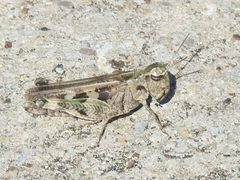
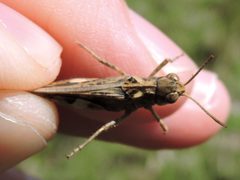
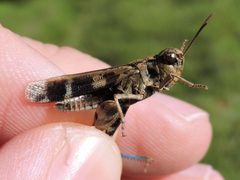
Distinguished from similar by combination of: blue hind tibia; long wings extending 1-4 mm beyond ; three dark bands on outer hind with dark knee; tegmina banded with weak dark bands on hind wings. Nymphs separable from Chortophaga viridifasciata by (not ) , four distinct longitudinal ridges (not two) on fore- and midleg femur and tibia with black lines between them, and pink half of hind femur medial area in instar I (not entirely green). Instars IV-V separable by moderately sloping pronotal disk with obtuse angle (vs. tectate disk with acute posterior angle in C. viridifasciata).
Images
Habitat
Inhabits mixedgrass, shortgrass, bunchgrass, and desert prairies. Most abundant in northern mixedgrass prairie. Favors moist areas of rich grass and sedge growth interspersed with bare ground. In southern distribution, occupies mesic swales and roadsides dominated by western wheatgrass, and prairies with Houston black clay soil dominated by Texas needlegrass. Also found in areas of fine sandy loam soil.
Distribution
Western North America from Canada to Mexico. Recorded from Colorado, Montana, Nebraska, Texas, and Mexico (Northeast). Ranges widely across prairie provinces of Canada including Saskatchewan, Manitoba, and Alberta.
Seasonality
Intermediate-developing . Hatching begins early to mid June in northern mixedgrass prairie, about three weeks after initial hatch of Ageneotettix deorum. Hatching period prolonged, continuing six to eight weeks. appear August 8-14 in Wyoming and Saskatchewan. In southern distribution (northeastern Texas), adults appear by mid April with second by August; stages present throughout year with at least two generations annually.
Diet
Primarily grass-feeding . Principal plants are western wheatgrass (Agropyron smithii) and needleleaf sedge (Carex eleocharis). Other substantial food plants include northern wheatgrass, needleandthread, green needlegrass, and blue grama. Additional recorded foods: quackgrass, prairie junegrass, sand dropseed, little bluestem, sideoats grama, Kentucky bluegrass, foxtail barley, timothy, and Penn sedge. Forbs constitute only 1% of natural diet but 11 of 22 species tested were accepted in laboratory feeding trials including scarlet globemallow, prairie coneflower, dandelion, and Vicia sparsifolia. Has been observed feeding on dry plant litter and dry cow .
Life Cycle
stage overwinters. Hatching begins early to mid June in north, with prolonged hatching period of six to eight weeks potentially due to heterogeneous soil temperatures. Nymphal development requires five instars for both sexes, lasting 56-66 days based on field observations in northern mixedgrass prairie. appear mid-August in north, mid-April in south with second in August. Fledgling adults require 2-3 weeks of growth and maturation before mating. Oviposition may begin by 16th day of adulthood. Females deposit eggs in bare ground interspersed among native grasses; test soil by boring several times before depositing clutch. Preferred oviposition substrate is Houston black clay soil. Pods 3/4 inch long, slightly curved, containing 14-20 tan eggs 4.0-4.4 mm long. Female brushes soil and litter over aperture after oviposition. In southern range, at least two generations annually with year-round stages.
Behavior
Geophilus spending almost all time on the ground. resting position: sitting horizontally on bare soil and litter, often under thin of leaves surrounded by grasses. Basking begins 1-2 hours after sunrise: turns side perpendicular to sun rays and lowers associated hindleg to expose for 2-3 hours. Feeding occurs during midday hours (9:12 a.m. to 1:27 p.m.) at ground temperatures 76-126°F. At extreme high temperatures (125°F+), takes evasive action by resting in partial shade, sitting on grass 1/2 inch above ground, crawling into full shade, or climbing onto litter facing sun to expose minimum body surface. Second basking period occurs late in day until sunset. Males make frequent to arouse females; pursue potential mates on ground producing burst of vibratory stridulation followed by pulse of ordinary stridulation. Non-receptive females escape by flight. Males often attend ovipositing females but are kicked away. Flushed flight softly crepitates, travels 3-9 feet at heights of 3-12 inches, usually straight with occasional turn near end. Capable of longer and migratory flights; documented in mixed species swarm landing in urban area and in movement from depleted rangeland into adjacent crops.
Ecological Role
Rangeland herbivore, usually subdominant member of that contributes to cumulative grazing pressure but rarely causes significant damage alone. In favorable can become , reaching up to 74% of grasshopper with densities of 2.5 young per square yard, though impact on vegetation may remain limited. Functions as primary consumer in grassland . Serves as prey for various vertebrate and .
Human Relevance
Minor agricultural pest. Reported as minor pest in alfalfa in Arizona and North Dakota, and as pest in fall wheat in Nebraska where migrated from depleted rangeland. Generally causes little economic damage due to typically low densities and preference for native grasses over crops. Adds to cumulative damage of more serious pest grasshoppers in rangeland . Subject of detailed ecological research at Matador site of International Biological Program in Saskatchewan.
Similar Taxa
- Chortophaga viridifasciataEarly instars (I-III) appear similar in green coloration and general structure. Separable by (not ) , two distinct longitudinal ridges (not four) on fore- and midleg and tibia without black lines between them, entirely green hind femur medial area in instar I (not pink in half). Instars IV-V separable by tectate pronotal disk with acute angle (vs. moderately sloping with obtuse angle).
- Hadrotettix trifasciatusLarger band-winged grasshopper in same with different color pattern: three dark bands on tegmina, orange or red hind tibia (not blue), and distinctive light annulus around hind . Nymphs have different leg color patterns and pronotal structure.
More Details
Population Ecology
Detailed 1967-1971 study at Matador site, Saskatchewan documented . In 1968, comprised ~74% of with peak of 12 early instar nymphs per square yard. High mortality of young nymphs in 1968 and 1969; daily mortality decreased after instar IV. Average daily mortality from instar IV through stage was 3% in 1968 and 5% in 1969. Population declined 1968-1971, apparently due to decreased soil temperature from shading by luxuriant vegetation growth, which delayed development and decreased production. Reduction of bare ground oviposition sites may have incited . After August 1969 fire, adults migrated from unburned area with heavy vegetation to burned area with light growth and abundant bare ground.
Feeding Methods
Exhibits multiple feeding postures: sitting -up on leaf to feed halfway up, cutting through and holding cut section with front ; turning head-down to feed on green basal tissue; from horizontal ground position reaching up to feed on short plants, cutting and consuming green portions; feeding on recumbent green leaves or stubs from ground position. Noted as thrifty feeder consuming most of attacked plant material, eating all green and dropping chiefly dry brown parts. Unusual observation of instar IV nymph perched on one leaf but reaching out to feed on tips of three younger leaves rather than the leaf it rested upon.
Laboratory Feeding Flexibility
Research demonstrated dietary flexibility: starved individuals limited to single food plants fed well on certain forbs and refused others. Well-eaten plants in trials included scarlet globemallow, prairie coneflower, dandelion, and Vicia sparsifolia. Non-adherence to strictly grass diet under stress conditions indicates ecological flexibility contributing to widespread distribution.
Sources and further reading
- BugGuide
- Wikipedia
- GBIF taxonomy match
- iNaturalist taxon
- NCBI Taxonomy
- Catalogue of Life
- Comparison
- Dusky Grasshopper
- Species Records and Accounts
- List of Species Fact Sheets| Grasshoppers of Wyoming and the West
- Greenstriped Grasshopper
- Threebanded Grasshopper
- Food preferences of the dusky grasshopper, Encoptolophus sordidus costalis (Scudder) (Orthoptera: Acrididae)