
Chortophaga viridifasciata
(De Geer, 1773)
green-striped grasshopper, green-striped locust
Species Guides
2- Chortophaga viridifasciata australior(Southern greenstriped grasshopper)
- Chortophaga viridifasciata viridifasciata(Greenstriped Grasshopper)
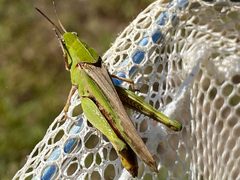
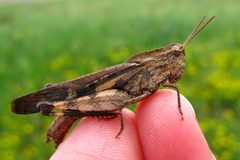
Chortophaga viridifasciata is a band-winged grasshopper widespread in North and Central America. The exhibits pronounced in coloration, with females typically green and males typically brown. It shows geographic variation in , with single-brooded in northern and western regions and multiple-brooded populations in the Southeast. The species is notable for being among the earliest grasshoppers active in spring due to as nymphs.
Pronunciation
How to pronounce Chortophaga viridifasciata: //kɔːrˈtɒfəɡə vɪˌrɪdɪˈfæsɪˌɑːtə//
These audio files are automatically generated. While they are not always 100% accurate, they are a good starting point.
Identification
distinguished from similar band-winged grasshoppers by combination of: tectate pronotal disk with acute angle (vs. obtuse in Encoptolophus costalis); hind wings with pale greenish-yellow basal area and faded incomplete dark band; hind tibiae bluish gray or red with tan annulus; (not ) . Nymphs distinguished from Encoptolophus costalis by ensiform antennae (vs. clavate), two distinct longitudinal ridges on outer of fore- and midleg and tibiae (vs. four with black lines), and entirely green medial area of hind femur in instar I (vs. pink in half). Instars IV–V separable by pronotal disk shape: tectate with acute posterior angle in C. viridifasciata vs. moderately sloping with obtuse angle in E. costalis.
Images
Habitat
Relatively moist areas of short grass, including roadsides, hay meadows, grass meadows, and slopes. In western regions, occupies small moist patches receiving additional moisture from overflow or subirrigation: swales, pond margins, stream banks with western wheatgrass, and irrigated or subirrigated smooth brome stands. More prevalent in eastern United States than in extensive western prairies; distribution patchy in West.
Distribution
North America from British Columbia to Gulf of Mexico, mostly east of Rocky Mountains; south through Central America to Rica. Widespread and abundant in eastern United States; patchy and localized in western states.
Seasonality
active early spring through summer. In northern and western Great Plains: single-brooded, laid early summer, hatch same summer, nymphs overwinter, adults appear early spring (often first active). In Southeast: multiple-brooded, with earlier and more extended hatching periods. In Texas, nymphs present year-round.
Diet
Feeds mainly on grasses with preference for succulent plants. Documented plants include Kentucky bluegrass, foxtail barley, western wheatgrass, quackgrass, little bluestem, junegrass, needleleaf sedge, Penn sedge, orchardgrass, poverty oatgrass, Johnsongrass, Bromus catharticus. Has been observed feeding on forb sowthistle even when lush grasses available. Also feeds on ground litter including cut green leaves. Feeds by climbing plant and cutting leaf edge about halfway up, holding cut section with front .
Life Cycle
Five instars during development. Northern/western : single-brooded, overwinter as late-instar nymphs, facultative broken by increasing in spring. Southern populations: multiple-brooded, no diapause, up to six annually possible under laboratory conditions. 4–4.5 mm long, light tan, laid in pods 1.125–1.25 inches long containing ~25 eggs in bottom half inch, remainder hardened froth. Females bore to depth of 1.25 inches. Oviposition observed in damp sand at pond margins and in bare sandy loam soil.
Behavior
Strong flier with regular from nymphal . Evasive : males 10–30 feet, females twice that distance, heights 6–24 inches, usually with (soft buzz); when startled, may fly without crepitation. Males perform crepitating flights to attract females, lasting 1–2 seconds at heights up to 3 feet. Visual and acoustical social displays: males use wing spreading, leg movements (-tipping), and stridulation in courtship and aggressive male-male interactions. Behavioral sequences in encounters are stereotyped and non-random, with forming. Cold-hardy: fourth instar nymphs survive 48 hours at 0°F. Daily activity includes basking in morning sun, feeding and pottering midday, seeking shade when ground temperatures exceed 120°F.
Ecological Role
Primary consumer in grassland . One of most abundant and widespread in eastern United States, though do not reach densities (25+ per square yard), possibly due to male spacing via . In western regions, occurs at low densities (<1 per square yard) in restricted moist .
Human Relevance
Minimal economic damage due to usually low numbers and patchy distribution. In eastern United States may cause minor damage to pastures and hayfields; occasionally recorded in red clover and tobacco fields but likely feeding on weedy grasses invading crops. Used extensively in physiological and cytological research, including studies of physiology, nitrogen metabolism, neuroblast development, and mutagenesis.
Similar Taxa
- Encoptolophus costalis (dusky grasshopper)Similar green nymphal coloration and preference. Distinguished by (clubbed) vs. , four longitudinal ridges with black lines on fore- and midleg and tibiae vs. two, pink hind femur in instar I vs. entirely green, and pronotal disk with obtuse angle vs. acute.
- Eritettix viridis (velvet-striped grasshopper)Shares moist preferences. C. viridifasciata hatch approximately two weeks earlier in eastern Wyoming where both co-occur.
More Details
Subspecies
Two recognized: C. v. viridifasciata and C. v. australior. The latter sometimes listed as separate but intergrades northward with nominate subspecies, making species-level distinction unlikely.
Research significance
Important model organism for insect physiology research due to large size, ease of laboratory rearing, and cytological accessibility of neuroblasts. Used in studies of ion regulation, nitrogen metabolism during starvation, neuroblast and cytokinesis, and chemical mutagenesis.
Sources and further reading
- BugGuide
- Wikipedia
- GBIF taxonomy match
- iNaturalist taxon
- NCBI Taxonomy
- Catalogue of Life
- Comparison
- Greenstriped Grasshopper
- Grasshoppers of Colorado
- Grasshoppers of Colorado
- Grasshoppers of Colorado
- Hayden Grasshopper
- An informational analysis of the inter-male behaviour of the grasshopper chortophaga viridifasciata
- Changes in the Distribution of Nitrogen during Starvation in the Grasshopper, Chortophaga viridifasciata De Geer
- Visual and acoustical social displays by the grasshopper Chortophaga viridifasciata (Acrididae: Oedipodinae)
- Studies on cytokinesis in neuroblasts of the grasshopper, Chortophaga viridifasciata (De Geer) I. Formation and behavior of the mitotic apparatus
- Chromosome fragments and other abnormalities induced by mitomycin C in the neuroblast of chortophaga viridifasciata
- THE BEHAVIOR OF ISOLATED HEARTS OF THE GRASSHOPPER, CHORTOPHAGA VIRIDIFASCIATA, AND THE MOTH, SAMIA WALKERI, IN SOLUTIONS WITH DIFFERENT CONCENTRATIONS OF SODIUM, POTASSIUM, CALCIUM, AND MAGNESIUM
- Formaldehyde‐induced acentric chromosome fragments and chromosome stickiness in Chortophaga neuroblasts