
Erebia rossii
Curtis, 1835
Ross's Alpine, Arctic Alpine
Erebia rossii is a circumpolar in the Nymphalidae, Satyrinae. It occurs in Arctic and subarctic regions of North America and Eurasia. The species shows in eyespot patterns and has been documented with multiple across its broad range.
Pronunciation
How to pronounce Erebia rossii: //ɛˈrɛ.bi.a ˈrɒs.si.aɪ//
These audio files are automatically generated. While they are not always 100% accurate, they are a good starting point.
Identification
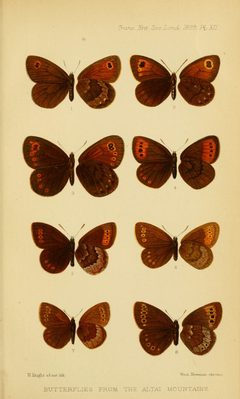
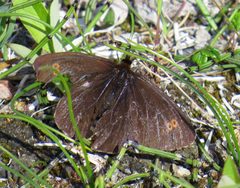
Distinguished from other Erebia by the combination of: (1) two prominent eyespots on male forewing with white pupils, (2) reduced or absent hindwing spotting in males, (3) larger and more numerous eyespots in females, and (4) greyish bands with jagged borders on hindwings. identification requires geographic context and subtle variation in spot patterns.
Images
Habitat
Arctic and subarctic alpine tundra, rocky slopes, and grassy meadows at high latitudes and elevations.
Distribution
Circumpolar distribution in Arctic North America (including Alaska, northern Canada) and northern Eurasia (Siberia, northern Europe). Documented indicate localized in: Sajan Mountains, eastern Siberia/Dzhugdzhur Mountains, Alaska, Kuskoquim Valley, Manitoba, and mountains of Yakutia and Chukotka.
Diet
Larvae feed on various grasses, including Carex .
Host Associations
- Carex - larval food plantvarious
Life Cycle
Complete with , larva, pupa, and stages. Larval stage herbivorous on grasses.
Ecological Role
Herbivore in Arctic and subarctic grassland ; serves as prey for birds and other .
Human Relevance
Subject of lepidopterological study due to its circumpolar distribution and variation; no significant economic or agricultural impact documented.
Similar Taxa
- Other Erebia speciesShares characteristics of dark brown wings with eyespots; distinguished by specific eyespot arrangement and wing patterns
More Details
Subspecies
Six recognized: E. r. erda (Sajan Mountains), E. r. ero (eastern Siberia, Dzhugdzhur Mountains), E. r. gabrieli (Alaska), E. r. kuskoquima (Kuskoquim Valley), E. r. ornata (Manitoba), E. r. subarctica (mountains of Yakutia and Chukotka)