
Anyphaenidae
Bertkau, 1878
ghost spiders, anyphaenid sac spiders
Genus Guides
5- Anyphaena(ghost spiders)
- Arachosia
- Hibana(ghost spiders)
- Lupettiana
- Wulfila(ghost spiders)
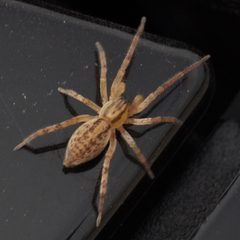
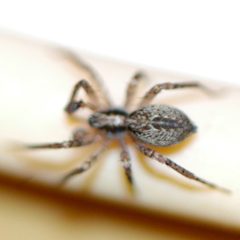
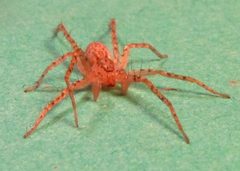
Anyphaenidae is a of araneomorph spiders commonly known as ghost spiders or anyphaenid sac spiders. The family is distinguished by a diagnostic abdominal positioned one-third to one-half of the way to the toward the epigastric furrow, unlike most spiders where the spiracle sits just anterior to the spinnerets. Members are wandering that construct silken retreats or sacs on vegetation, under bark, or beneath rocks rather than building capture webs. The family contains over 600 in more than 50 worldwide, with greatest diversity in the Americas.
Pronunciation
How to pronounce Anyphaenidae: //æ.nɪˈfiː.nɪˌdeɪ//
These audio files are automatically generated. While they are not always 100% accurate, they are a good starting point.
Identification
Anyphaenidae are distinguished from similar sac spiders (Clubionidae) and other spiders by the placement of the abdominal , located one-third to one-half of the distance from the toward the epigastric furrow. They possess conical anterior spinnerets and eight arranged in two rows. Most are pale in coloration, contributing to their 'ghost spider' . are relatively small, typically under 8 millimeters in body length.
Images
Habitat
Vegetation including shrubs, trees, and herbaceous plants; leaf litter; under bark; under rocks. They construct silken retreats or sacs in these locations, commonly on plant terminals, between leaves, or in sheltered microhabitats.
Distribution
Worldwide distribution with greatest diversity in the Americas. The Anyphaena occurs worldwide except tropical Africa and Asia. The genus Hibana is restricted to the New World. in the have been documented from North America, Central America, South America, China (Xizang/Tibet), and other regions. Only one species (A. accentuata) occurs in northwestern Europe.
Diet
Active of insects. Members of the Hibana are known to detect and feed on insect despite poor eyesight.
Behavior
wandering hunters that do not build capture webs. By day they hide in curled leaves tied together with silk, or in other constructed silken retreats. They are frequently observed near outdoor lighting where they exploit concentrations of insect prey. in the Hibana are important in agricultural systems, particularly tree crops.
Ecological Role
of insects in vegetation and leaf litter . Some serve as significant agents in agricultural . They are also documented prey items for spider wasps in the Pompilidae, including Priocnemis minorata and Auplopus species.
Human Relevance
Generally harmless to humans due to small size. Some provide beneficial pest control in agricultural settings, particularly in tree crops.
Similar Taxa
- ClubionidaeBoth are called 'sac spiders' and construct silken retreats, but Anyphaenidae are distinguished by the placement of the abdominal (one-third to one-half anterior to versus just anterior to spinnerets in Clubionidae).
- MiturgidaeSome members were formerly classified in Clubionidae and share wandering habits; Anyphaenidae differ in position and conical .
Sources and further reading
- BugGuide
- Wikipedia
- GBIF taxonomy match
- iNaturalist taxon
- NCBI Taxonomy
- Catalogue of Life
- Bug Eric: Priocnemis minorata
- Bug Eric: Masters of Mud: Auplopus Spider Wasps
- Bug Eric: October 2009
- Bug Eric: March 2013
- Bug Eric: 2009
- Bug Eric: ArachNovember?
- FAMILY ANYPHAENIDAE • Ghost Spiders
- Four new species of Anyphaena Sundevall, 1833 from Xizang, China (Araneae, Anyphaenidae)
- A phylogenetic analysis of the subfamilies of Anyphaenidae (Arachnida, Araneae)
- Chasing ghosts: the phylogeny of Amaurobioidinae ghost spiders (Araneae, Anyphaenidae)
- A revision and phylogenetic analysis of the spider genus Oxysoma Nicolet (Araneae: Anyphaenidae, Amaurobioidinae)
- A taxonomic revision of the Neotropical spider genus Xiruana Brescovit 1997 (Araneae: Anyphaenidae, Anyphaeninae)
- Taxonomic revision of the American spider genus Arachosia (Araneae: Anyphaenidae)
- Five new species of the Ghost Spider genus Anyphaenoides Berland from Colombia (Araneae: Anyphaenidae: Anyphaeninae)
- CHAPTER 20. Ghosts, Goblins, Pirates, and Other Wandering Hunters: Mimetidae, Corrinidae, Trachelidae, Gnaphosidae, Caponiidae, Dysderidae, Oonopidae, Anyphaenidae, Miturgidae, Eutichuridae, and Liocranidae
- Genetic relationships of Amaurobioides (Anyphaenidae) spiders from the southeastern coast of New Zealand
- Morphological and molecular evidence support a new species of the genus Ilocomba Brescovit, 1997 (Araneae, Anyphaenidae, Anyphaeninae) from the Andes of Colombia
- New records of Thaloe ennery Brescovit, 1993, and Thaloe leboulet Brescovit & Oliveira, 2019 (Araneae: Anyphaenidae) from Dominican Republic