
Clubionidae
Simon, 1878
Sac Spiders
Genus Guides
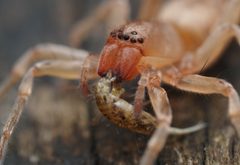
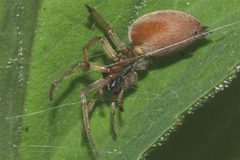
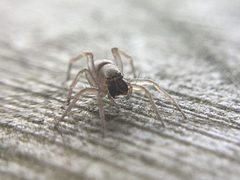
2Clubionidae, the sac spiders, are a of wandering spiders characterized by eight in two rows and conical that touch. They are active hunters that do not build webs to capture prey, instead constructing silken retreats or 'sacs' for shelter. The family has undergone significant taxonomic revision, with many former members reassigned to other families including Eutichuridae and Miturgidae. in this family are found worldwide and occupy diverse from forests to human dwellings.
Pronunciation
How to pronounce Clubionidae: /kluːˈbaɪ.ə.nɪˌdiː/
These audio files are automatically generated. While they are not always 100% accurate, they are a good starting point.
Identification
Clubiona can be distinguished from similar sac spiders by the presence of a distinct groove in the center of the and a tuft of curved setae on the front edge of the . These characters are absent in Cheiracanthium (now Eutichuridae), which was formerly classified in Clubionidae. Members of this have eight arranged in two rows and conical that are contiguous.
Images
Habitat
Diverse including subtropical forests, caves, under bark, under rocks, and between leaves. Some are found in human dwellings, though generally less commonly indoors than related formerly placed in this .
Distribution
Worldwide distribution on every continent except Antarctica. Documented from North America (including Vermont, USA), Europe (Denmark, Norway, Sweden), and Asia (Laos, Thailand, China, Malaysia, Philippines, Cambodia, Indonesia).
Diet
Active that hunt small insects and other arthropods without using webs. Laboratory studies on related indicate they will feed on available prey such as lepidopteran larvae.
Life Cycle
Development involves multiple from to adulthood. In related , males undergo 7–8 molts and females 9–10 molts. Females deposit eggs in silken sacs within their retreats.
Behavior
hunters that prowl for prey on foot. They construct silken retreats or 'sacs' for daytime shelter, typically on plant terminals, between leaves, under bark, or under rocks. These retreats are generally not reused. They possess tarsal claw tufts of densely-packed hairs that aid in climbing smooth surfaces.
Ecological Role
of small insects and arthropods; serve as prey for spider wasps in the Pompilidae.
Human Relevance
Generally harmless to humans. Some may enter human dwellings but are less commonly encountered indoors than related such as Cheiracanthium. They may contribute to household pest control by consuming small insects.
Similar Taxa
- Eutichuridae (Cheiracanthium)Formerly classified in Clubionidae; distinguished by lack of groove and abdominal setal tuft; more commonly encountered indoors
- MiturgidaeFormerly included now placed here; similar wandering and sac-building habits
More Details
Taxonomic History
This was formerly a large catch-all for spiders with eight in two rows, contiguous conical , and sac-building . Many have been reassigned to separate families including Eutichuridae and Miturgidae, making the family's current circumscription more restricted.
Sources and further reading
- BugGuide
- GBIF taxonomy match
- iNaturalist taxon
- NCBI Taxonomy
- Catalogue of Life
- Spider Alert! Guess Who's Coming to UC Davis? | Bug Squad
- Bug Eric: Spider Sunday: Longlegged Sac Spiders
- Bug Eric: Priocnemis minorata
- Bug Eric: Housemates
- Bug Eric: One Night, One House, Seventeen Spider Species
- Bug Eric: Masters of Mud: Auplopus Spider Wasps
- Biology of the spiderChiracanthium mildei [Arachnida: Clubionidae]
- Clubionidae from Laos and Thailand (Arachnida: Araneae)
- BIOLOGY OF THE SPIDER CHEIRACANTHIUM JOVI1JM (ARANEIDA CLUBIONIDAE
- On the genus Systaria (Araneae: Clubionidae) in Southeast Asia: new species from caves and forests
- Taxonomy of the genus Pristidia Deeleman-Reinhold, 2001 (Araneae: Clubionidae) in China
- Six new species of the spider genus Clubiona Latreille, 1804 (Araneae, Clubionidae) from subtropical forests of Sichuan Province, China.
- Re-description of Clubionahuaban (Araneae, Clubionidae), with the first description of the female.