
Clubiona
Latreille, 1804
Leafcurling Sac Spiders, Sac Spiders
Species Guides
22- Clubiona abboti
- Clubiona bishopi
- Clubiona canadensis(Canada Sac Spider)
- Clubiona janae
- Clubiona johnsoni(Johnson's Sac Spider)
- Clubiona kastoni(Kaston Sac Spider)
- Clubiona kulczynskii
- Clubiona lutescens(yellow sac spider)
- Clubiona maritima
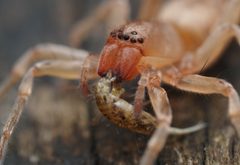
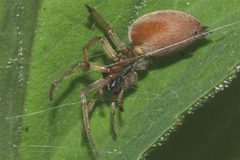
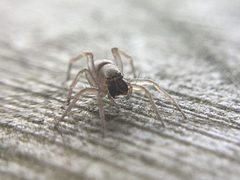
Clubiona is a large of sac spiders ( Clubionidae) comprising over 500 distributed worldwide. These spiders are active hunters that do not construct capture webs, instead relying on speed and tarsal claw tufts to pursue prey. Many species construct silken retreats for shelter and -laying. Notably, some Clubiona species remain active during winter months in temperate regions, aided by hyperactive antifreeze proteins that enable foraging at subzero temperatures. The genus exhibits considerable morphological and genetic diversity, with species occupying diverse from forests to orchards and human structures.
Pronunciation
How to pronounce Clubiona: /kluˈbi.o.na/
These audio files are automatically generated. While they are not always 100% accurate, they are a good starting point.
Identification
Clubiona can be distinguished from similar sac spiders in the Cheiracanthium ( Eutichuridae) by two key characters: a distinct longitudinal groove in the center of the , and a conspicuous tuft of curved setae on the edge of the . Cheiracanthium lacks both of these features. Clubiona typically have cylindrical abdomens and relatively long legs with dense tarsal claw tufts composed of packed hairs that aid in climbing smooth surfaces.
Images
Habitat
Found in diverse terrestrial including deciduous and coniferous forests, pome fruit orchards, and human structures. Winter-active occupy crevices within tree bark and corrugated cardboard wraps installed on orchard trees. Forest-dwelling species utilize spaces beneath loose bark, within leaf litter, and in rock crevices. Some species occur in subtropical forests.
Distribution
distribution spanning Oceania, Africa, North America, the Caribbean, Asia, Europe, South America, Panama, and Saint Helena. Documented from temperate regions including central Europe (Czechia), northeastern and north-central United States (Indiana, Vermont), and throughout New Zealand. Chinese occur in central and northern regions, with additional diversity in subtropical forests of Sichuan Province.
Seasonality
Activity patterns vary by and climate. Many species are active primarily in spring through fall, with present in summer and autumn. However, certain species are distinctly winter-active, foraging at subzero temperatures from December through February in central European orchards when most other arthropods are .
Diet
Active that hunt on foot for small insects and other arthropods. Winter-active in orchards have been observed capturing prey regularly during winter months. Specific prey records include various small insects; one species (Clubiona obesa) documented as prey for the spider wasp Priocnemis minorata.
Life Cycle
Females deposit within silken sacs constructed inside retreats. Spiderlings hatch and may return to the retreat briefly after initial explorations, dispersing after their next . Juveniles of winter-active are present in winter alongside , indicating year-round development in some . occurs in silken retreats, with both adults and juveniles observed hibernating under rocks during winter months in some species.
Behavior
hunters that rely on speed rather than web-building to capture prey. Construct silken retreats—flat, sac-like structures—for daytime shelter, molting, and -laying. Retreats are typically not reused, with spiders spinning new shelters after foraging excursions. Some are agile climbers capable of running across ceilings and other smooth vertical surfaces. Winter-active species exhibit remarkable cold , maintaining locomotor activity at subzero temperatures through antifreeze protein production.
Ecological Role
Important natural enemies of insect pests, particularly in agroecosystems. Winter-active in pome fruit orchards contribute significantly to pest suppression during winter when other predatory arthropods are . High abundance, , and functional diversity make them among the most important natural enemies in orchard . Forest-dwelling species contribute to dynamics as both and prey (documented as for spider wasps including Priocnemis minorata).
Human Relevance
Occasionally encountered indoors, though less frequently than the Cheiracanthium. Some associated with human structures in natural settings (beneath siding, in crevices). No documented medical significance; not considered dangerously venomous. One species (Clubiona medicinalis, now Coras medicinalis) historically used in 19th-century folk medicine for fever treatment.
Similar Taxa
- CheiracanthiumFormerly classified in Clubionidae, now placed in Eutichuridae. Lacks the distinct groove and abdominal setal tuft present in Clubiona. More commonly encountered indoors, especially C. mildei.
- CorasHistorically confused with Clubiona (C. medicinalis was placed in Clubiona by Walckenaer in 1837). Now recognized as funnel-web weavers (Agelenidae) with different arrangement and web architecture.
- HibanaGhost spiders (Anyphaenidae) that may resemble sac spiders in general form and use, but differ in arrangement and lack the diagnostic groove of Clubiona.
Sources and further reading
- BugGuide
- Wikipedia
- GBIF taxonomy match
- iNaturalist taxon
- NCBI Taxonomy
- Catalogue of Life
- Bug Eric: One Night, One House, Seventeen Spider Species
- Bug Eric: Spider Sunday: Longlegged Sac Spiders
- Bug Eric: Priocnemis minorata
- Bug Eric: Spider Sunday: Coras
- Redescription of Clubiona blesti Forster, 1979 (Araneae: Clubionidae) with a preliminary molecular phylogeny of New Zealand Clubiona
- On the Clubiona reclusa species-group in China, with the description of Clubiona qianlei sp. nov. (Araneae, Clubionidae)
- Winter-active spiders (Clubiona) have a hyperactive antifreeze protein with a unique beta-solenoid fold.
- Six new species of the spider genus Clubiona Latreille, 1804 (Araneae, Clubionidae) from subtropical forests of Sichuan Province, China.
- Re-description of Clubionahuaban (Araneae, Clubionidae), with the first description of the female.