
Coras
Simon, 1898
Species Guides
5- Coras aerialis
- Coras juvenilis
- Coras lamellosus
- Coras medicinalis(Medicinal Funnel Weaver)
- Coras montanus(Northern Spurred Woodland Funnelweaver)
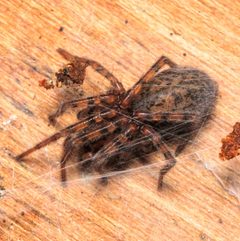
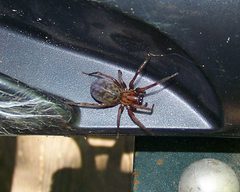
Coras is a of funnel-web spiders in the Agelenidae, containing fifteen described found exclusively in eastern North America. The genus was established by Eugène Simon in 1898 after complex taxonomic revisions involving multiple family placements. These spiders are distinguished by their arrangement and build smaller funnel webs with multiple retreats, often in forested and human structures.
Pronunciation
How to pronounce Coras: /ˈkoːras/
These audio files are automatically generated. While they are not always 100% accurate, they are a good starting point.
Identification
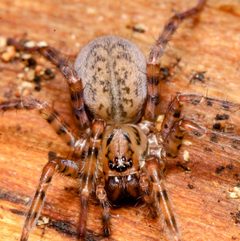
Distinguished from other Agelenidae by arrangement: eyes larger than anterior lateral eyes (opposite pattern in most related ). The dark line pattern on the is considered fairly diagnostic. Multiple retreats in webs, rather than a single retreat, is typical. Smaller web size relative to body compared to other funnel-web spiders. Previously confused with Tegenaria and Wadotes; distinguished from Wadotes by eye size pattern and from Tegenaria by web structure and preferences.
Images
Appearance
Medium-sized funnel-web spiders with body lengths of 8–13 mm for females and 8–10 mm for males. The displays a distinctive pattern of dark lines. The are larger than the anterior lateral eyes, reversing the typical pattern seen in related . Overall coloration is generally brownish, adapted for camouflage in woodland environments.
Habitat
Forested including deciduous and mixed forests. Webs constructed beneath stones, in rock wall crevices, under loose bark on trees and logs, and on building exteriors including eaves, pump houses, and basements. Some found in cellars and human structures. Webs may be positioned well above ground level when attached to structures.
Distribution
Eastern North America from Nova Scotia and southeast Canada south to Florida, west to Wisconsin and Louisiana. All fifteen occur principally east of the Mississippi River. Records from Vermont and throughout the eastern United States.
Seasonality
active in summer and fall. sacs produced in autumn. Both adults and juveniles observed hibernating in silken retreats under rocks during winter months.
Life Cycle
sacs produced in autumn. Eggs hatch and spiderlings develop; both and juveniles hibernate through winter in silken retreats under rocks. Development continues through following spring and summer. Mature adults present summer through fall.
Behavior
Constructs funnel-like webs with multiple retreats rather than single retreat typical of many funnel-web spiders. Webs often smaller relative to body size than those of other Agelenidae. activity suggested by observation patterns. When disturbed, retreats into web funnel or nearby crevice.
Ecological Role
of small arthropods in forest floor and building . Serves as prey for spider wasps including Priocnemis minorata, which has been documented paralyzing Coras juvenilis as for larval development.
Human Relevance
Occasionally found in basements, cellars, and building exteriors, leading to incidental human encounters. Coras medicinalis historically used in 19th-century folk medicine: webs employed to make tinctures for fever relief, giving the its name. No current medical or economic significance.
Similar Taxa
- WadotesSimilar size and ; distinguished by arrangement (Wadotes has lateral eyes larger than anterior eyes, opposite of Coras) and lack of cribellum in both caused historical confusion
- TegenariaFormerly placed in same ; Tegenaria generally larger with different web architecture and more consistent association with human structures in Europe
- EratigenaSimilar funnel-web architecture; distinguished by pattern and geographic distribution (Eratigena more widespread including western North America)
More Details
Taxonomic history
Subject to extensive taxonomic revision since first description. Original description as Tegenaria medicinalis by Hentz in 1821, followed by placement in Clubiona (Walckenaer, 1837), return to Tegenaria as T. nemorensis, reassertion of original name by Hentz, proposal as Coelotes urbanus by Keyserling (1887), and final establishment as Coras medicinalis by Simon (1898). placement shifted from Agelenidae to Amaurobiidae (Wunderlich, 1986) due to superficial similarities, then returned to Agelenidae when absence of cribellum and other characters confirmed original placement. Emerton (1902) and Comstock (1912) contributed to resolution of accepted name.
Web architecture
Multiple retreats in a single web is characteristic and unusual among funnel-web spiders; most Agelenidae construct webs with single retreat. This feature, combined with smaller web size, reflects to crevice-dwelling in forest where space is constrained.