
Coras lamellosus
(Keyserling, 1887)
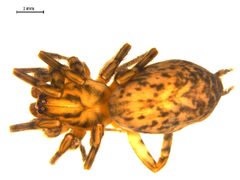
Coras lamellosus is a of funnel weaver spider in the Agelenidae. It occurs in the United States, where it constructs funnel-shaped webs in sheltered locations. Like other members of the Coras, it builds webs with multiple retreats rather than a single retreat, a distinguishing feature of this group. The species was described by Keyserling in 1887.
Pronunciation
How to pronounce Coras lamellosus: /ˈkoː.ras lam.elˈloː.sus/
These audio files are automatically generated. While they are not always 100% accurate, they are a good starting point.
Identification
Members of the Coras can be identified in part by arrangement: the eyes are larger than the anterior lateral eyes, meaning the middle pair of eyes in the front row is larger than the outer pair. A pattern of dark lines on the is also considered fairly diagnostic for the genus. Coras lamellosus specifically may be distinguished from by subtle morphological features, though detailed diagnostic characters for this require expert examination. The webs of Coras species differ from those of other funnel-web spiders in having multiple retreats rather than a single retreat.
Images
Habitat
Forested . Webs are constructed beneath stones, in crevices of rock walls, and from loose bark on trees and logs. The has also been observed in human-associated structures such as basements, cellars, pump houses, and beneath building eaves.
Distribution
United States. Records indicate presence in North America, specifically the USA and potentially Canada.
Seasonality
spiders are found in summer and fall. and adult specimens have been observed hibernating in silken retreats under rocks during winter months.
Life Cycle
sacs are probably produced in autumn. Both and specimens hibernate in silken retreats under rocks during winter months.
Behavior
Constructs funnel-shaped webs with multiple retreats, unlike other funnel-web spiders that typically have a single retreat. Webs may be positioned well above ground level, including on exterior walls of structures. Some younger spiders wander, possibly seeking new web locations.
Ecological Role
. Serves as prey for spider wasps; the Coras juvenilis is a known of the spider wasp Priocnemis minorata, suggesting potential similar relationships for C. lamellosus.
Human Relevance
Occasionally found in basements and cellars of human dwellings. The Coras medicinalis was historically used in the 1800s to make a tincture for fever relief, though this practice has been abandoned.
Similar Taxa
- Coras medicinalisShares the and builds similar funnel webs with multiple retreats; differs in -level morphological details and geographic distribution patterns.
- Tegenaria spp.Also builds funnel webs but typically constructs larger webs with a single retreat rather than multiple retreats; arrangement differs.
- Wadotes spp.Formerly classified in the same group and shares similar preferences; differs in morphological details and web structure.
More Details
Taxonomic History
The Coras has undergone extensive taxonomic revision. It was originally placed in Agelenidae, moved to Amaurobiidae in 1986 by Wunderlich, and subsequently returned to Agelenidae. The 1986 transfer to Amaurobiidae was problematic because Coras lacks the cribellum (a plate-like silk-spinning organ) that defines Amaurobiidae.