
Coras medicinalis
(Hentz, 1821)
Medicinal Funnel Weaver
Coras medicinalis is a funnel-weaving spider in the Agelenidae, native to eastern North America. The was first described in 1821 and has undergone extensive taxonomic revision, with its current placement in Coras established by Eugene Simon in 1898. It constructs distinctive funnel-shaped webs with multiple retreats, often in human-associated structures as well as natural forest . The species acquired its name from historical medicinal use of its webs in fever treatments during the 1800s.
Pronunciation
How to pronounce Coras medicinalis: //ˈkoʊræs mɛdɪˈsɪnəlɪs//
These audio files are automatically generated. While they are not always 100% accurate, they are a good starting point.
Identification
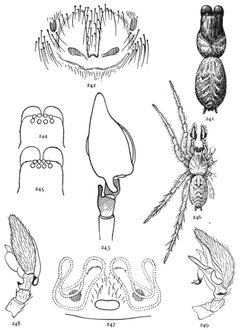
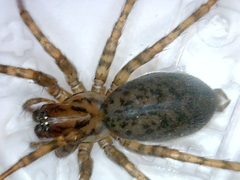
The Coras can be identified by arrangement: the eyes are larger than the anterior lateral eyes (the middle pair in the front row is larger than the outer pair). Dark lines on the provide additional diagnostic patterning. Mature females measure 8–13 mm in body length, males 8–10 mm. The web structure is distinctive, featuring multiple retreats rather than a single retreat typical of many funnel weavers, and may be positioned well above ground level.
Images
Habitat
Forested including deciduous and mixed forests. Webs are constructed beneath stones, in rock wall crevices, under loose bark on trees and logs, and on building exteriors including under eaves, in basements, and cellars. The readily occupies human-associated structures.
Distribution
Eastern North America: southeastern Canada south to Florida, west to Wisconsin and Louisiana. Principally found east of the Mississippi River.
Seasonality
active in summer and fall. sacs likely produced in autumn. Both adults and juveniles observed hibernating in silken retreats under rocks during winter months.
Life Cycle
Females produce sacs in autumn. Juveniles and hibernate through winter in silken retreats under rocks. Development continues through spring with mature adults appearing in summer.
Behavior
Constructs funnel-shaped webs with multiple retreats, unlike the single-retreat webs of many agelenid spiders. Webs may be built well above ground level, attached to building exteriors or natural substrates. The spider occupies the retreat and rushes out to capture prey that contacts the sheet portion of the web.
Ecological Role
in forest floor and building-associated . Documented as for the mantisfly Mantispa viridis, with mantispid larvae parasitizing the spider. Prey for spider wasps including Priocnemis minorata.
Human Relevance
Historical medicinal use: webs were used to prepare tinctures for fever relief in the 1800s, giving the its name. Commonly encountered in basements and cellars, generally harmless to humans.
Similar Taxa
- Tegenaria domesticaAlso a funnel weaver in Agelenidae, but constructs webs with a single retreat and has different arrangement and patterning.
- Eratigena atricaLarger funnel weaver with single retreat; Coras medicinalis has multiple retreats and smaller body size.
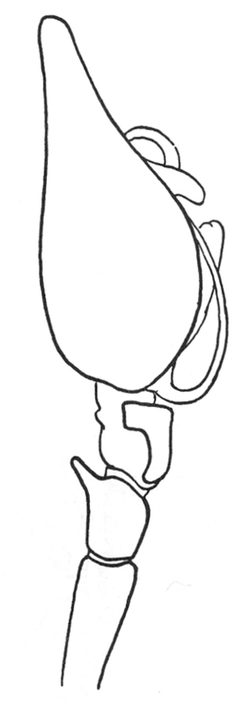
- Wadotes spp.Closely allied formerly placed with Coras in Amaurobiidae; distinguished by morphological details of arrangement and genitalia.
Sources and further reading
- BugGuide
- Wikipedia
- GBIF taxonomy match
- iNaturalist taxon
- Catalogue of Life
- Bug Eric: Spider Sunday: Coras
- Fascinating Invertebrates ~ Bring on the leeches! - Buglife Blog - Buglife
- A decade of Open Access: Zoosystematics and Evolution celebrates 10 years with Pensoft
- Bug Eric: Priocnemis minorata
- Conservation Translocations: It’s Not Just Beavers - Buglife Blog - Buglife
- Bug Eric: One Night, One House, Seventeen Spider Species
- Coras Medicinalis (Araneae, Amaurobiidae), a New Host of the Mantisfly, Mantispa viridis (Neuroptera, Mantispidae)