
Amaurobiidae
Thorell, 1869
Hackledmesh Weavers, Night Spiders, Laceweavers
Genus Guides
4- Amaurobius(Lace web spiders)
- Callobius(tangled nest spiders)
- Cybaeopsis
- Pimus(tangled nest spiders)
Amaurobiidae is a of three-clawed spiders found worldwide, containing approximately 286 in 51 . Members are characterized by possessing either a cribellum (a silk-spinning plate) or being ecribellate, and are often difficult to distinguish from related families such as Agelenidae, Desidae, and Amphinectidae. The family's taxonomic boundaries and internal relationships have been historically contentious, with genera frequently reassigned between families based on morphological and molecular studies. Australian representatives are small to medium-sized entelegyne spiders with minimal sheet webs, while North American species include relatively large, powerful hunters.
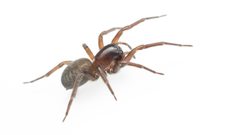
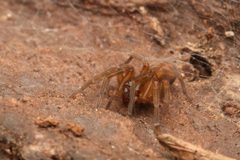
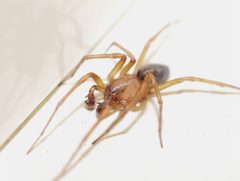
Pronunciation
How to pronounce Amaurobiidae: /ˌæmɔːrəˈbɪɪdae/
These audio files are automatically generated. While they are not always 100% accurate, they are a good starting point.
Identification
Amaurobiidae possess three tarsal claws on each leg. Cribellate members have a calamistrum (a row of bristles) on IV associated with a cribellum located to the ; ecribellate members lack these structures. Most have eight similar arranged in two conservatively curved rows. Australian amaurobiids may be distinguished from Desidae by the absence of a pretarsal fracture and the presence of a retrocoxal hymen on I. The is distinguished from Agelenidae and other related families primarily by genitalic and spinneret characters that require microscopic examination.
Images
Habitat
Found in crevices and hollows, under stones, and in loose bark on trees and logs. Many construct unlidded burrows in crusty, loamy soil. Australian species inhabit cooler rainforest , with some species in caves. Members are frequently collected in pitfall traps, suggesting ground-dwelling or ground-foraging habits. Some species also occur in human structures such as basements and cellars.
Distribution
Worldwide distribution. In Australia, fairly common in Tasmania and nearby mainland Australia in cooler rainforest; widespread but uncommon along the eastern coastline. In North America, primarily distributed east of the Mississippi River, with records from southeast Canada south to Florida and west to Wisconsin and Louisiana. Also recorded from the Pacific Northwest (British Columbia, Oregon). Chinese are to mountainous regions of Sichuan and Shaanxi provinces, distributed on the south slope of the Qinling Mountains and the eastern extension of the Hengduan Mountains.
Behavior
Construct retreats in sheltered locations; some build minimal sheet webs while others are primarily wandering hunters. In autumn, both and specimens have been observed hibernating in silken retreats under rocks during winter months. Some species, such as those in the Coras, construct funnel-like webs with multiple retreats rather than a single retreat.
Ecological Role
of small . Some serve as for parasitic (Pompilidae) such as Priocnemis minorata. Parasitic associations have been recorded with ichneumonid wasps, dipteran flies, and mermithid in or subadult specimens.
Human Relevance
Some , such as Coras medicinalis, have historical medicinal associations—its webs were used in the 1800s to make tinctures for fever relief. Several species frequently enter human structures, including basements and cellars. Some larger species such as Wadotes hybridus may appear intimidating due to their size and robust build. Generally not considered dangerous to humans.
Similar Taxa
- AgelenidaeFunnel-web spiders with similar web architecture; distinguished by genitalic characters and . such as Coras and Wadotes have been moved between these based on revised interpretations of morphological characters.
- Desidae spiders with similar preferences; Australian Desidae share habitat with Amaurobiidae and require examination of pretarsal fracture and retrocoxal hymen characters for separation.
- AmphinectidaeRelated with similar cribellate/ecribellate variation; distinguished by detailed genitalic and somatic .
Sources and further reading
- BugGuide
- Wikipedia
- GBIF taxonomy match
- iNaturalist taxon
- NCBI Taxonomy
- Catalogue of Life
- Bug Eric: Priocnemis minorata
- Bug Eric: Spider Sunday: Coras
- Bug Eric: I See Dead Spiders
- Bug Eric: 2009
- Bug Eric: October 2009
- A REVISION OF THE NEARCTIC AMAUROBIIDAE (ARACHNIDA: ARANEIDA)
- Four new species of the genus Coelotes (Araneae: Amaurobiidae) from China
- Two new species of Amaurobius C.L. Koch, 1837 from China (Araneae, Amaurobiidae)
- Review of the spider genus Amaurobius (Araneae, Amaurobiidae) from China, with description of a new genus.