
Cybaeopsis
Strand, 1907
Species Guides
2- Cybaeopsis euopla(hacklemesh weaver)
- Cybaeopsis wabritaska(hacklemesh weaver)
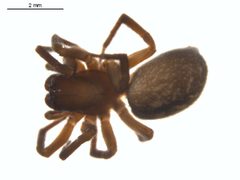
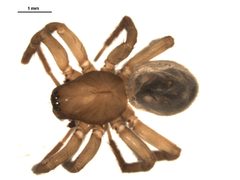
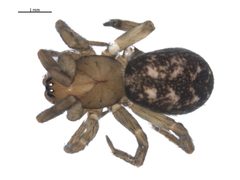
Cybaeopsis is a of spiders in the Amaurobiidae, originally described by Embrik Strand in 1907 and transferred from Agelenidae to its current family by Pekka T. Lehtinen in 1967. The genus contains twelve as of December 2024, with most species distributed in North America. Three species—C. lodovicii, C. theoblicki, and C. typica—occur outside North America, in Italy, Portugal, and Russia/Japan respectively. Members of this genus are known to closely resemble spiders of the genus Callobius, particularly females.
Pronunciation
How to pronounce Cybaeopsis: //ˌsaɪbiːˈɒpsɪs//
These audio files are automatically generated. While they are not always 100% accurate, they are a good starting point.
Identification
Females closely resemble those of the Callobius, making visual separation between these two genera difficult. The genus can be distinguished from Alauximus (now a synonym of Tugana) and from the Cuban genus Tugana, to which two former Cybaeopsis (C. crassa and C. infumata) were transferred.
Images
Distribution
Predominantly North American, with twelve distributed across the United States and Canada. Three species have Palearctic distributions: C. typica occurs in Russia (Sakhalin, Kurile Islands) and Japan; C. lodovicii is known from Italy; and C. theoblicki is found in Portugal.
Behavior
As members of Amaurobiidae, these spiders construct tangled, irregular webs (cobweb or tangled nest architecture), though specific behavioral details for the have not been documented.
Similar Taxa
- CallobiusFemales of Cybaeopsis closely resemble Callobius females, making the two difficult to distinguish visually.
- TuganaTwo former Cybaeopsis (C. crassa and C. infumata) were transferred to this Cuban ; Alauximus, previously considered related, is now synonymized with Tugana rather than Cybaeopsis.
More Details
Taxonomic history
Originally placed in Agelenidae, the was transferred to Amaurobiidae by Lehtinen in 1967. Cybaeopsis is considered a senior synonym of Callioplus. The genus has undergone recent taxonomic revision, with C. crassa and C. infumata moved to Tugana and new described in 2022 (C. lodovicii) and 2021 (C. theoblicki).
Species diversity
As of December 2024, the contains twelve described , though iNaturalist records indicate relatively few observations (30) suggesting these spiders may be cryptic, understudied, or restricted to specific microhabitats.