
Callobius
Chamberlin, 1947
tangled nest spiders
Species Guides
5- Callobius bennetti(Bennett's Laceweaver)
- Callobius gertschi
- Callobius nomeus(hacklemesh weaver)
- Callobius pictus
- Callobius severus(West Coast Laceweaver)
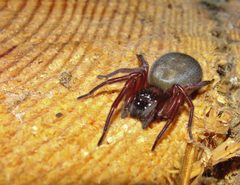
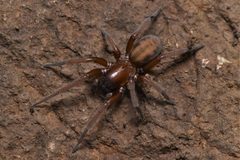
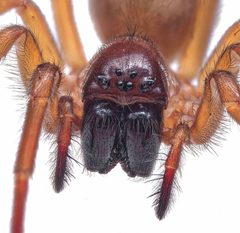
Callobius is a of cribellate spiders in the Amaurobiidae, commonly known as tangled nest spiders. The genus was established by R.V. Chamberlin in 1947 and contains 35 with a Holarctic distribution spanning North America and Eurasia. Members of this genus construct characteristic tangled, lacy webs that issue from a retreat, often in crevices or holes. They are frequently confused with other cribellate spiders such as Kukulcania (Filistatidae) due to similar web architecture.
Pronunciation
How to pronounce Callobius: /ˈkæloʊbiəs/
These audio files are automatically generated. While they are not always 100% accurate, they are a good starting point.
Identification
Callobius can be distinguished from superficially similar crevice-weaving spiders in the Filistatidae (such as Kukulcania) by family-level characters: Amaurobiidae lack the present in Filistatidae and possess distinct arrangements and genitalic . From other Amaurobiidae, -level identification requires examination of genitalic structures, particularly the male and female . The is characterized by a cribellum and calamistrum for producing cribellate silk. Accurate identification to species often requires geographic context and microscopic examination.
Images
Habitat
occur in diverse microhabitats including rock crevices, under bark, in leaf litter, and in man-made structures. Several species are cave-dwelling (e.g., Callobius cavernarius from Ryukyu Islands). They construct tangled, cribellate webs with a tubular retreat, often positioned in sheltered locations. The web architecture—lacy, non-sticky threads designed to entangle prey through physical snagging rather than adhesion—is characteristic of the .
Distribution
Holarctic distribution encompassing North America (USA, Canada, Mexico), Europe, Turkey, Caucasus region, Kazakhstan, Russia (including Kurile Islands), Japan (including Ryukyu Islands), Korea, and China. The shows strong diversification in western North America and the Japanese archipelago.
Behavior
Constructs tangled, cribellate webs with a retreat; the silk is 'carded' using the calamistrum on the fourth leg to create fine, woolly threads that physically entangle prey. Web-building is , with spiders occupying the retreat during daylight hours and emerging to the web periphery after dark to intercept prey.
Ecological Role
Predatory arthropods that contribute to control of small insect . Their cribellate webs represent a distinct foraging strategy within spider , occupying a structural similar to some filistatids but within different lineages.
Human Relevance
Occasionally found in and around human dwellings, particularly in stone walls, window frames, and similar structures. Frequently subject to misidentification with medically significant spiders (e.g., brown recluse) or with other cribellate spiders such as Kukulcania. Not considered medically significant; no documented dangerous envenomations.
Similar Taxa
- Kukulcania (Filistatidae)Similar tangled, lacy web architecture issuing from a crevice retreat; distinguished by (Filistatidae) versus freely movable chelicerae (Amaurobiidae), and different arrangement. Male Kukulcania have extremely long, elbowed not seen in Callobius.
- Amaurobius (Amaurobiidae)Congeneric members with similar web structure and cribellate silk; distinguished by genitalic and geographic distribution (Amaurobius primarily Palearctic with some overlap).
- Ariadna (Segestriidae)Builds similar silken tubes in crevices; distinguished by six (versus eight in Callobius) and different web architecture—segestriids construct signal threads radiating from the retreat rather than tangled capture webs.
More Details
Taxonomic note
The was revised by Leech (1971, 1972), who described numerous North American . Recent work by Japanese arachnologists (Okumura, Suzuki, and colleagues, 2010–2022) has substantially expanded the known diversity in East Asia, particularly from the Ryukyu Islands. The genus demonstrates a disjunct Holarctic distribution pattern with centers of diversity in western North America and the Japanese archipelago.
Web terminology
The 'tangled nest spiders' refers to the irregular, three-dimensional cribellate web architecture. This contrasts with the planar orb webs of Araneidae or the sheet webs of Linyphiidae. The cribellum, a plate-like silk-spinning organ to the , produces extremely fine fibrils that are combed into woolly capture threads by the calamistrum—a row of curved setae on the of leg IV.