
Amaurobius
C.L. Koch, 1837
Lace web spiders, Tangled nest spiders
Species Guides
3- Amaurobius borealis(hacklemesh weaver)
- Amaurobius ferox(black lace-weaver)
- Amaurobius similis(Lace-Weaver Spider)
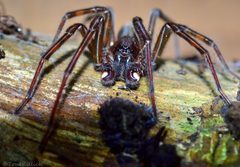
Amaurobius is a of araneomorph spiders in the Amaurobiidae, first described by Carl Ludwig Koch in 1837. The genus contains approximately 68 with primarily Holarctic distribution. Members are commonly known as lace web spiders or tangled nest spiders due to their characteristic web architecture. The genus includes notable species such as Amaurobius ferox, which exhibits the rare behavioral phenomenon of matriphagy, where offspring consume the mother after hatching.
Pronunciation
How to pronounce Amaurobius: //æmɔːˈroʊbiəs//
These audio files are automatically generated. While they are not always 100% accurate, they are a good starting point.
Identification
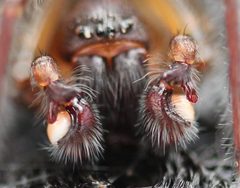
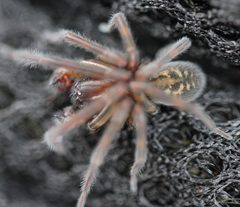
Lace web spiders construct irregular, tangled webs with a distinct lace-like or hackled appearance, often in crevices, under bark, or in similar sheltered locations. The webs feature a retreat area, frequently a tubular silk structure, from which the spider emerges to capture prey. identification requires examination of genitalia: males possess complex palps with multiple (retrolateral tibial, tibial, tegular, and ), while females have epigynes with median lobes, lateral teeth, and distinct spermathecae.
Images
Habitat
occupy diverse microhabitats including rock crevices, bark crevices, cave entrance zones, and forest floor debris. Some species occur in anthropogenic structures. Chinese species inhabit montane forests at elevations of 1002-1786 m on the south slope of the Qinling Mountains and eastern extension of the Hengduan Mountains. Amaurobius ferox has been documented in cave entrance zones within meters of entrances, though it lacks specialized subterranean adaptations.
Distribution
Primarily Holarctic distribution. Native range includes Europe, North Africa, Turkey, the Caucasus region, and North America. Multiple introduced to North America including A. ferox (established in Canada, USA, Mexico) and A. similis (established in North America). Chinese species restricted to Sichuan and Shaanxi provinces. North American native species occur across the USA and southern Canada.
Behavior
Amaurobius ferox exhibits matriphagy: mothers are systematically consumed by their offspring at a consistent interval after hatching. The process involves mother-offspring interactions with maternal solicitation that activate and synchronize the young. Synchronized molting behavior has been observed in A. ferox spiderlings. Females of A. ferox have been observed to continue molting after reaching sexual maturity, a trait otherwise known primarily in mygalomorph spiders.
Ecological Role
Human Relevance
Some have been introduced to human-modified environments outside their native range. Webs may occur on building exteriors. Not considered medically significant.
Similar Taxa
- KukulcaniaAlso constructs tangled, lacy webs with tubular retreats issuing from crevices; both sometimes called crevice weavers. Kukulcania belongs to Filistatidae and possesses cribellate silk-producing structures that Amaurobius lacks.
- CallobiusRelated in Amaurobiidae with similar web architecture; both occupy crevice and construct lace-like webs, requiring genital examination for definitive separation.
- AgelenidaeConstruct funnel-shaped webs that may resemble Amaurobius retreats; agelenid webs typically feature a more pronounced sheet-like platform with a funnel retreat, whereas Amaurobius webs are more irregular and tangled without a distinct sheet.
More Details
Taxonomic history
The was established by Carl Ludwig Koch in 1837. Recent phylogenetic studies using genetic data from museum specimens have helped clarify relationships within the marronoid spider clade, which includes Amaurobiidae. The genus Amaurobius has been subject to ongoing revision, with two new described from China in 2023 and additional species in 2024.
Genomic resources
The of Amaurobius ferox has been sequenced and published, providing resources for studying spider , silk production, and the genetic basis of matriphagy.
Sources and further reading
- BugGuide
- Wikipedia
- GBIF taxonomy match
- iNaturalist taxon
- NCBI Taxonomy
- Catalogue of Life
- marronoid phylogram - Entomology Today
- Bug Eric: Spider wasp, Dipogon calipterus
- Bug Eric: Spider Sunday: Crevice Weavers
- Two new species of Amaurobius C.L. Koch, 1837 from China (Araneae, Amaurobiidae)
- Occurrence of the Black lace-weaver spider, Amaurobius ferox, in caves
- Matriphagy in the Spider Amaurobius ferox (Araneidae, Amaurobiidae): an Example of Mother‐Offspring Interactions
- Social Facilitation of Synchronized Molting Behavior in the Spider Amaurobius ferox (Araneae, Amaurobiidae)
- Review of the spider genus Amaurobius (Araneae, Amaurobiidae) from China, with description of a new genus.
- The genome sequence of the Black Lace-weaver spider, Amaurobius ferox (Walckenaer, 1830).