
Amaurobius ferox
(Walckenaer, 1830)
black lace-weaver, black lace weaver
Amaurobius ferox is a spider known for its distinctive cribellate web with woolly, lace-like silk. The exhibits a unique subsocial organization among spiderlings, including synchronized molting, cooperative prey capture, and matriphagy—where offspring consume their mother after hatching. Native to Europe, it has been introduced to North America and is commonly found near human structures in dark, moist environments.
Pronunciation
How to pronounce Amaurobius ferox: //əˈmɔːroʊbiəs ˈferɒks//
These audio files are automatically generated. While they are not always 100% accurate, they are a good starting point.
Identification
Distinguished from by the skull-like abdominal pattern. The cribellate web with lace-like, woolly texture and faint blue color when fresh is diagnostic. Found in dark, moist crevices near structures, unlike the more outdoor-dwelling congeners. Males wander indoors in spring seeking mates.
Images
Appearance
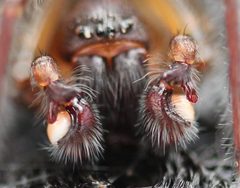
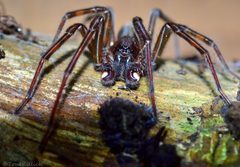
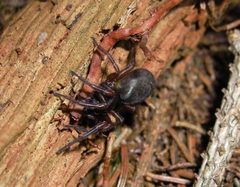
Females measure 11–16 mm in body length; males are smaller and more slender at 8–10 mm. The body is very dark, appearing black, brown, dark red, or tan. The rounded bears light yellow to pale markings arranged in a distinctive skull-like or skeletal pattern. The spider produces cribellate silk with extremely fine, sticky fibers that give the web a woolly texture and faint blue color when fresh.
Habitat
Prefers dark, moist, shaded crevices including under logs, stones, and dilapidated walls. Frequently found near human-made structures such as cellars and building foundations. Also occurs in cave entrance zones within meters of the entrance, though lacks specialized cave adaptations.
Distribution
Native to Europe, distributed across the continent but rare in Northern Europe due to low temperatures. Introduced to North America (Canada, USA, Mexico) and parts of Eastern Europe including Turkey.
Seasonality
Nocturnally active year-round. males wander indoors in spring seeking mates. In cave entrance , absent from late winter to early spring.
Diet
Feeds on insects captured in its cribellate web. Spiderlings consume laid by the mother shortly after hatching, then practice matriphagy (consume the mother) after their first .
Life Cycle
Females live approximately two years; males live only a few months. Females lay 60–180 in a white, lens-shaped sac (7–15 mm diameter) and guard it until hatching. Spiderlings emerge and enter a social period characterized by synchronized molting, consumption of , cooperative prey capture, and progressive over approximately one month. Matriphagy occurs 1–2 days after the first , when spiderlings consume their mother.
Behavior
web-building on vertical surfaces, creating tangled mesh surrounding a circular retreat. Highly developed subsocial organization among spiderlings: synchronized molting facilitated by group presence, cooperative prey capture, and progressive driven by prey availability and increasing mutual aggression. Mothers exhibit 'solicitation' to activate and synchronize young before matriphagy. Responds to web vibrations from prey at any time of day.
Ecological Role
in terrestrial and cave entrance . Subsocial among spiderlings may reduce and maintain group cohesion during the dependent period.
Human Relevance
Bites have been documented; one verified case involved dull pain similar to a sting, peaking at 2 hours and resolving within 12 hours, with localized swelling (6 mm) and redness (30 mm). Dark red bumps with small blisters appeared after one week, with complete recovery by two weeks. No serious effects reported. Often found in cellars and buildings, leading to incidental human encounters.
Similar Taxa
- Amaurobius fenestralisAlso subsocial with matriphagy, but prefers different microhabitats and lacks the distinctive skull-like abdominal pattern.
- Amaurobius similisThird subsocial in with similar social , but morphologically distinct and occupies different .
- Metellina merianaeCo-occurs in cave entrance zones; distinguished by different web architecture and lack of subsocial organization.
- Meta menardiCo-occurs in cave entrance zones; larger size and different web structure.
- Tegenaria spp.Co-occurs in cave entrance zones; funnel-web builders with different and .
Sources and further reading
- BugGuide
- Wikipedia
- GBIF taxonomy match
- iNaturalist taxon
- NCBI Taxonomy
- Catalogue of Life
- Marronoids: The (Mostly) Little Brown Spiders With a Big Story to Tell
- Mosquito Management in the Era of Extreme Weather
- animal behaviour | Blog
- Forgotten tropical plants rediscovered after 100+ years
- Bug Eric: Spider wasp, Dipogon calipterus
- Occurrence of the Black lace-weaver spider, Amaurobius ferox, in caves
- Social Facilitation of Synchronized Molting Behavior in the Spider Amaurobius ferox (Araneae, Amaurobiidae)
- Matriphagy in the Spider Amaurobius ferox (Araneidae, Amaurobiidae): an Example of Mother‐Offspring Interactions
- The genome sequence of the Black Lace-weaver spider, Amaurobius ferox (Walckenaer, 1830).