
Amaurobius similis
(Blackwall, 1861)
Lace-Weaver Spider, lace-webbed spider
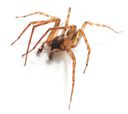
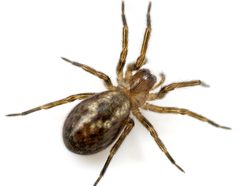
Amaurobius similis is a small spider in the Amaurobiidae, commonly known as the lace-weaver spider. It is frequently found in human dwellings, particularly near windows and in wall crevices. The is visually similar to A. fenestralis, with which it has been historically confused, and reliable identification requires microscopic examination of genitalia. It has a Holarctic distribution, native to Europe and the Caucasus, and has been introduced to North America.
Pronunciation
How to pronounce Amaurobius similis: //əˌmɔːˈroʊbiəs ˈsɪmɪlɪs//
These audio files are automatically generated. While they are not always 100% accurate, they are a good starting point.
Identification
Externally very similar to Amaurobius fenestralis; A. similis tends to be larger and darker when mature, but these traits overlap. Definitive identification requires microscopic examination of the genitalia. Both are commonly found near windows, but A. similis is more frequently associated with buildings. The specific epithet 'similis' refers to its resemblance to A. fenestralis.
Images
Habitat
Primarily , occurring in and around buildings where it constructs webs in holes in walls, fences, and window frames. Less commonly found in natural such as woodlands, where it occurs under bark. The shows a strong association with human-modified environments.
Distribution
Native to Europe and the Caucasus region. Holarctic distribution with introduced in North America, including Alaska. Records from Andorra are marked as doubtful.
Behavior
Constructs characteristic lace-like webs in sheltered crevices, holes, and cavities. The web structure is typical of the Amaurobiidae, with an irregular, tangled appearance. Activity patterns not well documented in available sources.
Human Relevance
Common household spider that contributes to pest control in buildings. One of at least two spider commonly referred to as 'lace-webbed spiders' in houses. Its presence in dwellings is generally benign and may help control small insect .
Similar Taxa
- Amaurobius fenestralisExtremely similar ; historically confused with A. similis. A. fenestralis tends to be smaller and paler, with referring to windows ('fenestralis'), but reliable separation requires genitalia examination.
More Details
Taxonomic history
The specific epithet 'similis' was chosen by Blackwall in 1861 to reflect the ' similarity to A. fenestralis. The basionym Ciniflo similis reflects older .
Genomic context
Amaurobius similis belongs to the marronoid clade, a group of spiders united by molecular despite lacking obvious morphological synapomorphies. This clade includes approximately 3,400 and encompasses diverse ecologies including the only fully aquatic spider (Argyroneta aquatica).
Sources and further reading
- BugGuide
- Wikipedia
- GBIF taxonomy match
- iNaturalist taxon
- NCBI Taxonomy
- Catalogue of Life
- Encyrtid Holdings | Entomology Research Museum
- Bug Eric: A Jumping Spider, Tutelina similis
- Study Shows American Dog Ticks in Western U.S. Are a Separate Species
- springtails | Blog
- Marronoids: The (Mostly) Little Brown Spiders With a Big Story to Tell
- Bug Eric: Spider wasp, Dipogon calipterus